

Explore the BBTrend Indicator, which merges Bollinger Bands and trend analysis to enhance trading strategies and improve market decision-making.
The BBTrend Indicator blends Bollinger Bands with trend analysis to give traders a clearer view of market behavior. It simplifies complex data into a histogram, helping identify trends, momentum, and potential breakout points. Here's what you need to know:
- Bollinger Bands: Measures market volatility with upper and lower bands around a moving average. Overbought and oversold conditions can occur when price repeatedly presses into (or closes outside) these bands.
- Trend Analysis: Tracks market direction and momentum using historical data, support/resistance levels, and volume patterns.
- BBTrend's Advantage: Combines Bollinger Bands' volatility insights with trend direction for better decision-making. The histogram format visually shows trends - positive for uptrends, negative for downtrends.
Key Features:
- Detects early momentum shifts and potential breakouts.
- Works on multiple timeframes for day or swing trading.
- Best when paired with other confirmation inputs like volume analysis or support/resistance context.
Limitations:
- Can lag in fast-moving markets (like most indicators derived from rolling windows).
- False signals in sideways or low-volume conditions.
- Requires fine-tuning Bollinger Band settings for accuracy.
For traders, BBTrend offers a practical way to refine strategies, but it’s crucial to confirm its signals with other tools and market context.
BBTrend Indicator on TradingView
BBTrend Video Walkthrough
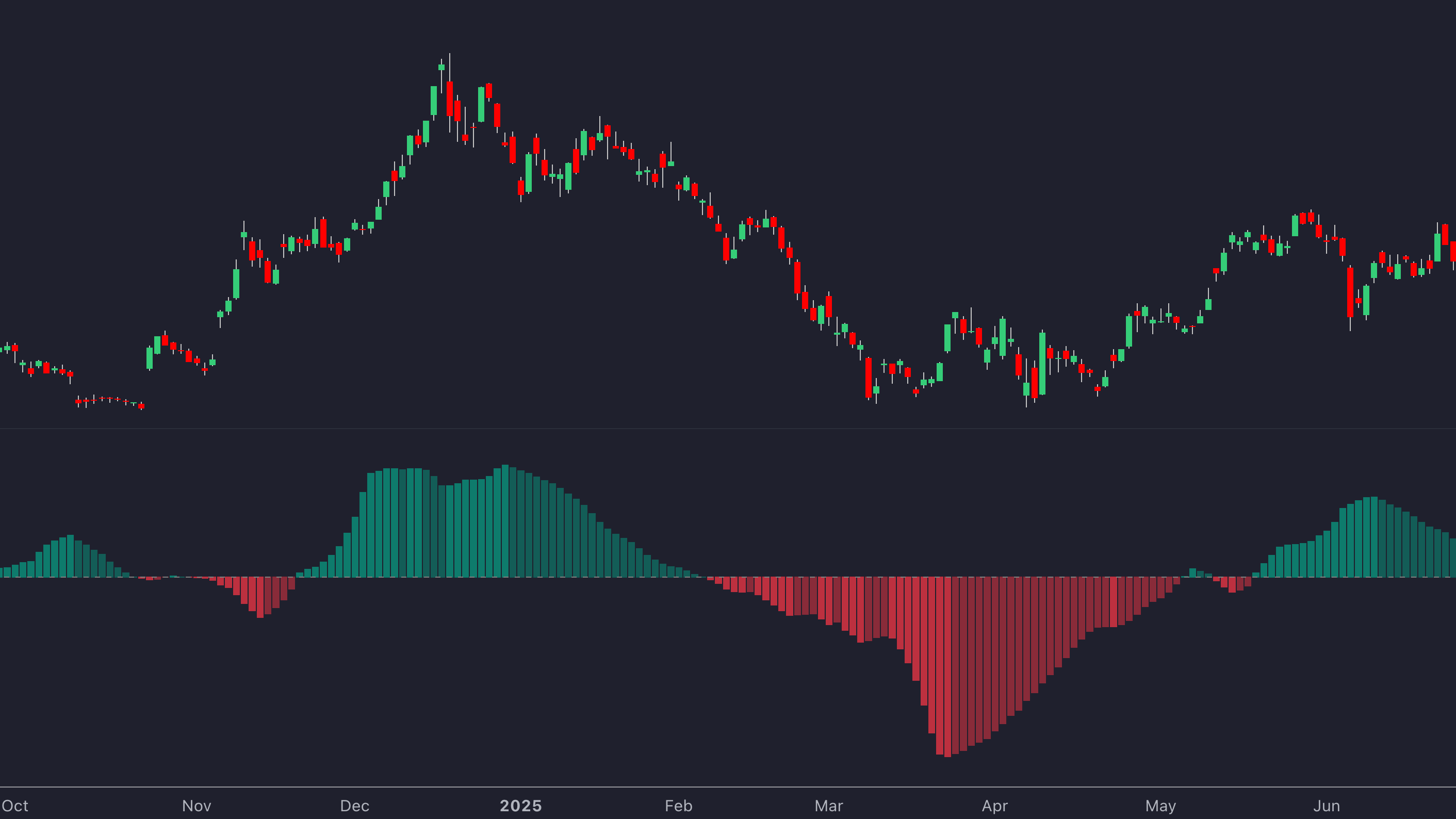
This video provides a practical walkthrough of BBTrend in action. It focuses on how to read the histogram around the zero line, what stronger vs weaker momentum looks like, and how traders often pair BBTrend-style signals with confirmation (like structure and volume context) to avoid reacting to isolated flips during choppy conditions.
How the BBTrend Indicator Works
The BBTrend Indicator takes the complexity of Bollinger Band dynamics and simplifies it into a visual histogram, making it easier for traders to evaluate market trends.
BBTrend Indicator Calculation Method
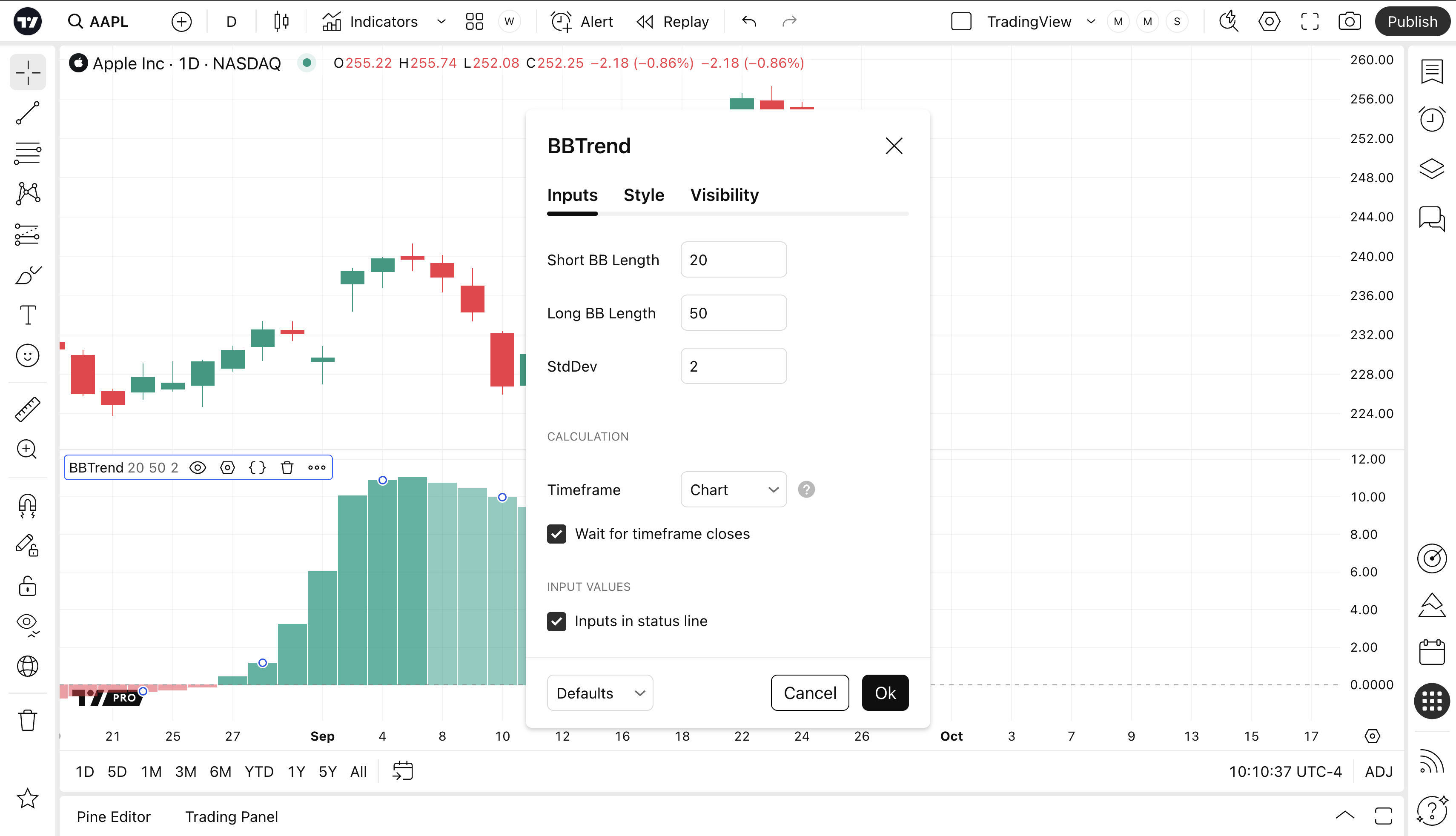
This indicator is built using 20-day and 50-day Bollinger Bands set at ± two standard deviations [1][2]. The core idea is that during an uptrend, the upper bands move closer together while the lower bands spread apart. The opposite happens in a downtrend.
"At its core, BBTrend is about understanding the dynamics between the Bollinger Bands. It calculates the absolute value of the difference between the lower bands and subtracts it from the absolute value of the difference between the upper bands, normalizing the result. This algebraic approach transforms complex market movements into a clear and interpretable form." - TrendSpider Blog [1]
The formula works by taking the absolute difference between the lower bands and subtracting it from the absolute difference of the upper bands. This normalized value captures both the strength and direction of a trend by analyzing how the Bollinger Bands behave [1][2].
The final result is displayed as a histogram, offering a straightforward way to interpret market conditions.
Reading the BBTrend Histogram
The histogram fluctuates around a zero line. Positive values indicate an uptrend, while negative values suggest a downtrend [2]. This visual representation helps traders make decisions quickly and confidently.
Main Signals from the BBTrend Indicator
The histogram's polarity is key: positive bars signal an uptrend, and negative bars point to a downtrend.
Using the BBTrend Indicator in Trading Strategies
The BBTrend Indicator translates the behavior of Bollinger Bands into actionable trend context. It’s versatile across timeframes and can help you standardize decisions when you define exactly what “trend strength” and “trend shift” mean for your system.
Understanding Trend Strength and Direction
The BBTrend histogram offers a visual representation of trend momentum. Positive values on the histogram confirm an uptrend, with taller bars reflecting stronger upward momentum, while shorter bars suggest a potential loss of strength.
In contrast, negative histogram values indicate a downtrend. The deeper the negative bars, the stronger the bearish momentum. Traders often wait for the histogram to cross zero - moving above zero signals a potential long opportunity, while crossing below zero suggests a short trade setup.
Extreme values on the histogram can signal overextended trends that might be due for a correction. Meanwhile, moderate readings are often associated with more sustainable momentum. Whether you're analyzing intraday, daily, or weekly charts, BBTrend can help align short-term signals with the bigger market picture.
Identifying Consolidation and Breakout Patterns
Beyond tracking trends, BBTrend is particularly useful for spotting consolidation phases and breakouts. During consolidation, the histogram tends to hover near zero. A sudden shift to strong positive or negative values often signals the beginning of a breakout.
The indicator also helps traders distinguish between genuine and false breakouts. A true breakout is accompanied by sustained histogram readings in the breakout direction, while false breakouts quickly revert to near-zero values.
For range-bound strategies, BBTrend’s near-zero histogram readings can guide mean reversion decisions - buying near support and selling near resistance. When the histogram moves decisively above or below zero, traders can transition to trend-following strategies.
Breakouts often come with increased volatility, and BBTrend captures this through its Bollinger Band foundation. Rapid band expansion leads to more extreme histogram readings, alerting traders to heightened market activity and fresh trading opportunities.
Combining BBTrend with Other Trading Tools
BBTrend becomes even more effective when paired with complementary tools. Many traders combine BBTrend with alerts and systematic rules, especially when experimenting with algorithmic trading logic (even if you’re only using it for alerting and consistency, not full automation).
Alerts are particularly useful for key thresholds. For instance, traders might set alerts for zero-line crossovers to catch trend changes or for extreme histogram values that could signal potential reversals.
Testing BBTrend across different market conditions can highlight its strengths. For instance, combining BBTrend with volume confirmation often yields more reliable signals - strong BBTrend readings during high-volume periods tend to be more trustworthy than similar readings during low-volume conditions.
The indicator also supports better risk management. Traders can adjust position sizes based on histogram readings, increasing exposure during strong, sustained trends and scaling back when momentum weakens or approaches zero.
Using BBTrend across multiple timeframes can create robust trading setups. For example, traders might require a positive BBTrend reading on a daily chart before acting on a long signal from an hourly chart. This approach helps filter out trades that contradict the broader market trend, improving overall reliability.
Using BBTrend with LuxAlgo

LuxAlgo provides trading tools on TradingView that can help you add structure around BBTrend signals - from price action context to momentum confirmation and workflow features like alerts and multi-timeframe analysis. If you’re new to LuxAlgo, the Toolkits (TradingView) are the core set of exclusive tools built for chart-based decision-making, while the Library refers to the free collection of indicators you can access with a free LuxAlgo account.
If you're building a more data-driven approach, the AI Backtesting Assistant (with docs available here) can help you iterate on BBTrend-style ideas by testing rule sets across historical data. For context on plans: LuxAlgo’s Free plan is $0 (lifetime) and includes hundreds of tools across multiple platforms; Premium is $39.99/month for advanced signals, alerts, and oscillator tools on TradingView; and Ultimate is $59.99/month and includes the AI Backtesting platform.
LuxAlgo's Technical Analysis Tools
LuxAlgo offers three core TradingView toolkits that can complement BBTrend by adding confluence and clearer structure:
- Price Action Concepts (PAC): Focuses on automating price action such as market structure, support/resistance, trendlines, and pattern-based context. When BBTrend turns strongly positive, PAC can help you map where that momentum is occurring relative to key structure zones (helpful for planning entries, invalidation, and targets).
- Signals & Overlays (S&O): Designed for signal workflows, overlays, and alerting. Many traders pair BBTrend zero-line crosses with a separate momentum/confirmation input to reduce weak setups. One example is adding a momentum layer from the Adaptive Momentum Oscillator to confirm direction before acting on a crossover.
- Oscillator Matrix (OSC): Useful for trend analysis and reversal context using multiple momentum components. If BBTrend prints extreme readings that hint at an overextended move, Oscillator Matrix can provide additional confirmation via its internal components (like money flow and divergence-style behavior) to help avoid chasing late entries.
AI Backtesting and Strategy Testing
BBTrend is easiest to use consistently when you define objective rules: entry trigger, filter(s), exit trigger, and risk constraints. The AI Backtesting Assistant helps you test those BBTrend-style rules on historical data so you can see how changes to thresholds and timeframes affect outcomes.
A practical workflow is to test variations of: (1) BBTrend threshold rules, (2) a market filter (trend vs range, volatility regime, or volume condition), and (3) a confirmation input (structure or momentum). This reduces the chance that a single histogram crossover becomes your only decision factor.
When optimizing, avoid overfitting by validating across multiple assets and time periods, and by keeping rules simple enough to remain stable in new market conditions. If performance collapses when you slightly change parameters, that’s often a sign the rules are too fragile.
Community Support and Regular Updates
Beyond chart tools, traders often improve BBTrend usage by sharing playbooks: what conditions to avoid (tight ranges), what to confirm (structure + volume), and how to manage risk when momentum fades.
- Community Discussions: Use shared examples to compare BBTrend thresholds, timeframes, and confirmation rules across markets.
- Support: If you’re combining multiple indicators and alerts, getting help with setup can reduce errors (especially around multi-timeframe logic and alert conditions).
- Product Updates: As TradingView evolves, indicator workflows and UI improvements can change how you apply tools day-to-day—so it’s worth staying current when you rely on repeatable processes.
Additionally, educational resources and case studies can help you see how experienced traders apply BBTrend-style momentum concepts within a complete workflow (context → trigger → confirmation → risk plan → review).
BBTrend Pros and Cons
BBTrend blends Bollinger Bands with trend analysis, offering traders a unique approach with distinct strengths and weaknesses. Here's a closer look at what makes BBTrend stand out and where it falls short.
Benefits of the BBTrend Indicator
BBTrend's combination of Bollinger Bands and trend analysis provides a more detailed view of market conditions than relying on either approach alone. This dual method helps traders spot opportunities more effectively.
Its histogram format offers a clear and simple way to interpret trends. Positive values indicate upward momentum, while negative values signal downward pressure, making it easy to identify shifts at a glance.
BBTrend is particularly useful for detecting early momentum. When its values rise from near-zero levels, it often points to the beginning of significant price movements, even before they become obvious on standard charts.
The indicator is adaptable to different timeframes, making it suitable for a variety of trading styles. Day traders can use shorter timeframes like 5-minute or 15-minute charts, while swing traders might prefer daily or 4-hour charts for longer-term trends.
BBTrend integrates seamlessly with automated trading systems. Its numerical output allows traders to set specific rules, such as triggering alerts when the value crosses above +0.5 or below -0.5. This makes it easier to design systematic entry and exit strategies.
By incorporating volatility analysis, BBTrend adds an extra layer of insight. During periods of high volatility, its readings can become more pronounced, helping traders adjust their strategies, such as modifying position sizes or refining risk management.
Drawbacks of the BBTrend Indicator
Despite its advantages, BBTrend has some notable limitations. One of the biggest challenges is its lagging nature, as it relies on historical price data. In fast-moving markets, this delay can result in missed opportunities, with trends being confirmed only after the best entry points have passed.
False signals in sideways markets are another issue. When prices fluctuate within a narrow range, BBTrend often produces multiple crossovers around the zero line, leading to whipsaw behavior. Acting on these without additional confirmation can result in repeated small losses.
The indicator's performance heavily depends on Bollinger Band settings. Using inappropriate parameters, such as incorrect period lengths or standard deviation values, can lead to unreliable signals.
BBTrend also struggles in gap-heavy markets, where overnight price gaps can distort its readings. Since the calculation doesn't account for these discontinuities, it may fail to accurately reflect momentum.
During low-volume periods, such as holiday trading sessions or pre-market hours, BBTrend signals often lack reliability. Limited market activity in these times means signals may not lead to sustained price moves.
Finally, BBTrend works best when used alongside other tools. It often requires confirmation from additional indicators, such as support/resistance levels or volume analysis, to filter out false signals and improve accuracy.
BBTrend Pros and Cons Summary Table
| Advantages | Limitations |
|---|---|
| Clear trend visualization through histogram format | Lagging signals in fast-moving markets |
| Identifies early momentum shifts | False signals in sideways markets |
| Usable across multiple timeframes | Sensitivity to Bollinger Band settings |
| Integrates well with automated systems | Struggles with gap-heavy market conditions |
| Combines trend and volatility insights | Less reliable in low-volume periods |
| Suitable for various trading styles | Requires confirmation from other tools |
| Easy to interpret positive/negative values | May miss optimal entry points in rapid trends |
| Works effectively with alert systems | Can produce whipsaw signals in ranging markets |
BBTrend's strengths lie in its ability to simplify trend detection and provide added context through volatility analysis. However, its limitations highlight the need for thoughtful application. Pairing it with other tools and understanding its ideal conditions can help traders make the most of this indicator while reducing the impact of its drawbacks.
Conclusion
The BBTrend Indicator combines the power of Bollinger Bands with trend analysis to refine your trading strategies. By blending insights on market volatility with directional trends, BBTrend provides a comprehensive view of market conditions. This synthesis brings together the earlier analysis and lays out actionable steps for traders.
Key Highlights
- Clear Trend Direction: BBTrend’s histogram visually indicates trend direction, with values moving away from zero marking potential trend shifts.
- Entry Timing Advantage: A rise in BBTrend values from near-zero often signals significant price moves, aiding in precise entry timing.
- Adaptable Across Timeframes: Whether you're a day trader using 5-minute or 15-minute charts for scalping, or a swing trader focusing on daily or 4-hour charts, BBTrend fits various trading styles.
- Confirmation is Key: While valuable, BBTrend can lag or give false signals in sideways markets. Use it alongside tools like support and resistance levels, volume analysis, or other indicators to confirm entries and exits.
- Automation Potential: BBTrend integrates seamlessly with automated trading systems, allowing you to set systematic rules and alerts. For instance, thresholds like +0.5 or -0.5 can streamline entry and exit decisions, ensuring consistency in your trading approach.
Next Steps for Traders
To fully harness BBTrend, here’s how you can build on these insights:
- Test Extensively: Begin by testing BBTrend on historical data across various market conditions. This will help you understand how it performs in trending versus ranging markets and identify its most reliable signals.
- Enhance with LuxAlgo Toolkits: Use Price Action Concepts, Signals & Overlays, and Oscillator Matrix to confirm BBTrend signals. These additional layers of analysis help filter out false signals and improve accuracy.
- Optimize with AI Backtesting: Leverage LuxAlgo's AI Backtesting Assistant to experiment with different settings, timeframes, and confirmation methods. This process will help you tailor BBTrend to your trading style and risk tolerance.
- Engage with the Community: Learn from other traders’ real-world applications and adjustments to BBTrend-style rules and confirmations.
- Start Small: Begin with smaller positions to build confidence in BBTrend signals. As you refine your strategy and gain experience, you can gradually increase your exposure, always keeping risk management at the forefront.
Trading with BBTrend demands patience and discipline. Focus on high-probability setups where multiple factors align, rather than reacting to every signal. By staying selective, you can amplify the indicator’s strengths while mitigating its weaknesses.
FAQs
How can I adjust the BBTrend Indicator settings to suit different market conditions?
To customize the BBTrend Indicator for different market conditions, you can start by tweaking the Bollinger Bands parameters - specifically, the period length and the standard deviation multiplier. In markets with high volatility, increasing the standard deviation helps filter out false signals. On the other hand, in quieter markets, lowering the standard deviation can make the indicator more responsive to smaller trend shifts.
You can also adjust the indicator's sensitivity to price movements and trading volume to improve its ability to detect trends. Pairing these adjustments with other tools for trend confirmation can provide a more comprehensive view of market dynamics. Testing and experimenting with these settings will help you identify the best configuration for your trading approach.
What tools work best with the BBTrend Indicator to improve trading accuracy?
To make the most of the BBTrend Indicator, it’s smart to pair it with other tools that can fill in the gaps and provide a more complete picture. For example, the stochastic oscillator is commonly used for gauging momentum and spotting overbought or oversold conditions. Similarly, the MACD (Moving Average Convergence Divergence) can help you better understand the direction and strength of a trend.
You might also consider using a currency strength meter or correlation analysis to evaluate how different assets interact with each other. On top of that, market sentiment can give you a clearer read on the broader risk-on/risk-off environment that often influences trend follow-through.
How does the BBTrend Indicator handle market gaps and periods of low trading volume, and what strategies can help address these challenges?
The BBTrend Indicator can struggle during market gaps or periods of low trading volume. These situations often result in false signals or less dependable insights. To navigate this, traders should pay close attention to trading volume as a confirmation tool. Generally, higher trading volume suggests stronger and more reliable market moves, while lower volume might point to weaker trends or potential false alarms.
Incorporating gap-specific strategies can also be valuable. For instance, an exhaustion gap can sometimes occur near the end of a move and may signal a reversal, especially when follow-through fails quickly after the gap. By blending volume confirmation with BBTrend, you can enhance effectiveness in volatile or low-liquidity conditions and avoid reacting to isolated histogram flips.
References
LuxAlgo Resources
- BBTrend Indicator (Library)
- Support & Resistance Dynamic
- Multi Timeframe Market Formation
- Volumetric Toolkit
- The Best Trading Indicator Settings & Timeframes
- Bollinger Bands Breakout Oscillator
- Breakouts with Tests & Retests
- LuxAlgo
- Toolkits (TradingView)
- AI Backtesting Assistant
- AI Backtesting Assistant Docs: Introduction
- Price Action Concepts (PAC)
- Adaptive Momentum Oscillator
- Oscillator Matrix (OSC)
- Trend Lines
External Resources
- Bollinger Bands (Wikipedia)
- TradingView
- BBTrend: A New Indicator from John Bollinger (TrendSpider)
- BBTrend by John Bollinger (BabyPips)
- Mean Reversion (Investopedia)
- Algorithmic Trading (Investopedia)
- Whipsaw (Investopedia)
- Stochastic Oscillator (Investopedia)
- MACD (Investopedia)
- Correlation Coefficient (Investopedia)
- Market Sentiment (Investopedia)
- Exhaustion Gap (Investopedia)
- BBTrend Video Walkthrough (YouTube)