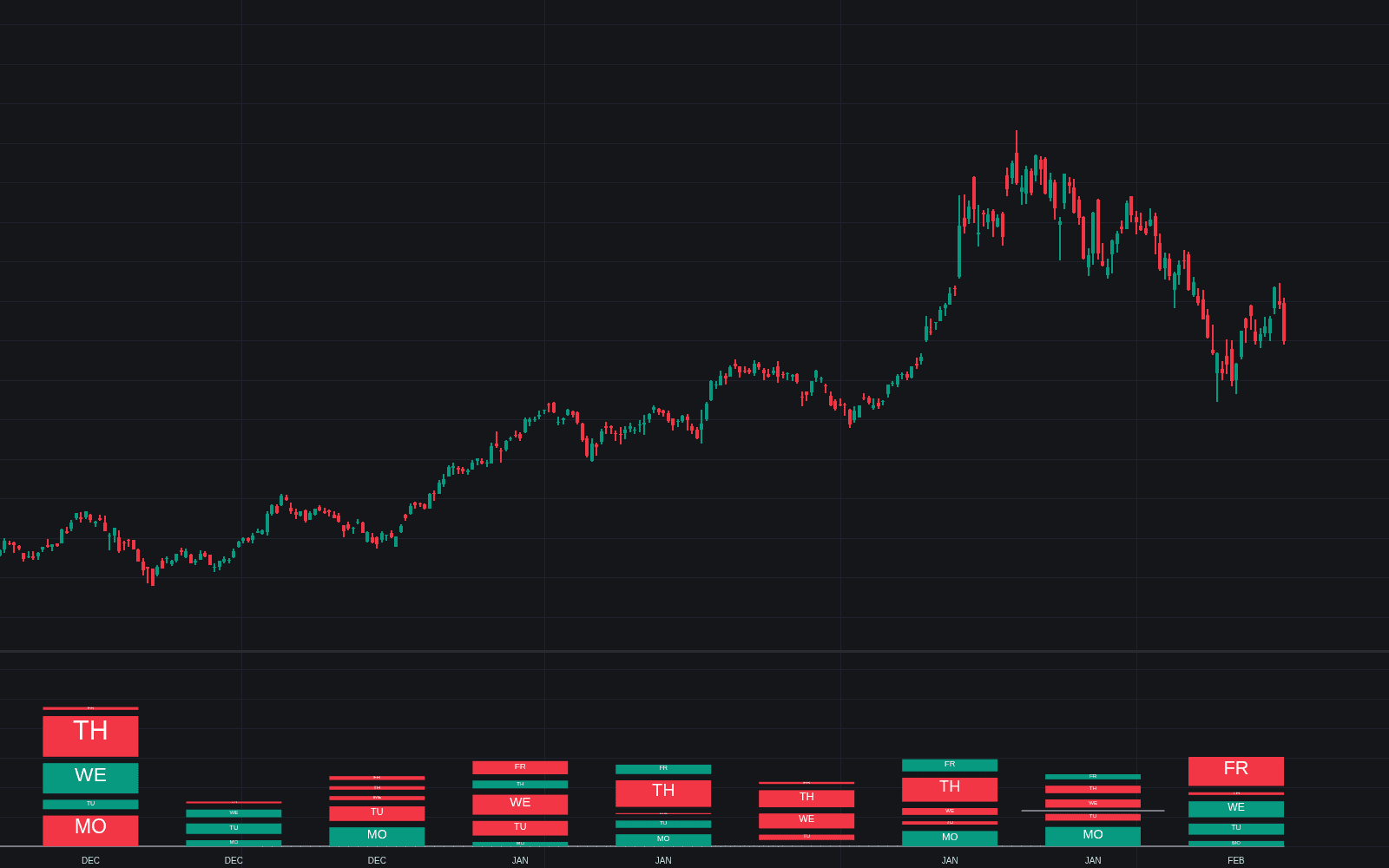
Day Of Week Price Distribution

Feb 18, 2026

Static chart image
Time Based
Dashboard
Patterns
Works on the following platforms:
tradingviewSymbolTradingView
For free use on the TradingView platform
ninjatraderNinjaTrader
For free use on the NinjaTrader platform
metatrader4MetaTrader 4/5
For free use on the MetaTrader 4/5 platform
thinkorswimThinkorswim
For free use on the Thinkorswim platform

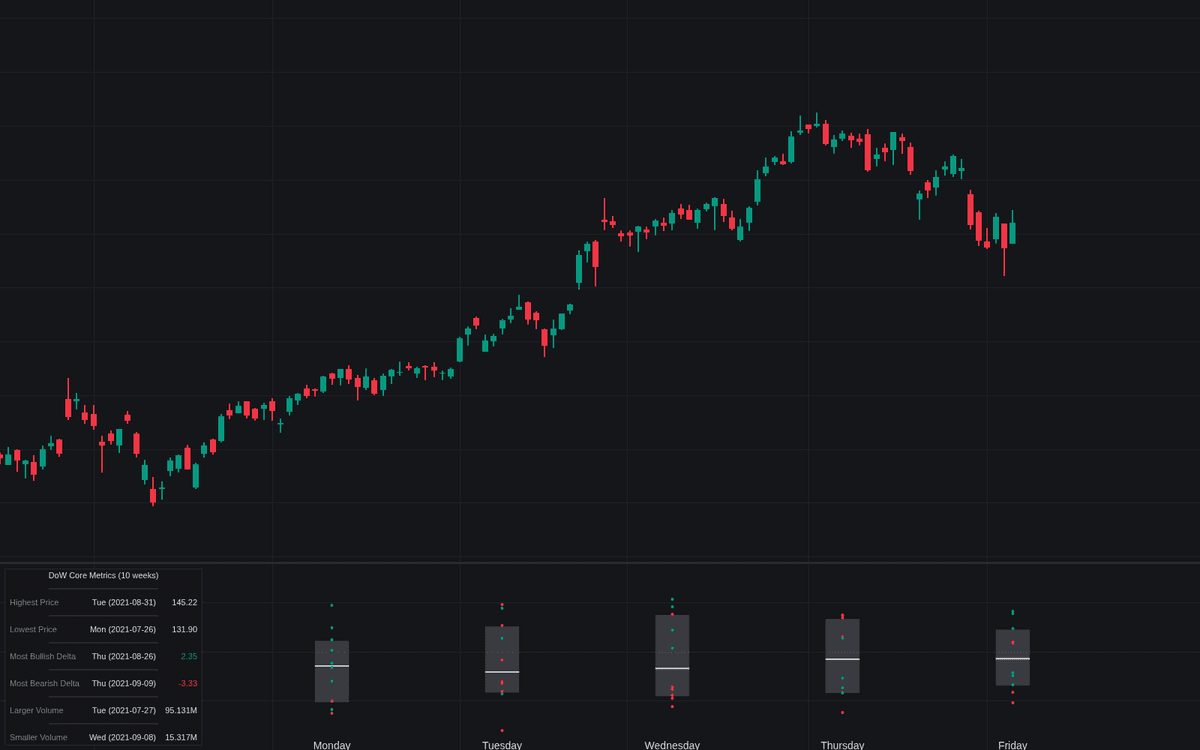
The Day of Week Price Distribution is a powerful trading indicator that visualizes how closing prices behave on each weekday over a user-defined number of weeks. By combining statistical box plots with interactive data points and a performance dashboard, this tool helps traders uncover recurring patterns, volatility tendencies, and day-specific price behavior at a glance. Whether you are building a short-term trading strategy or studying historical price structure, this indicator transforms raw data into actionable insights.

How to Trade the Day of Week Price Distribution Indicator?

indicator image

Using this trading indicator is simple yet highly informative. Traders can select:

  • Window (10 weeks by default): Defines how many weeks of historical data are analyzed.
  • Spacing (20 by default): Adjusts the visual width and separation of each weekday box plot.

Once applied to the chart, the indicator organizes closing price data into five distinct box plots — one for each weekday. This statistical representation allows traders to quickly identify:

  • Which weekdays tend to close higher or lower
  • Where volatility clusters
  • Whether certain days frequently produce outliers
  • If distributions are tightening or expanding over time

This makes it a valuable companion for day traders, swing traders, and quantitative analysts looking to refine entry timing or filter trades by weekday bias.

Understanding the Box Plot Structure

Each weekday is represented with a complete statistical distribution model:

  • Box (IQR – Interquartile Range):
    The rectangle represents the 25th to 75th percentile range. This shows where the majority of closing prices cluster.

  • Median Line (50th Percentile):
    The line inside the box indicates the median closing price for that weekday.

  • Dots (Individual Data Points):
    Each dot represents a single closing price from the selected period.
    Hovering over a dot reveals:

    • Closing price
    • Daily price change (delta from open to close)
    • Volume
    • Date

This granular visibility makes the indicator more than just a visual tool — it becomes an interactive statistical engine.

Identifying Outliers and Market Behavior

Outliers (dots located far outside the box) are particularly important in trading strategy development. They may signal:

  • News-driven moves
  • High-impact economic events
  • Abnormal volatility spikes
  • Institutional participation

By recognizing these deviations, traders can adjust risk management and position sizing for specific weekdays.

indicator image

As shown above, increasing the data window leads to smoother, more uniform distributions. A smaller window highlights short-term regime shifts, while a larger window emphasizes long-term weekday tendencies.

Core Dashboard Metrics for Data-Driven Trading

The integrated dashboard enhances the analytical depth of this trading indicator by displaying essential statistics for the selected window:

  • Highest Price: Maximum closing price in the dataset
  • Lowest Price: Minimum closing price in the dataset
  • Most Bullish Delta: Largest open-to-close price increase
  • Most Bearish Delta: Largest open-to-close price decrease
  • Largest Volume: Day with the highest trading volume
  • Smallest Volume: Day with the lowest trading volume

These metrics allow traders to quickly evaluate:

  • Which weekday historically delivers the strongest bullish momentum
  • Which day carries the highest downside risk
  • Where volume concentration occurs
  • Whether volatility aligns with participation

This is especially useful when integrating the indicator into a broader trading strategy involving trend filters, volatility tools, or liquidity-based systems.

Why Use Day-of-Week Analysis in Your Trading Strategy?

Market behavior is not random. Institutional flows, economic releases, options expirations, and macro events often cluster on specific weekdays. By analyzing structured weekday distributions, traders can:

  • Optimize entry timing
  • Avoid statistically weaker days
  • Align breakout strategies with high-volatility sessions
  • Improve mean-reversion setups on historically balanced days

The Day of Week Price Distribution indicator turns historical tendencies into measurable trading edges.

Indicator Settings Explained

Window

Select the number of weeks used to gather historical data.

  • Smaller windows capture recent market conditions.
  • Larger windows provide more stable statistical averages.

Spacing

Controls the visual width of the box plots.
Higher spacing values create larger boxes for clearer visual comparison.

Dashboard Settings

  • Dashboard: Enable or disable the statistical panel.
  • Position: Choose where the dashboard appears on the chart.
  • Size: Adjust the dashboard scale to match your layout.

Style Customization

  • Bullish Color: Define the color for bullish price movements.
  • Bearish Color: Define the color for bearish price movements.
  • IQR Area: Customize the box color. Enable Auto to use the default scheme.
  • Median Line: Customize the median color. Enable Auto for automatic styling.

Who Is This Trading Indicator For?

The Day of Week Price Distribution is ideal for:

  • Day traders seeking weekday bias confirmation
  • Swing traders analyzing recurring weekly structures
  • Quantitative traders validating statistical assumptions
  • Algorithm developers incorporating time-based filters
  • Portfolio managers studying volatility clustering

It can be applied to stocks, forex, crypto, indices, and futures markets.

Frequently Asked Questions (FAQ)

What does the Day of Week Price Distribution indicator show?

It shows the statistical distribution of closing prices for each weekday over a selected number of weeks, including the interquartile range, median, individual data points, and key performance metrics.

How can this improve my trading strategy?

By identifying weekday tendencies, volatility clusters, and outliers, traders can refine entry timing, improve risk management, and align strategies with statistically favorable sessions.

Does this indicator work on all markets?

Yes. It works on any market with consistent weekday trading sessions, including stocks, forex, crypto, indices, and futures.

How do I access the Day of Week Price Distribution indicator?

You can get access on the LuxAlgo Library for charting platforms like TradingView, MetaTrader (MT4/MT5), and NinjaTrader for free.

Trading & investing are risky and many will lose money in connection with trading and investing activities. All content on this site is not intended to, and should not be, construed as financial advice. Decisions to buy, sell, hold or trade in securities, commodities and other investments involve risk and are best made based on the advice of qualified financial professionals. Past performance does not guarantee future results.

Hypothetical or Simulated performance results have certain limitations. Unlike an actual performance record, simulated results do not represent actual trading. Also, since the trades have not been executed, the results may have under-or-over compensated for the impact, if any, of certain market factors, including, but not limited to, lack of liquidity. Simulated trading programs in general are designed with the benefit of hindsight, and are based on historical information. No representation is being made that any account will or is likely to achieve profit or losses similar to those shown.

Testimonials appearing on this website may not be representative of other clients or customers and is not a guarantee of future performance or success.

As a provider of technical analysis tools and strategies, we do not have access to the personal trading accounts or brokerage statements of our customers. As a result, we have no reason to believe our customers perform better or worse than traders as a whole based on any content, tool, or platform feature we provide.

Charts used on this site are by TradingView in which the majority of our technical indicators are built on. TradingView® is a registered trademark of TradingView, Inc. www.TradingView.comTradingView® has no affiliation with the owner, developer, or provider of the Services described herein.

Market data is provided by CBOE, CME Group, BarChart, CoinAPI. CBOE BZX real-time US equities data is licensed from CBOE and provided through BarChart. Real-time futures data is licensed from CME Group and provided through BarChart. Select cryptocurrency data, including major coins, is provided through CoinAPI. All data is provided “as is” and should be verified independently for trading purposes.

This does not represent our full Disclaimer. Please read our full disclaimer.

© 2026 LuxAlgo Global, LLC.