Fibonacci Grid
 By LuxAlgoMar 28, 2022
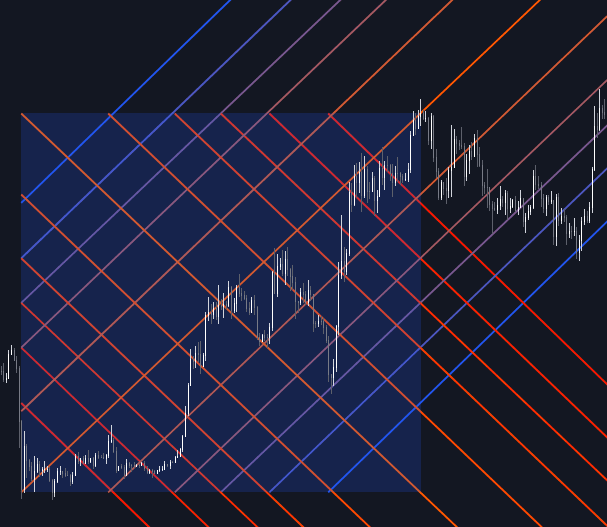
Fibonacci Grid projects support and resistance diagonally instead of horizontally. Every line is drawn at a precise 45-degree angle and positioned using Fibonacci ratios applied to the highest and lowest prices of a lookback window — or, for uniform structure, switched to equidistant spacing. The result is a lattice where price interacts with sloped levels whose values evolve bar by bar rather than sitting flat.
How to Trade the Fibonacci Grid?
- Individual diagonals: each line is a candidate support or resistance level; watch for price riding along a diagonal or rejecting it outright.
- Converging lines form channels: price tends to travel inside these corridors until a breakout, and the break itself can flag a shift in market conditions.
- Distance from the main diagonals: moves that stretch far from the orange main diagonals typically gravitate back toward the narrower channels — a built-in mean-reversion cue.
- Ratio versus equidistant spacing: Fibonacci spacing tightens the channels as they extend from the center of the lookback area; equidistant spacing keeps every gap uniform.
Fibonacci Grid Settings
- Length: the lookback used to find the maximum and minimum prices that frame the grid.
- Resolution: grid density when Fibonacci spacing is off — higher values draw more lines.
- Use Fibonacci Ratios: positions the lines at six specific Fibonacci ratios instead of equal intervals.
Frequently Asked Questions
Can I combine Fibonacci and equidistant lines?
No — the grid runs in one mode at a time. Toggle Use Fibonacci Ratios on for ratio-based placement or off for uniform spacing, and match the choice to how you frame the market.
How is a diagonal grid different from standard retracements?
Standard retracements are horizontal levels fixed between two prices. The grid tilts its levels at 45 degrees, so each level's price changes as bars pass — support and resistance with a time axis. For the classic horizontal toolset, the Fibonacci Toolkit carries retracements, arcs, fans, and more.
How do I get the Fibonacci Grid?
It costs nothing — the grid is part of the free LuxAlgo Library, and Quant, LuxAlgo's AI, can run and backtest it directly from this page.
Free indicator
Get free access to this indicator on the platforms below.

The Library is free. Quant makes it yours.
Pull any concept or indicator into Quant: rebuild it, retune it, or turn it into a backtested strategy of your own.