High/Low Location Frequency
 By LuxAlgoNov 6, 2024
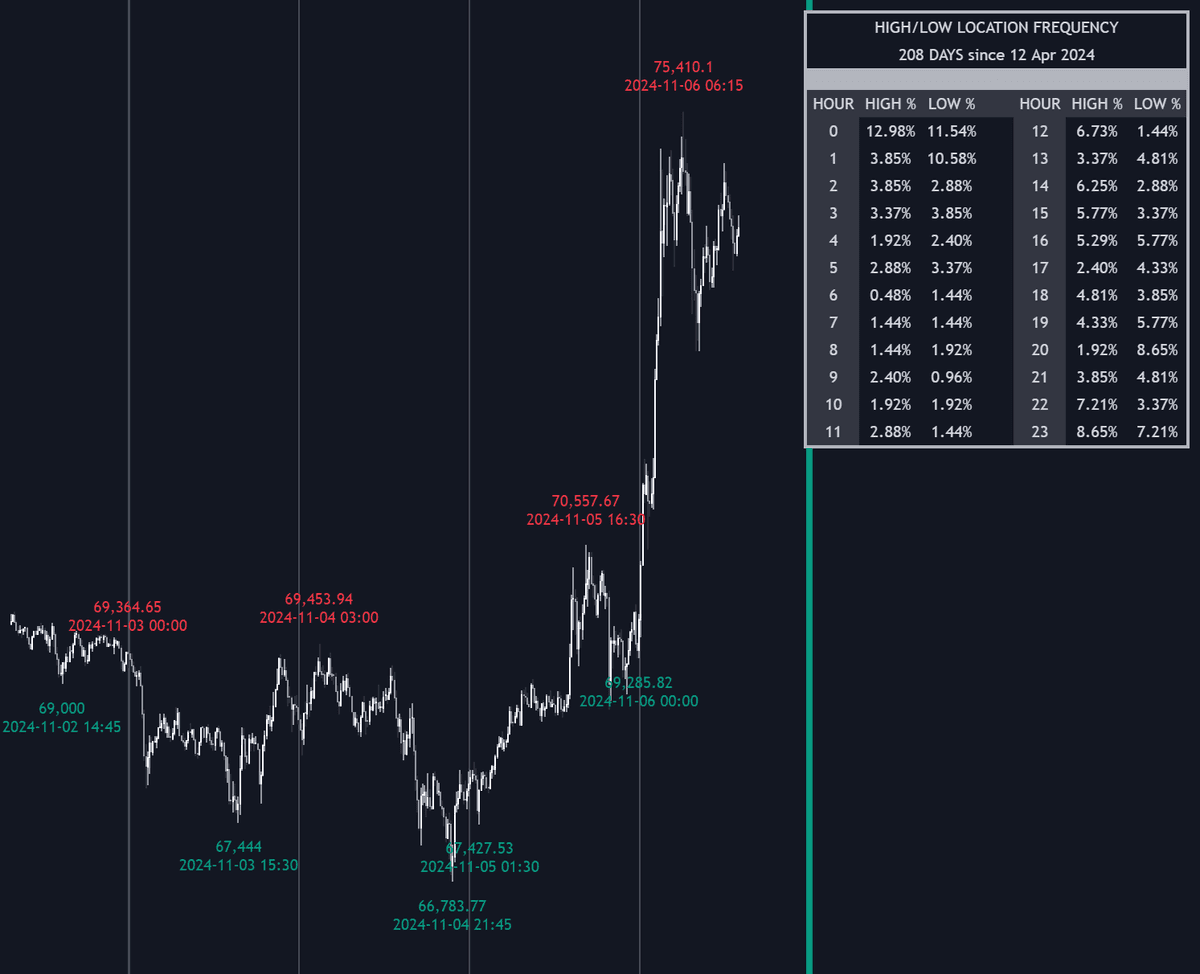
High/Low Location Frequency compiles session high/low statistics for the symbol on your chart, measuring how often highs and lows have printed in each hour of the day, day of the week, day of the month, and month of the year. The probabilities appear in a dashboard whose header reports how much history was sampled, and the strongest readings can be projected onto the chart itself, turning a statistical table into visible timing levels.
How to Trade the High/Low Location Frequency?
- Red high-probability lines: periods where tops have formed unusually often, a caution zone for chasing strength and a candidate window for fading it.
- Green high-probability lines: the mirror image for bottoms, marking when weakness has historically found buyers.
- Top/Bottom labels and period highlights: optional markers denote each period's extreme ranges and the start of every new period, keeping the context readable bar by bar.
Because the readings are computed per period type, the tool makes intraday time-of-day effects visible for your exact market rather than a generic session template. Week handling adapts too: continuously traded markets count the week from Sunday, while weekday-only markets span Monday to Friday.
High/Low Location Frequency Settings
- Period: which bars (hours, days, months) the statistics are computed over.
- Execution Window: the range of bars used for gathering data.
- Hours of Day / Days of Week / Days of Month / Months / Years: exclusion filters accepting lists such as
1,2,3or1 2 3(one separator, comma or space) for pruning old regimes or dead sessions from the sample. - Dashboard and style inputs: dashboard position and size, plus visibility and coloring for the probability lines, labels, and period-change highlights.
Frequently Asked Questions
Free indicator
Get free access to this indicator on the platforms below.

The Library is free. Quant makes it yours.
Pull any concept or indicator into Quant: rebuild it, retune it, or turn it into a backtested strategy of your own.