Market State Matrix

Apr 1, 2026

Static chart image
Cycle
Works on the following platforms:
tradingviewSymbolTradingView
For free use on the TradingView platform
ninjatraderNinjaTrader
For free use on the NinjaTrader platform
metatrader4MetaTrader 4/5
For free use on the MetaTrader 4/5 platform
thinkorswimThinkorswim
For free use on the Thinkorswim platform

The Market State Matrix trading indicator is a visual market analysis dashboard that turns complex price data into a single, easy-to-read radial display. Instead of forcing traders to compare multiple separate indicators, this tool combines trend, momentum, volatility, volume, and price structure into one layered view. The result is a cleaner way to spot market confluence, identify conflicts between conditions, and understand whether the current environment supports trend continuation, reversal, or consolidation.

How to Read the Market State Matrix Trading Indicator

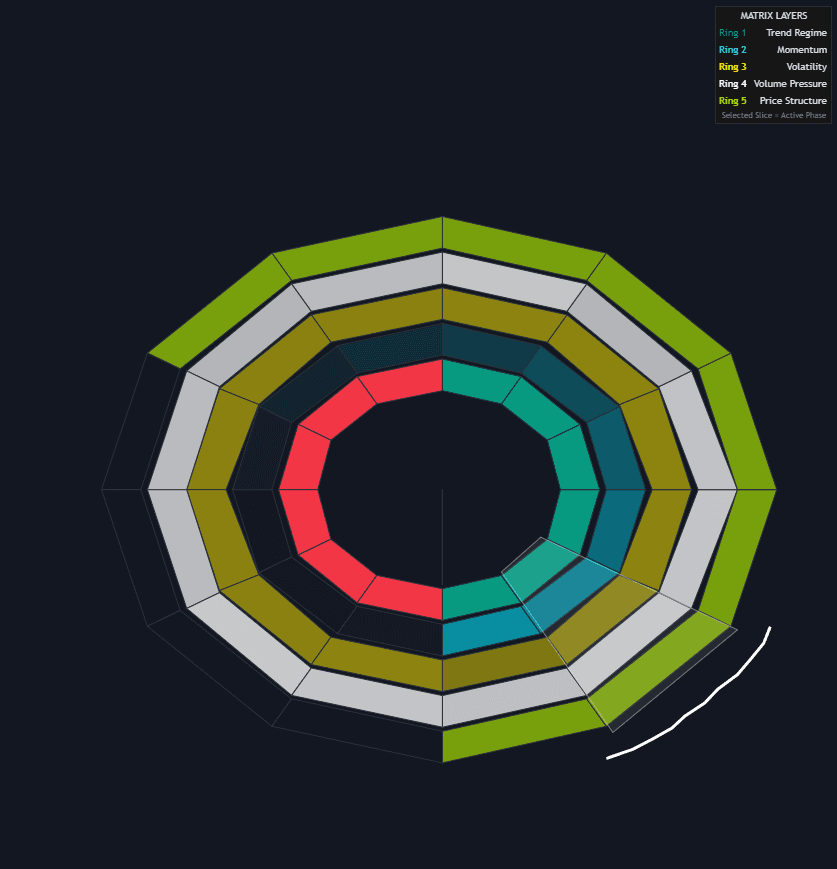
The indicator runs in its own pane and presents market conditions as a circular “radar” made up of 5 concentric rings and 12 radial slices. Each slice represents a different lookback period, so traders can instantly evaluate how short-term and long-term market behavior compare.

This makes the Market State Matrix especially useful for traders who want a broader read on price action without constantly switching between separate oscillators, volume tools, and trend-following indicators. It works well as a market condition indicator, trend confirmation tool, and trading strategy filter for both discretionary and systematic traders.

The 5 Market Dimensions in the Matrix (Inside to Outside)

  • Ring 1: Trend Regime (Teal/Red) - Displays the dominant EMA-based market direction, helping traders quickly determine whether the market is leaning bullish or bearish.
  • Ring 2: Momentum Intensity (Cyan/Purple) - Functions as a momentum heatmap using RSI distance from the 50-line, making it easier to see whether bullish or bearish momentum is accelerating.
  • Ring 3: Volatility Glow (Gold) - Expands in brightness when ATR rises relative to its historical baseline, highlighting periods of increasing market activity and risk.
  • Ring 4: Volume Pressure (White) - Reveals relative participation, helping traders identify where stronger buying or selling interest may be building.
  • Ring 5: Price Structure (Lime/Orange) - Tracks evolving market structure through Higher Highs/Higher Lows versus Lower Highs/Lower Lows across multiple scales.

What the Colors and Alignment Tell You

Because the Matrix stacks these market dimensions on top of one another, it becomes easy to spot when the market is highly coordinated or internally divided.

  • Full Alignment: A solid vertical path of matching signals from the inner ring to the outer ring suggests strong confluence. In trading terms, this often means trend, momentum, volatility, volume, and structure are supporting the same directional bias.
  • Internal Conflict: Mixed colors inside a single slice suggest disagreement between market forces. For example, bullish trend structure with fading momentum can point to trend exhaustion, weakening continuation odds, or a possible mean reversion setup.
  • Volatility Expansion: When the Gold volatility ring becomes more active and the Volume Pressure ring also lights up, the market may be entering a more explosive phase. This can be especially useful for breakout traders and momentum traders.
  • Regime Core: The center of the Matrix acts as a directional anchor. It reflects the fastest regime layer and can help traders stay oriented when the outer rings become more mixed.

How the Multi-Scale Engine Helps Traders

At the core of the Market State Matrix is a Multi-Scale Engine built around 12 radial slices, each tied to a progressively longer lookback period from 8 to 220 bars. This creates a powerful way to view market behavior across time horizons without loading multiple copies of separate indicators.

Shorter slices respond more quickly to momentum changes, intraday swings, and short bursts of volatility. Longer slices react more slowly and provide a clearer read on the broader market regime. This allows traders to distinguish between a short-term pullback and a true higher-timeframe shift.

In practice, this is one of the most useful features of the indicator. A trader might see short-term slices weakening while longer-term slices remain aligned, which could suggest a temporary retracement within a larger trend. On the other hand, if both fast and slow slices begin rotating into conflict, that may signal a more meaningful change in market state.

Sensitive Slices vs. Stable Slices

The Matrix naturally separates market behavior into two useful categories:

  • Sensitive Slices: These shorter lookback segments react fastest to price changes. They are helpful for active traders who want early warnings of momentum shifts, micro-reversals, or breakout pressure.
  • Stable Slices: These longer lookback segments smooth out noise and reflect the broader macro regime. They are more useful for swing traders and traders who want confirmation before acting.

This layered design makes the Market State Matrix more than just a visual dashboard. It becomes a multi-timeframe trading indicator that helps traders interpret whether current price movement is noise, continuation, or genuine structural change.

How to Use the Dominant Phase Highlighter in a Trading Strategy

The indicator also includes a Dominant Phase Highlighter, which uses a glowing radial arc and focus overlay to identify the currently active slice of price action. This feature is designed to show where the market sits in its present cycle.

The highlighted phase may suggest one of several market conditions, such as:

  • Expansion: Strong directional movement with building momentum and participation.
  • Exhaustion: A late-stage move where momentum starts to weaken even if trend remains visible.
  • Contraction: Lower-volatility conditions where the market compresses before a potential breakout.
  • Accumulation: A quieter phase where positioning may be building before a larger move emerges.

For traders, this adds a useful cyclical layer to the indicator. Instead of only answering whether the market is bullish or bearish, the Matrix can also help answer whether the move looks early, mature, fading, or dormant. That makes it a valuable companion for breakout trading, mean reversion trading, and trend-following strategies.

Why This Trading Indicator Is Useful

The Market State Matrix stands out because it reduces indicator overload. Many traders rely on separate windows for trend, RSI, ATR, volume, and structure analysis. This tool compresses those factors into a unified view, making it easier to read market confluence at a glance.

This can help with:

  • Filtering low-quality setups
  • Confirming trend direction before entering
  • Spotting internal weakness before a reversal
  • Identifying volatility and volume expansion before a major move
  • Comparing short-term and long-term market behavior in one place

As a result, the Market State Matrix can serve as a trading strategy confirmation indicator, a market regime indicator, or a broader decision-support tool for traders who want more context before taking a trade.

Settings

Visual Settings

  • Horizontal Offset: Moves the Matrix left or right on the chart for better placement and readability.
  • Core Radius: Controls the size of the center circle, which acts as the directional anchor of the dashboard.
  • Ring Width: Adjusts the thickness of each concentric ring to emphasize or compact the visual layout.
  • Ring Gap: Sets the spacing between segments to improve contrast and make the layers easier to distinguish.
  • Show Dashboard Legend: Enables or disables the "Matrix Layers" table shown in the top-right corner.

FAQ

What is the Market State Matrix indicator?

The Market State Matrix is a radial trading indicator that combines trend, momentum, volatility, volume, and price structure into one circular dashboard. It helps traders quickly assess whether market conditions are aligned, conflicting, expanding, or contracting.

How does the Market State Matrix help a trading strategy?

It helps traders confirm market confluence before entering a trade. By showing whether different market dimensions agree or disagree, it can improve trade filtering, help avoid weak setups, and provide better timing for trend-following or reversal strategies.

Is the Market State Matrix good for multi-timeframe analysis?

Yes. The 12 radial slices represent different lookback periods, allowing traders to compare fast and slow market behavior in one view. This makes it useful as a multi-scale and multi-timeframe market analysis tool.

What does full alignment mean in the Matrix?

Full alignment means multiple rings within the same slice are confirming the same directional bias. This often signals strong conviction, stronger trend conditions, and a more favorable environment for directional trading.

How do I access the Market State Matrix?

You can get access on the LuxAlgo Library for charting platforms like TradingView, MetaTrader (MT4/MT5), and NinjaTrader for free.

Trading & investing are risky and many will lose money in connection with trading and investing activities. All content on this site is not intended to, and should not be, construed as financial advice. Decisions to buy, sell, hold or trade in securities, commodities and other investments involve risk and are best made based on the advice of qualified financial professionals. Past performance does not guarantee future results.

Hypothetical or Simulated performance results have certain limitations. Unlike an actual performance record, simulated results do not represent actual trading. Also, since the trades have not been executed, the results may have under-or-over compensated for the impact, if any, of certain market factors, including, but not limited to, lack of liquidity. Simulated trading programs in general are designed with the benefit of hindsight, and are based on historical information. No representation is being made that any account will or is likely to achieve profit or losses similar to those shown.

Testimonials appearing on this website may not be representative of other clients or customers and is not a guarantee of future performance or success.

As a provider of technical analysis tools and strategies, we do not have access to the personal trading accounts or brokerage statements of our customers. As a result, we have no reason to believe our customers perform better or worse than traders as a whole based on any content, tool, or platform feature we provide.

Charts used on this site are by TradingView in which the majority of our technical indicators are built on. TradingView® is a registered trademark of TradingView, Inc. www.TradingView.comTradingView® has no affiliation with the owner, developer, or provider of the Services described herein.

Market data is provided by CBOE, CME Group, BarChart, CoinAPI. CBOE BZX real-time US equities data is licensed from CBOE and provided through BarChart. Real-time futures data is licensed from CME Group and provided through BarChart. Select cryptocurrency data, including major coins, is provided through CoinAPI. All data is provided “as is” and should be verified independently for trading purposes.

This does not represent our full Disclaimer. Please read our full disclaimer.

© 2026 LuxAlgo Global, LLC.