No-stop Hedging
 By LuxAlgoAug 9, 2026
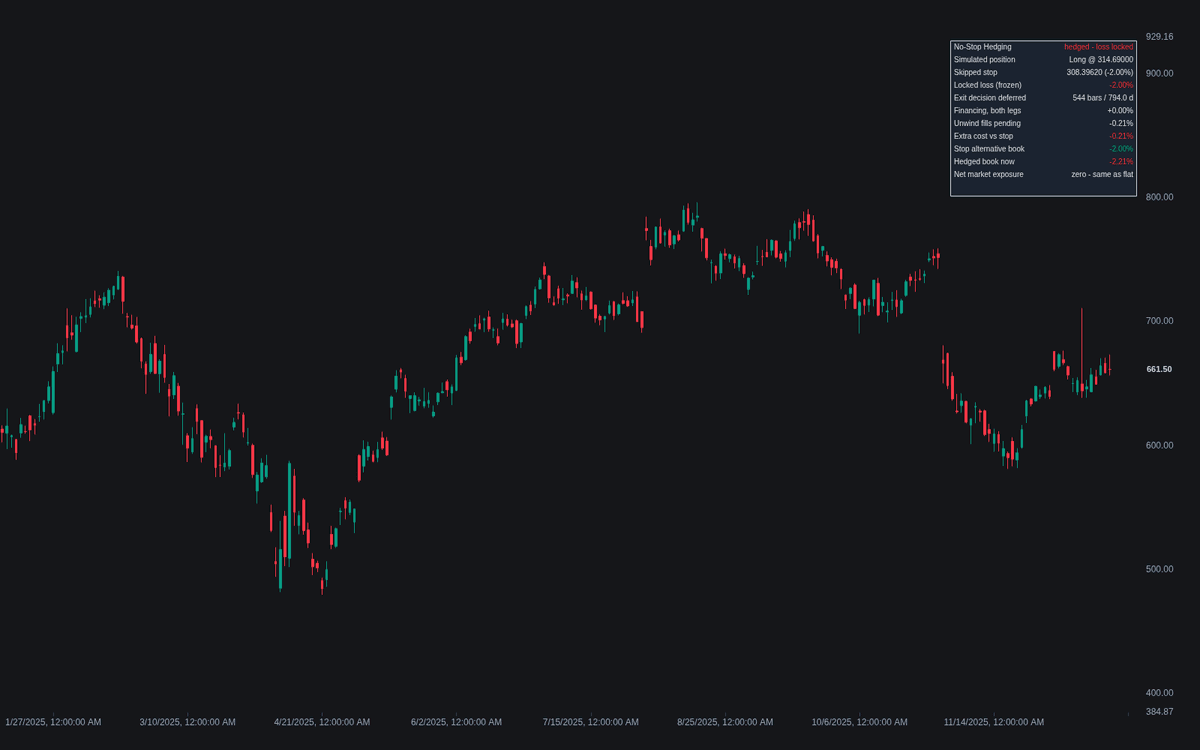
No-stop Hedging replays the loss-locking sequence on a hypothetical trade so its full cost sits on the chart. At the adverse distance where a stop would sit, the simulated position opens an equal opposite leg instead — the practice of no-stop hedging — and from that bar it accounts for everything the lock owes that a stop never would: the frozen loss, the pending unwind fills, financing on both legs by wall-clock time and, cross-instrument, the drift between the legs.
How to Trade the No-stop Hedging?
- Hedge trigger hit: an event label marks where the loss was locked; the corridor between entry and skipped stop turns from open risk into frozen loss.
- Lock Bleed fill: the gap between the Stop alternative and Hedged book value lines deepens as carrying costs accrue — alerted past the threshold.
- Back at entry while locked: price has returned, the book is still down the frozen loss plus costs, the deferred exit still unmade — labeled and alerted.
- Cross-hedge basis loss: with a correlated instrument set, the dashboard tracks basis P&L and correlation; an alert flags the pair losing as an unmanaged spread.
No-stop Hedging Settings
- Direction (default Long), Entry anchor (default Auto (bars back)), Bars back (auto) (default 200) and Anchor time (custom): the simulated trade.
- Trigger distance (default ATR multiple), ATR length (default 14), ATR multiplier (default 1.5) and Percent distance (default 2): where the skipped stop sits.
- Spread cost per fill (%) (default 0.05), Financing per leg (% / year) (default 3) and Carry-cost alert threshold (%) (default 0.25): the cost model.
- Correlated hedge instrument (default empty — same-instrument lock) and Correlation length (default 100): the cross variant.
- Show dashboard (on, Top right, Small) plus Frozen-loss zone and Event labels (both on).
Frequently Asked Questions
Is this an entry or signal tool?
No — a demonstration instrument. The position is hypothetical; the point is the accounting that follows the lock, with every cost made explicit.
Isn't locking the loss safer than taking the stop?
A fully offset same-instrument book has zero market exposure — economically flat with the loss realized, as the dashboard says, yet still paying financing and owing two closing fills. A plain fixed stop pays one spread at the same level and is done.
What changes with a correlated hedge instrument?
The book stops being frozen: equal cash notional in another symbol drifts with the basis between the legs, and a correlation break can sink both legs at once — hence correlation now and at lock side by side.

The Library is free. Quant makes it yours.
Pull any concept or indicator into Quant: rebuild it, retune it, or turn it into a backtested strategy of your own.