Probabilistic Breakout Forecaster

Mar 13, 2026

Static chart image
Oscillators
Works on the following platforms:
tradingviewSymbolTradingView
For free use on the TradingView platform
ninjatraderNinjaTrader
For free use on the NinjaTrader platform
metatrader4MetaTrader 4/5
For free use on the MetaTrader 4/5 platform
thinkorswimThinkorswim
For free use on the Thinkorswim platform

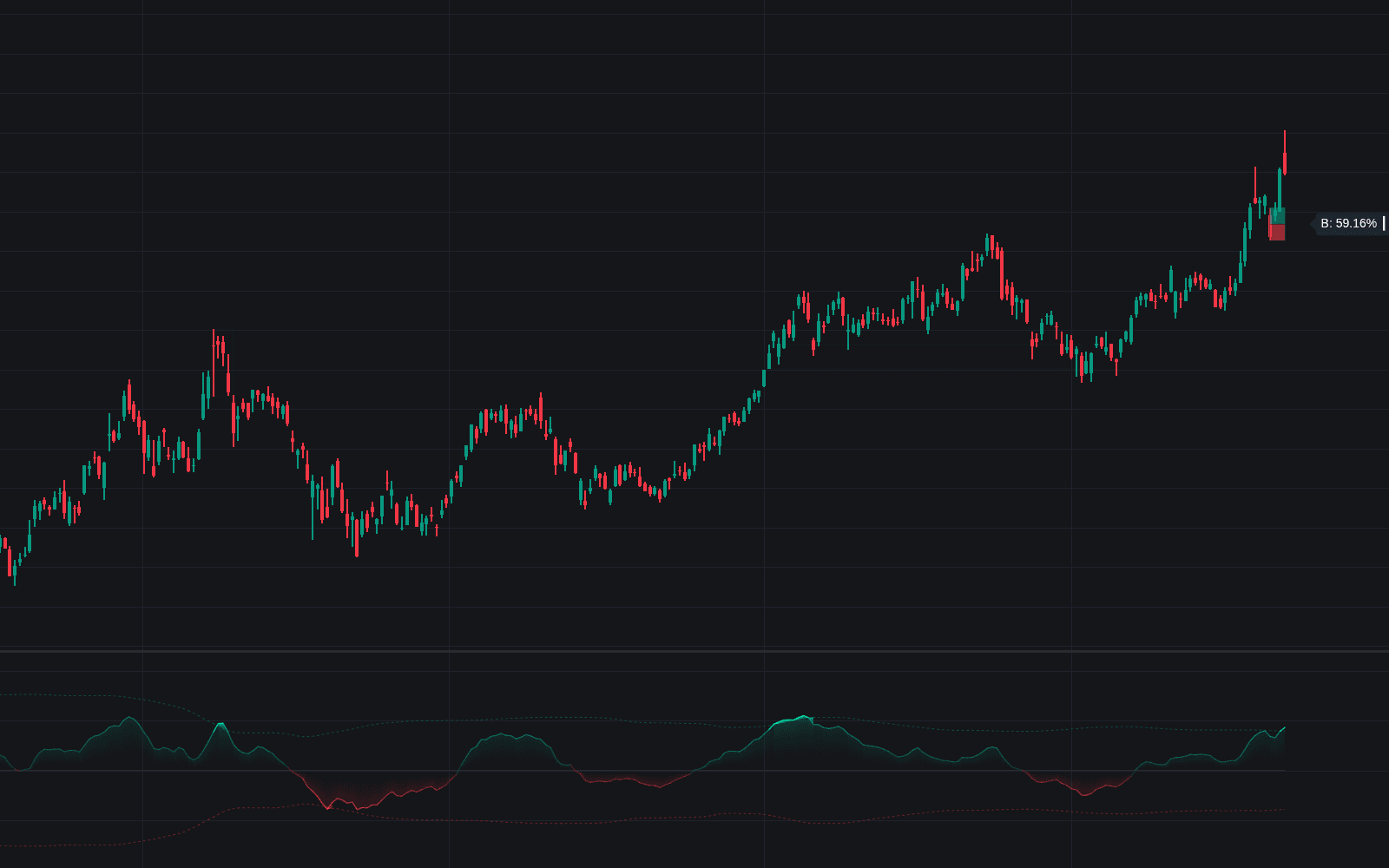
The Probabilistic Breakout Forecaster is a trading indicator built to estimate the likelihood of price breaking above resistance or below support before the move actually happens. By applying a log-normal random walk model to current volatility and recent price structure, it helps traders quantify breakout probability, evaluate consolidation strength, and spot potential trading strategy setups with more confidence.

How to Trade the Probabilistic Breakout Forecaster Indicator

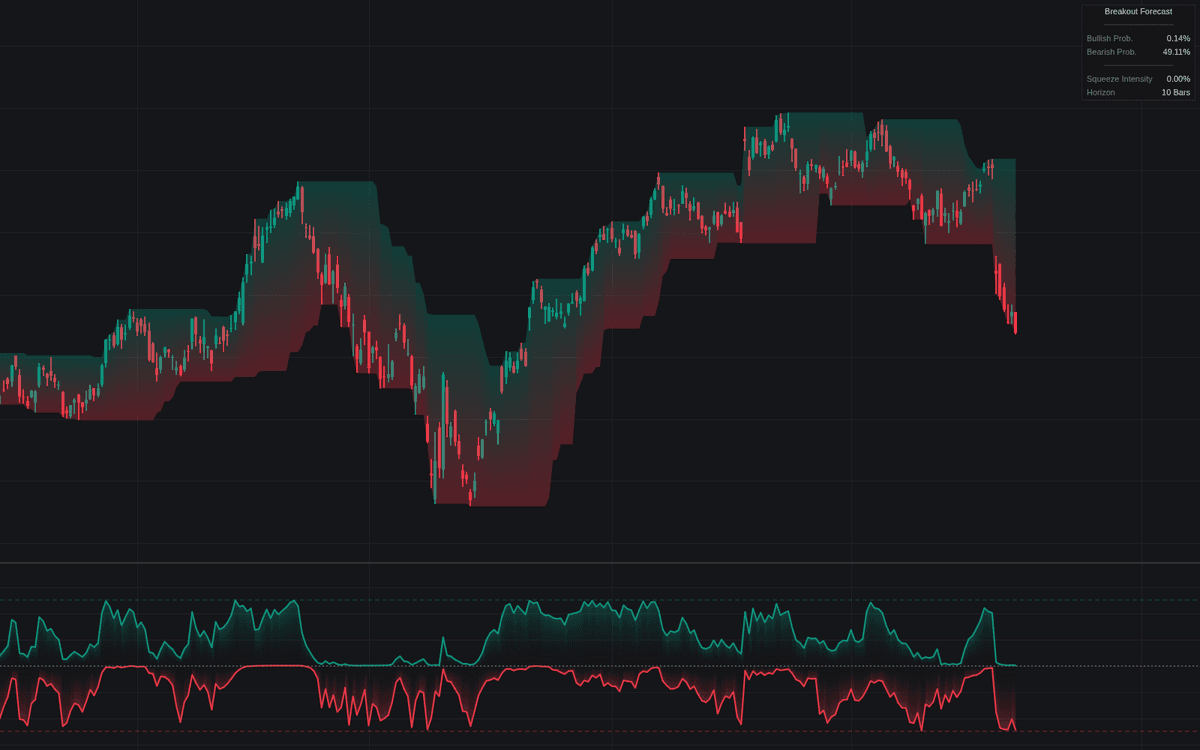
The indicator appears in a separate pane and plots two probability curves designed to help traders assess both bullish and bearish breakout conditions in real time. The bullish breakout probability is shown as a positive line, while the bearish breakout probability is shown as a negative line, making it easy to compare upside and downside pressure at a glance.

When the bullish probability moves toward or above the 50% threshold, it suggests the market has a stronger statistical chance of breaking above the recent range high within the selected forecast window. When the bearish probability pushes toward or below the -50% threshold, it signals an increased probability of price breaking beneath the recent range low over that same time horizon.

This trading indicator can be especially useful for traders who want to anticipate range expansion instead of reacting late to breakout candles. It can also help confirm whether current market conditions support a real breakout or whether the move may be more likely to stall.

Traders can use this tool for:

  • Identifying breakout opportunities before price escapes a consolidation range.
  • Comparing statistical probability with visible price action to avoid fakeouts and low-quality entries.
  • Measuring whether current volatility conditions are supportive of a trend continuation move.
  • Building a more informed breakout trading strategy around support, resistance, and volatility expansion.

Real-Time Probability Dashboard

The built-in dashboard gives a clean summary of the current breakout forecast so traders do not need to interpret the plots alone. It highlights the most important statistics behind the current setup and can be used as a quick market condition filter before taking a trade.

  • Bullish/Bearish Probabilities: Shows the exact percentage chance of an upside or downside breakout occurring within the selected forecast horizon.
  • Squeeze Intensity: Measures how compressed current volatility is relative to its historical average. Higher readings, especially above 50%, can point to conditions where a large directional move may be building.
  • Horizon: Displays how many bars into the future the indicator is currently forecasting.

How the Breakout Forecast Model Works

The script uses a Log-Normal Random Walk framework to model potential future price movement. In simple terms, it assumes price returns behave in a statistically consistent way over time, which allows the indicator to estimate how likely price is to reach or exceed the recent range boundaries.

This makes the indicator useful for traders who want more than visual chart reading alone. Instead of only watching highs and lows, they can incorporate a probability-based trading model into their technical analysis process.

Breakout Probability Calculation

The core breakout forecast is generated using the Normal Cumulative Distribution Function (CDF). The script measures the distance from the current price to the upper and lower boundaries of the active range, then adjusts that distance using two major inputs:

  • Time, through the selected Forecast Horizon
  • Volatility, through the standard deviation of log returns

This creates a probabilistic estimate of whether price is statistically likely to break above resistance or below support before the horizon expires. In practice, this gives traders a structured way to judge whether a breakout setup has enough underlying momentum and volatility to matter.

Volatility Squeeze Analysis

The Squeeze Intensity reading compares the current Average True Range (ATR) to its 100-period simple moving average. When the ATR is running well below its historical baseline, the indicator interprets the market as compressed.

Low-volatility compression is often important in breakout trading because quiet ranges frequently lead to sharp directional expansion once price escapes. By combining squeeze conditions with breakout probability, traders can better identify setups where both structure and volatility favor movement.

Indicator Settings and Customization

The indicator includes flexible inputs that allow traders to adapt the model to different assets, chart timeframes, and trading strategies. Whether the goal is short-term breakout trading, swing trading, or filtering noisy ranges, these settings can change how aggressive or conservative the forecast becomes.

Calculation Settings

  • Range Length: Sets the lookback period used to define the highest high and lowest low that form the current breakout boundaries.
  • Forecast Horizon (Bars): Determines how many bars into the future the model projects. A longer horizon usually increases the odds of reaching a boundary, but it also makes timing less precise.
  • Volatility Lookback: Controls the period used to calculate the standard deviation of log returns. This directly affects how wide or narrow the projected price distribution becomes.

Visualization Settings

  • Bullish/Bearish Color: Lets traders customize the colors used for the bullish and bearish breakout probability plots.
  • Fill Transparency: Adjusts the visibility of the shaded area between the probability lines and the zero baseline, helping improve chart readability.

Dashboard Settings

  • Enable Dashboard: Turns the on-screen probability summary on or off.
  • Position: Moves the dashboard to different corners of the chart.
  • Size: Changes the scale of the dashboard text and cells for better visibility.

Why Traders Use This Breakout Trading Indicator

Many breakout strategies fail because traders enter too early, chase weak moves, or confuse random price fluctuation with real expansion. The Probabilistic Breakout Forecaster helps solve that by framing breakout conditions in statistical terms.

Instead of relying only on candles touching a range edge, traders can ask stronger questions:

  • Is there actually enough probability behind the move?
  • Is current volatility too weak for a real breakout?
  • Is the market coiled enough for a larger expansion?
  • Does the bullish or bearish side have a measurable edge?

That makes this tool valuable for traders who want a more systematic trading strategy, especially when combining range analysis, volatility compression, and breakout confirmation.

FAQ

What does the Probabilistic Breakout Forecaster indicator do?

It estimates the statistical probability that price will break above a recent high or below a recent low within a selected number of future bars. This helps traders evaluate breakout setups before price leaves the range.

Is this a good trading indicator for breakout trading?

Yes, it can be a strong breakout trading indicator for traders who want to combine technical analysis with probability-based decision making. It is especially useful during consolidations, squeezes, and range-bound conditions where breakout potential is building.

How should traders use the bullish and bearish probability lines?

The bullish line helps estimate the chance of an upside breakout, while the bearish line helps estimate the chance of a downside breakdown. Many traders use these readings alongside support and resistance, price structure, and volatility conditions to confirm a trading strategy.

What does Squeeze Intensity mean?

Squeeze Intensity measures how compressed current volatility is compared with its historical average. Higher squeeze readings can signal that the market is storing energy for a potential expansion move.

How do I access the Probabilistic Breakout Forecaster?

You can get access on the LuxAlgo Library for charting platforms like TradingView, MetaTrader (MT4/MT5), and NinjaTrader for free.

Trading & investing are risky and many will lose money in connection with trading and investing activities. All content on this site is not intended to, and should not be, construed as financial advice. Decisions to buy, sell, hold or trade in securities, commodities and other investments involve risk and are best made based on the advice of qualified financial professionals. Past performance does not guarantee future results.

Hypothetical or Simulated performance results have certain limitations. Unlike an actual performance record, simulated results do not represent actual trading. Also, since the trades have not been executed, the results may have under-or-over compensated for the impact, if any, of certain market factors, including, but not limited to, lack of liquidity. Simulated trading programs in general are designed with the benefit of hindsight, and are based on historical information. No representation is being made that any account will or is likely to achieve profit or losses similar to those shown.

Testimonials appearing on this website may not be representative of other clients or customers and is not a guarantee of future performance or success.

As a provider of technical analysis tools and strategies, we do not have access to the personal trading accounts or brokerage statements of our customers. As a result, we have no reason to believe our customers perform better or worse than traders as a whole based on any content, tool, or platform feature we provide.

Charts used on this site are by TradingView in which the majority of our technical indicators are built on. TradingView® is a registered trademark of TradingView, Inc. www.TradingView.comTradingView® has no affiliation with the owner, developer, or provider of the Services described herein.

Market data is provided by CBOE, CME Group, BarChart, CoinAPI. CBOE BZX real-time US equities data is licensed from CBOE and provided through BarChart. Real-time futures data is licensed from CME Group and provided through BarChart. Select cryptocurrency data, including major coins, is provided through CoinAPI. All data is provided “as is” and should be verified independently for trading purposes.

This does not represent our full Disclaimer. Please read our full disclaimer.

© 2026 LuxAlgo Global, LLC.