Range Average Retest Model
 By LuxAlgoMay 7, 2024
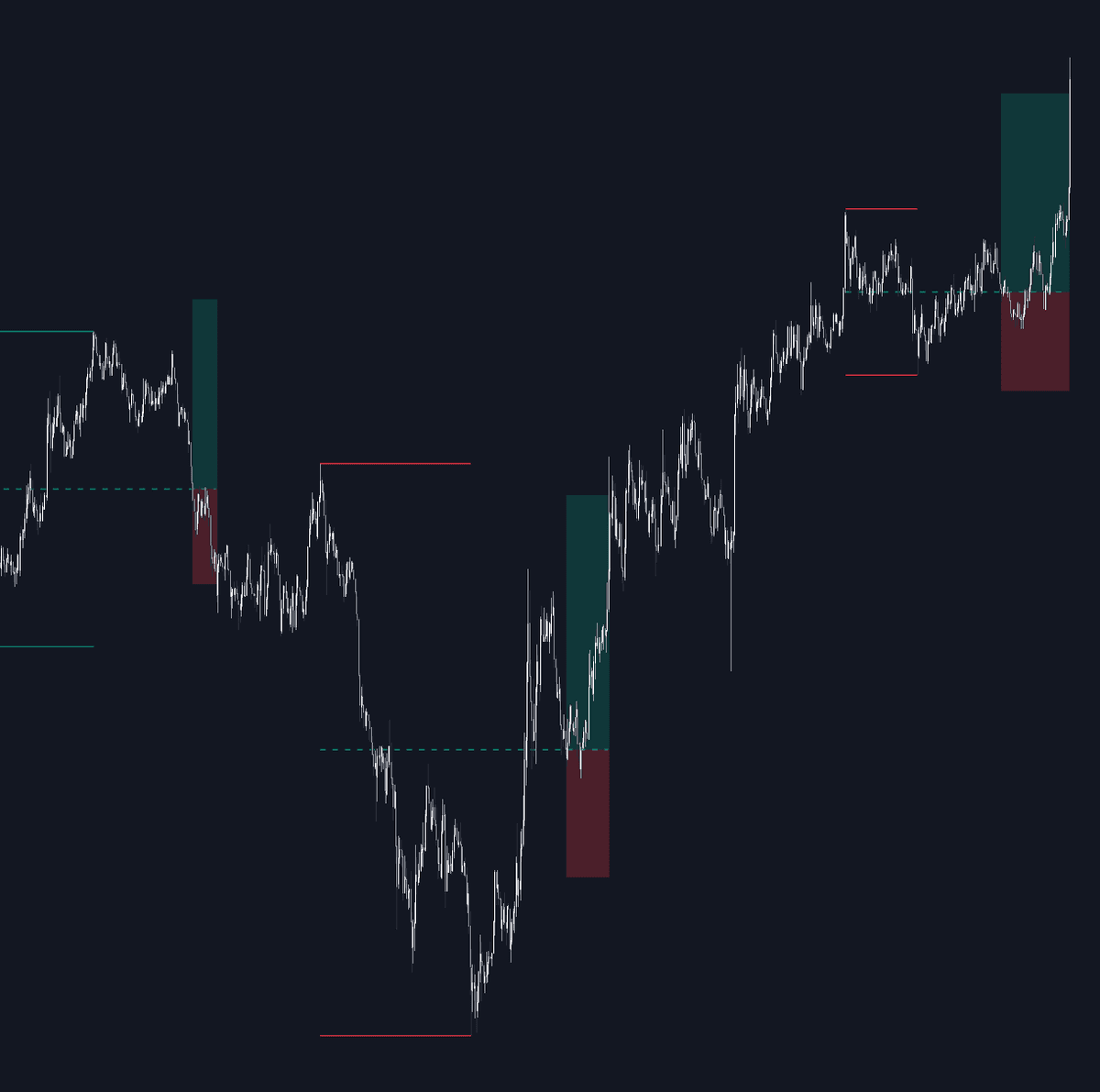
The Range Average Retest Model is a powerful tool designed to highlight trading setups using the average retest entry model. This approach involves entering a trade when the price retests the average between two swing points, offering a strategic entry for traders. With an emphasis on long-term volatility, this tool allows traders to customize parameters to refine swing areas and strategically set take profit and stop loss levels.
Traders can draw up to 165 swing areas and control the trades associated with these swings. By utilizing parameters like Pivot Length, Selection Mode, Threshold, Maximum Distance, and Minimum Distance, traders can filter swing areas and trades according to their strategies. Additionally, customization options are available for enabling/disabling swing areas, overlapping trades, and adjusting the visual markers for Take Profit and Stop Loss zones.
How to Trade with the Range Average Retest Model?
This entry model operates by entering positions when the price retests the average established between two swing points. Traders can set the period for detecting swing points using the "Pivot Length" setting. Long and short positions are determined by the following conditions:
- Long positions: Initiated when the current bar's close is below the swing area average and the previous bar's close was above it.
- Short positions: Initiated when the current bar's close is above the swing area average, and the previous bar's close was below it.
Each trade is visually represented on the chart, connected to its swing area by a line highlighting the range average. Green and red zones depict Take Profit and Stop Loss areas, respectively, calculated using user-defined multipliers and the average true range from the last 200 bars. Trades stay active until they hit the designated Stop Loss or Take Profit levels.
How to Filter Swing Areas Effectively?
Harness the power of the settings panel to adjust the behavior of swing areas to align with your trading strategy. On a daily chart of the Nasdaq-100 futures (NQ) with a pivot length of 2 and bullish selection mode, for instance, only bullish areas are detected. These, while smaller, are more numerous.
Traders can manipulate swing areas through the selection mode, filtering areas by bias to detect bullish, bearish, or both types of swing areas. The Threshold parameter further refines this by applying volatility measures to avoid areas where average prices are tightly grouped, demanding a higher variance for area detection.
Maximizing Trade Opportunities
Control over trade behavior is granted through the settings panel, where traders can adjust parameters to fit their strategy. For example, on a 3-minute chart of the Nasdaq-100 futures (NQ) with a pivot length of 5, bearish selection mode, and a specified maximum and minimum distance, traders can evaluate trades with asymmetric risk/reward ratios.
Setting the maximum and minimum distances helps place trades at optimal points relative to swing areas. The Take Profit and Stop Loss levels use long-term volatility measures to establish strategic price targets.
Managing Overlapping Trades
By default, overlapping trades are not displayed, offering cleaner chart visuals. However, traders can enable overlapping mode in the settings for a comprehensive view of all potential trades, though this may clutter the chart.
Configurations and Parameters
Fine-Tuning Swing Detection
- Pivot Length: This parameter determines how many bars are used to confirm a swing point, affecting the size and frequency of swing areas.
- Selection Mode: Adjust this setting to detect only bullish, bearish, or both swings.
- Threshold: Applied to the average true range, this controls the proximity of swing areas, ensuring new detections are sufficiently spaced from existing areas.
Setting Trade Parameters
- Maximum Distance: The furthest point a trade can be positioned from a swing area.
- Minimum Distance: The closest point a trade can be positioned to a swing area.
- Take Profit: Defined by multiplying volatility measures, it sets the size of profit targets.
- Stop Loss: Similar to Take Profit, it sets loss limits based on volatility measures.
Frequently Asked Questions
How do I access the Range Average Retest Model?
You can get access on the LuxAlgo Library for charting platforms like TradingView, MetaTrader (MT4/MT5), and NinjaTrader for free. Simply navigate to LuxAlgo's library and follow the easy steps to integrate it into your trading strategy.
What is a swing area in trading?
A swing area in trading is a price range that is identified using past price swings. It helps traders determine potential entry and exit points based on historical price patterns.
Can I customize trade visualizations?
Yes, the settings allow for custom adjustments to line markings and color codes for Take Profit and Stop Loss areas to suit your personal preferences.
This enriched description is optimized to help traders understand the potential of the Range Average Retest Model while boosting its visibility through strategic SEO practices.
Free indicator
Get free access to this indicator on the platforms below.

Unlock the entire LuxAlgo Library
Every indicator, every strategy, full charts, and complete access to Quant — our AI agent.