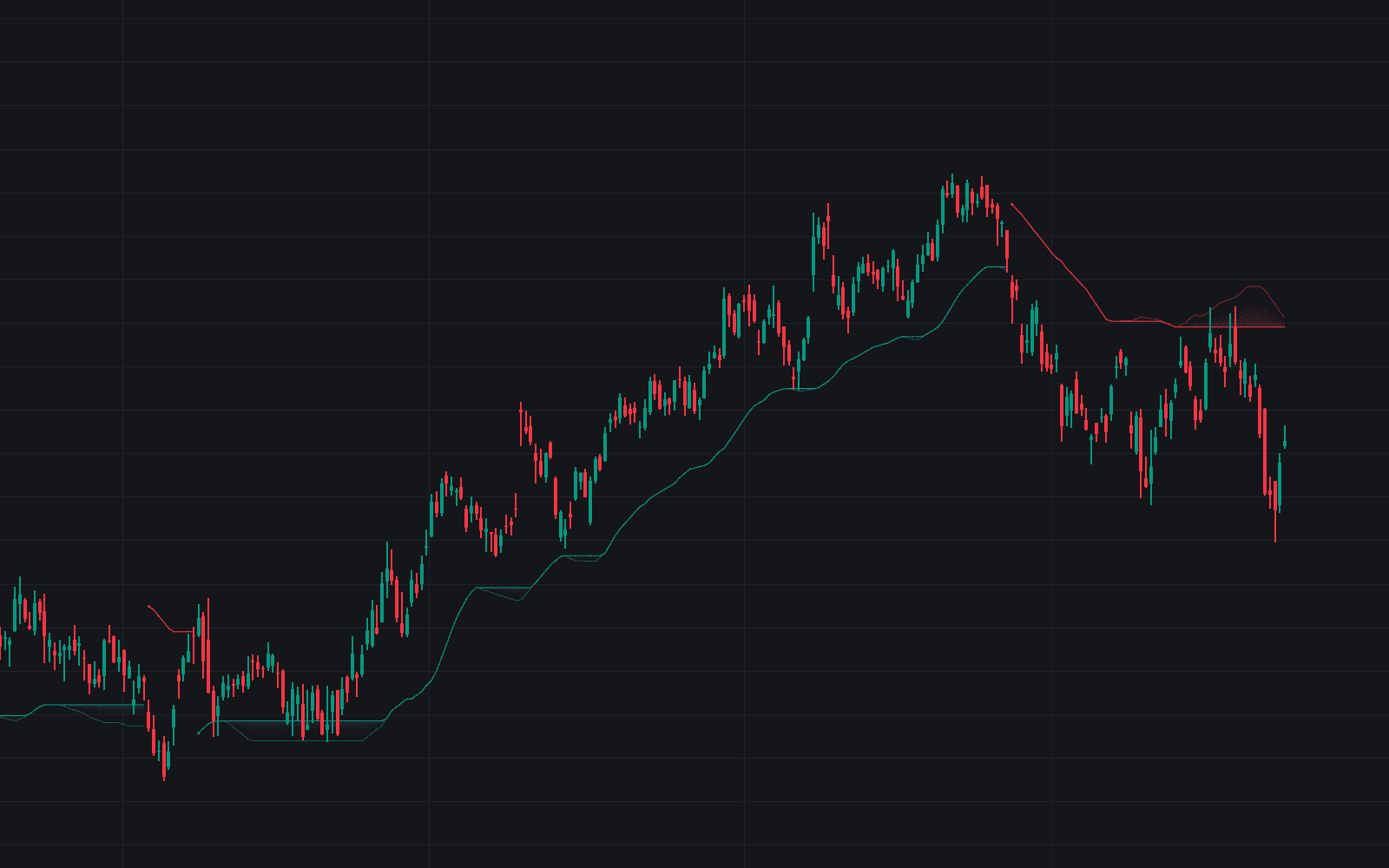
Sigmoid Transition Trailing Stop
Mar 31, 2026

The Sigmoid Transition Trailing Stop is a volatility-aware trading indicator and risk management tool designed to help traders protect profits and manage trend exits with more flexibility than a standard trailing stop. Instead of moving in a rigid linear way, this trailing stop uses a mathematical sigmoid curve to accelerate its adjustment when price becomes stretched too far away from the stop. The result is a smoother, more adaptive stop-loss and take-profit framework that can better respond to strong momentum while still respecting market structure and volatility.
How to Trade the Sigmoid Transition Trailing Stop Indicator
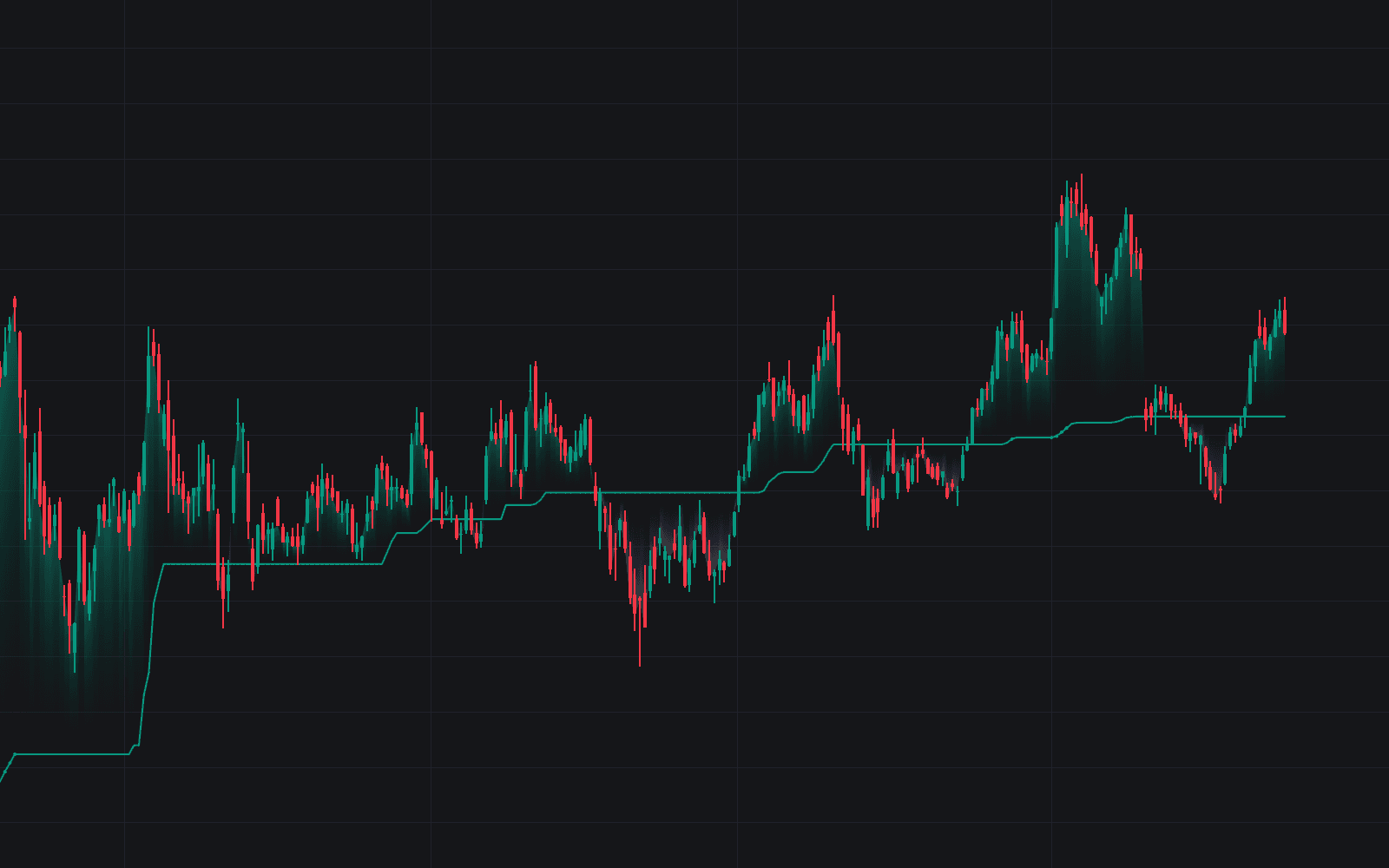
This trading indicator works as a trend-following stop level that can be used for both trade management and trend confirmation. In bullish conditions, the stop trails below price. In bearish conditions, it trails above price. When price closes through the stop, the trend flips and the script recalculates a new stop based on the current ATR distance.
What makes this trading strategy tool different from a traditional ATR trailing stop is the way it reacts when the gap between price and the stop becomes too large. Instead of passively waiting for a new extreme to form, the indicator can enter an Adjustment phase and begin pulling the stop closer using a non-linear sigmoid transition.
During this active phase:
- The trailing stop becomes more responsive when price momentum expands.
- The stop advances using an S-curve rather than a straight-line shift.
- The adjustment is designed to tighten risk without creating an abrupt or unnatural jump.
- The process ends when the transition completes or when the stop reaches the minimum safe distance from price.
This makes the tool useful for traders looking for a smarter trailing stop indicator for strong trends, breakout trades, swing trades, or momentum-based trade management.
Why the Sigmoid Transition Matters
Most trailing stop indicators either:
- trail very slowly and leave too much unrealized profit exposed, or
- tighten too aggressively and stop traders out too early.
The Sigmoid Transition Trailing Stop attempts to balance both problems. By using a sigmoid function, the stop begins adjusting gradually, speeds up through the middle of the move, and then slows again as it approaches its target. This creates a more natural progression that aligns better with how price often behaves during overextended trends.
For traders, this means:
- better profit protection during strong runs,
- smoother stop transitions,
- less dependence on harsh step-like stop movements,
- and improved visual clarity when managing open trades.
Bullish and Bearish Use Cases
In an uptrend, the trailing stop remains below price and only moves higher. If the market becomes extended, the sigmoid adjustment may activate and allow the stop to catch up faster without breaking the bullish structure.
In a downtrend, the stop sits above price and only moves lower. If price keeps trending down and the gap becomes excessive, the same non-linear logic helps the stop move down toward price more efficiently.
This makes the indicator suitable for:
- Trend-following strategies
- ATR-based stop-loss systems
- Momentum trading setups
- Trailing take-profit management
- Swing trading entries and exits
- Systematic trade management
Visual Cues Traders Should Watch
The script includes simple visual feedback that makes it easier to read the current market state and identify when the trailing stop is behaving normally versus when it is actively adjusting.
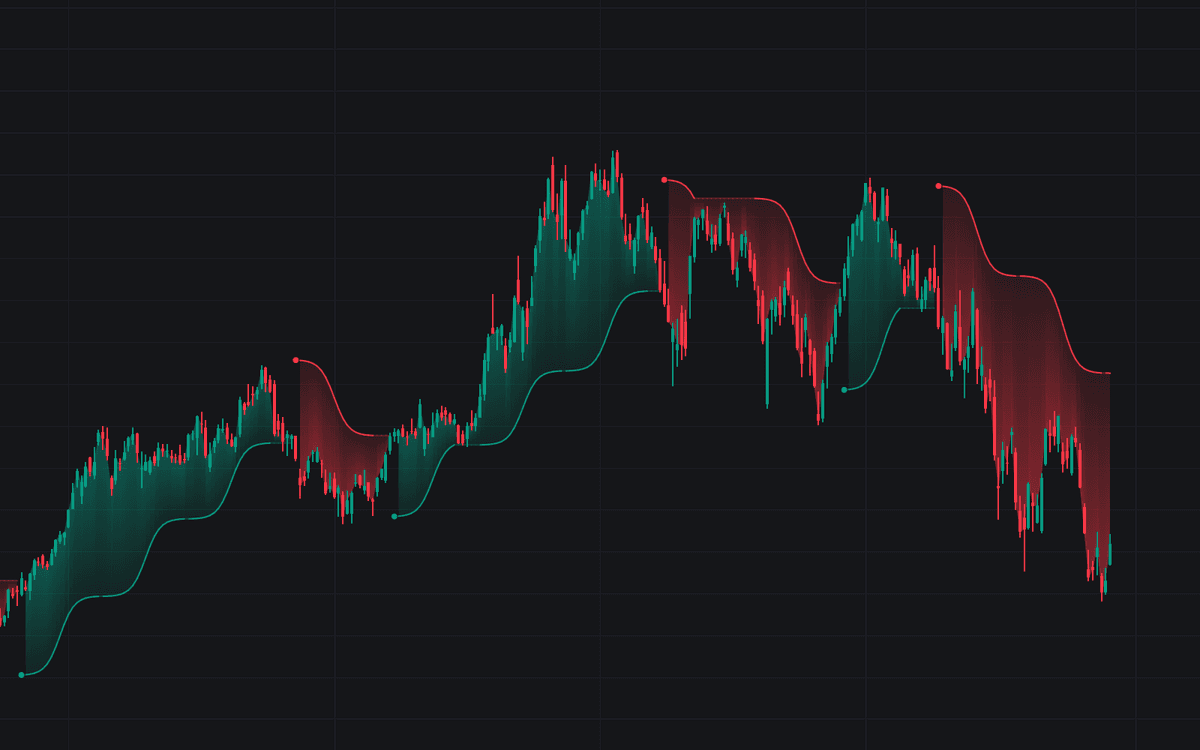
- Green Line and Fill: Bullish trend. The trailing stop is below price and acting as support.
- Red Line and Fill: Bearish trend. The trailing stop is above price and acting as resistance.
- Solid Line: A sigmoid adjustment is currently active. The stop is transitioning closer to price.
- Transparent Line: The stop is in its regular trailing mode and is not actively compressing the distance.
These cues help traders quickly understand whether the market is in a steady trailing phase or a more aggressive risk-tightening phase.
How the Sigmoid Trailing Stop Works
At the core of this trading indicator is a sigmoid function. In simple terms, a sigmoid converts a straight progression through time into an S-shaped curve that starts slow, speeds up, and then slows again.
That shape is ideal for a dynamic trailing stop because it avoids the two extremes that often hurt traders:
- a stop that lags too much behind price, and
- a stop that snaps too fast and exits a good trend.
The script monitors the distance between price and the current trailing stop. When that distance exceeds the original ATR-based threshold, the adjustment phase can begin. From there, the stop starts transitioning toward price in a controlled way.
Importantly, the script preserves the core rule of any good trailing stop: it does not move against the direction of the trend.
- In a bullish trend, the stop can only move upward.
- In a bearish trend, the stop can only move downward.
If price pulls back during the sigmoid phase, the stop does not reverse direction. It simply holds position until price behavior allows the transition to continue or until the adjustment window ends. This helps the indicator remain logically consistent as a trailing stop-loss strategy.
Why This Can Improve Trade Management
A common issue with many trading indicators is that they either react too late or behave too mechanically. The Sigmoid Transition Trailing Stop offers a more advanced alternative by combining:
- ATR-based volatility measurement
- trend-following stop logic
- non-linear adjustment behavior
- minimum distance protection
That combination can make it easier for traders to stay in strong moves while still progressively reducing risk as the move matures.
For example, in a fast breakout, a normal stop may remain too far away for too long. This tool can identify that the stop is lagging excessively and begin closing the gap more intelligently. That can help preserve more of an open profit without forcing an immediate tight stop.
Indicator Settings Explained
General Settings
- ATR Length: Sets the lookback period for the Average True Range calculation. This controls how the indicator measures volatility and helps determine the trailing stop distance.
- ATR Multiplier: Defines the initial stop distance in ATR units whenever a new bullish or bearish trend begins.
- Sigmoid Length (Bars): Controls how many bars the sigmoid transition lasts once the adjustment phase is activated.
- Sigmoid Amplitude (ATR Units): Sets the maximum amount the stop can travel toward price during an active sigmoid adjustment.
- Min Distance (ATR Units): Establishes a volatility-based safety buffer so the stop does not move too close to price and trigger an exit too easily.
How to Tune the Settings for Different Trading Styles
Traders can adapt this trailing stop indicator to different markets and strategies:
- Short-term traders may prefer shorter ATR lengths and faster sigmoid lengths for quicker stop reactions.
- Swing traders may use slightly wider ATR multipliers and larger minimum distance values to avoid noise.
- Momentum traders may benefit from a balanced sigmoid amplitude that helps lock in gains during explosive trends.
- Higher-volatility assets may require wider buffers and a larger minimum distance to prevent premature stop-outs.
As with any trading strategy, the best settings depend on the asset, timeframe, and how aggressively the trader wants to protect profits.
Best Ways to Use This Trading Indicator
This indicator is especially useful when combined with a broader trading system rather than used in isolation. Many traders may choose to pair it with:
- trend filters,
- momentum oscillators,
- market structure analysis,
- breakout confirmation,
- or volume-based tools.
The Sigmoid Transition Trailing Stop can serve as:
- a dynamic exit tool,
- a trailing stop-loss indicator,
- a stop-and-reverse trend reference,
- or a visual overlay for active trade management.
Because it combines adaptive volatility logic with a non-linear transition model, it can also work well in markets where price tends to trend strongly and then become extended before reversing.
FAQ
What is the Sigmoid Transition Trailing Stop indicator?
It is a trailing stop trading indicator that uses ATR for volatility-based stop placement and a sigmoid function to smoothly tighten the stop when price becomes too extended from its current trailing level.
How is this different from a normal trailing stop?
A traditional trailing stop usually moves in a linear or static way. This indicator adds a non-linear sigmoid adjustment that helps the stop catch up more smoothly during powerful trends.
Is this indicator good for trend-following trading strategies?
Yes. It is designed primarily as a trend-following and trade management indicator. It can help traders stay in trends while also reducing risk as the move becomes more extended.
Can I use this as both a stop-loss and take-profit tool?
Yes. Many traders can use it as a dynamic stop-loss during the life of a trade and as a trailing take-profit mechanism to protect open gains.
What does the solid line mean?
A solid line means the sigmoid adjustment is currently active and the stop is transitioning closer to price.
What does the transparent line mean?
A transparent line means the indicator is in its regular trailing state and not currently performing an active sigmoid adjustment.
How do I access Sigmoid Transition Trailing Stop?
You can get access on the LuxAlgo Library for charting platforms like TradingView, MetaTrader (MT4/MT5), and NinjaTrader for free.
Trading & investing are risky and many will lose money in connection with trading and investing activities. All content on this site is not intended to, and should not be, construed as financial advice. Decisions to buy, sell, hold or trade in securities, commodities and other investments involve risk and are best made based on the advice of qualified financial professionals. Past performance does not guarantee future results.
Hypothetical or Simulated performance results have certain limitations. Unlike an actual performance record, simulated results do not represent actual trading. Also, since the trades have not been executed, the results may have under-or-over compensated for the impact, if any, of certain market factors, including, but not limited to, lack of liquidity. Simulated trading programs in general are designed with the benefit of hindsight, and are based on historical information. No representation is being made that any account will or is likely to achieve profit or losses similar to those shown.
Testimonials appearing on this website may not be representative of other clients or customers and is not a guarantee of future performance or success.
As a provider of technical analysis tools and strategies, we do not have access to the personal trading accounts or brokerage statements of our customers. As a result, we have no reason to believe our customers perform better or worse than traders as a whole based on any content, tool, or platform feature we provide.
Charts used on this site are by TradingView in which the majority of our technical indicators are built on. TradingView® is a registered trademark of TradingView, Inc. www.TradingView.comTradingView® has no affiliation with the owner, developer, or provider of the Services described herein.
Market data is provided by CBOE, CME Group, BarChart, CoinAPI. CBOE BZX real-time US equities data is licensed from CBOE and provided through BarChart. Real-time futures data is licensed from CME Group and provided through BarChart. Select cryptocurrency data, including major coins, is provided through CoinAPI. All data is provided “as is” and should be verified independently for trading purposes.
This does not represent our full Disclaimer. Please read our full disclaimer.
© 2026 LuxAlgo Global, LLC.