Stochastic Adaptive %D
Feb 18, 2026

The Stochastic Adaptive %D Difference Oscillator is an advanced trading indicator designed to enhance classic stochastic analysis by combining deep smoothing with intelligent adaptive reactivity. Instead of relying on a static signal line, this oscillator measures the divergence between a pre-smoothed Stochastic %D and a dynamically adaptive %D baseline. The result is a cleaner, more responsive momentum tool that reduces noise while still reacting quickly to trend acceleration and market intensity shifts.
This trading strategy tool is ideal for traders who want smoother signals without sacrificing timing precision. By visualizing the momentum “spread” as a Difference Oscillator, it highlights acceleration, deceleration, and early momentum transitions in a structured, easy-to-read format.
How to Trade the Stochastic Adaptive %D Difference Oscillator?
This trading indicator is built for clarity. The Difference Oscillator acts as the primary visual guide, showing the distance between raw smoothed momentum and its adaptive signal baseline.
Rather than simply watching crossovers, traders can analyze:
- Momentum expansion (trend acceleration)
- Momentum contraction (trend weakening)
- Divergence from adaptive equilibrium
- Overbought and oversold responsiveness
Because the system balances smoothness and adaptability, it works effectively across scalping, day trading, and swing trading strategies.
Signal Generation and Interpretation
The indicator includes three core components working together:
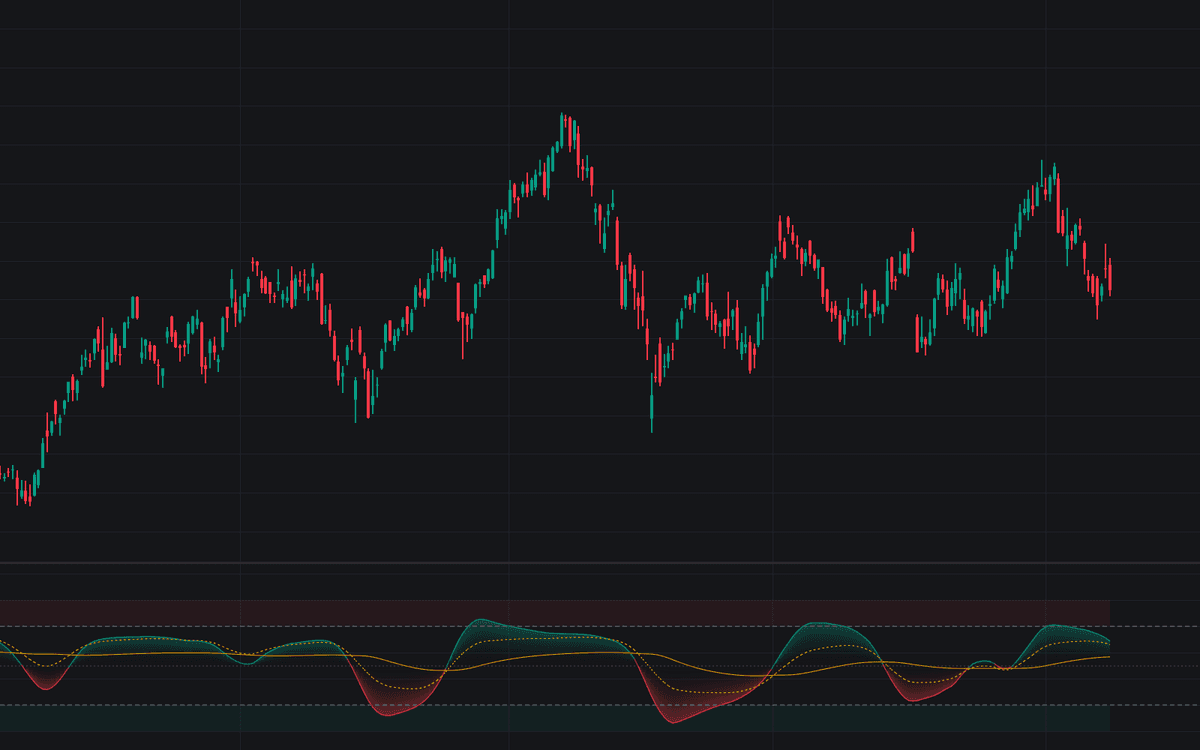
- Standard %D Line: A dual-smoothed stochastic momentum calculation plotted as a dotted line. This serves as the primary momentum engine.
- Adaptive %D Line: A dashed signal line that dynamically adjusts smoothing intensity based on market conditions.
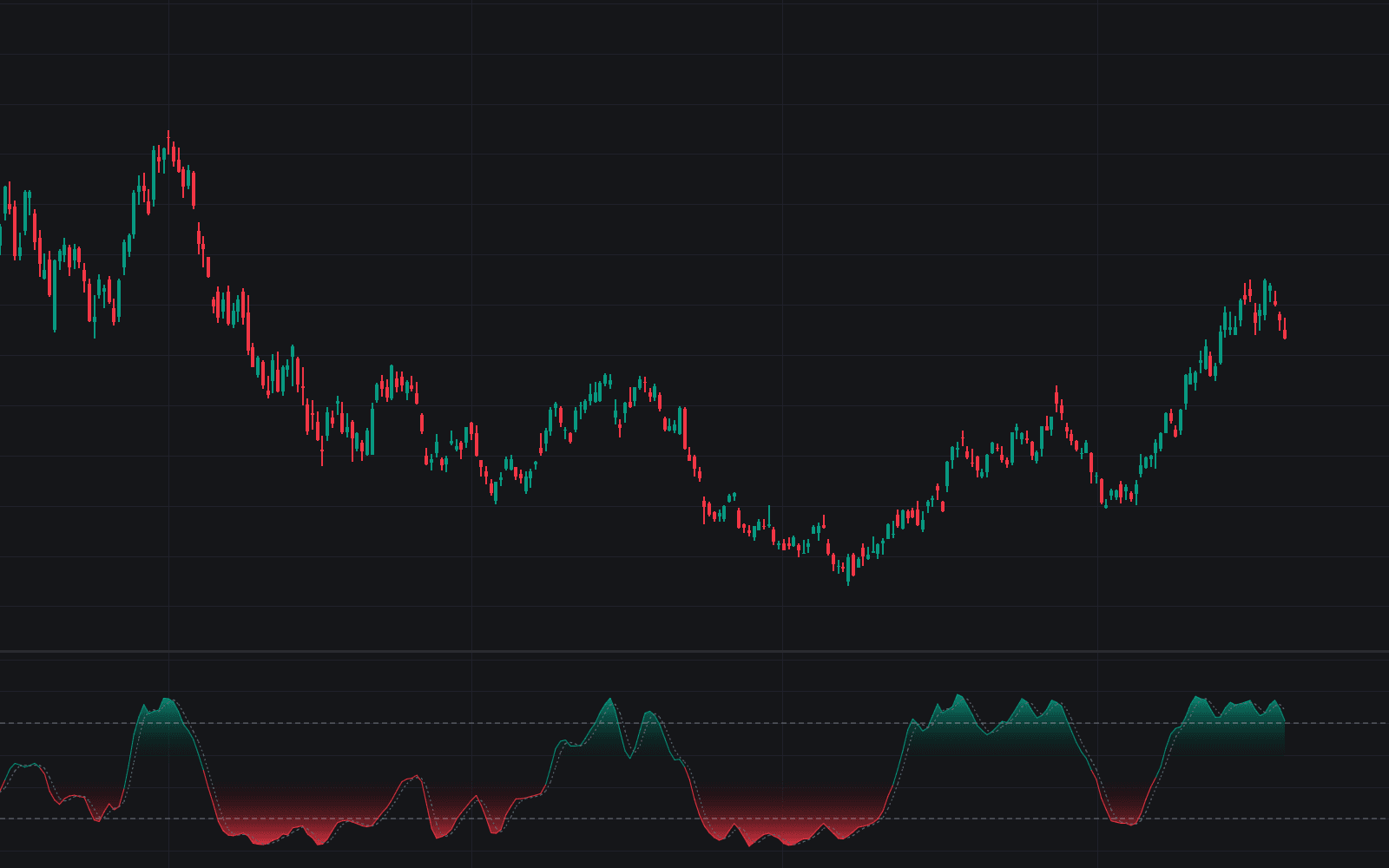
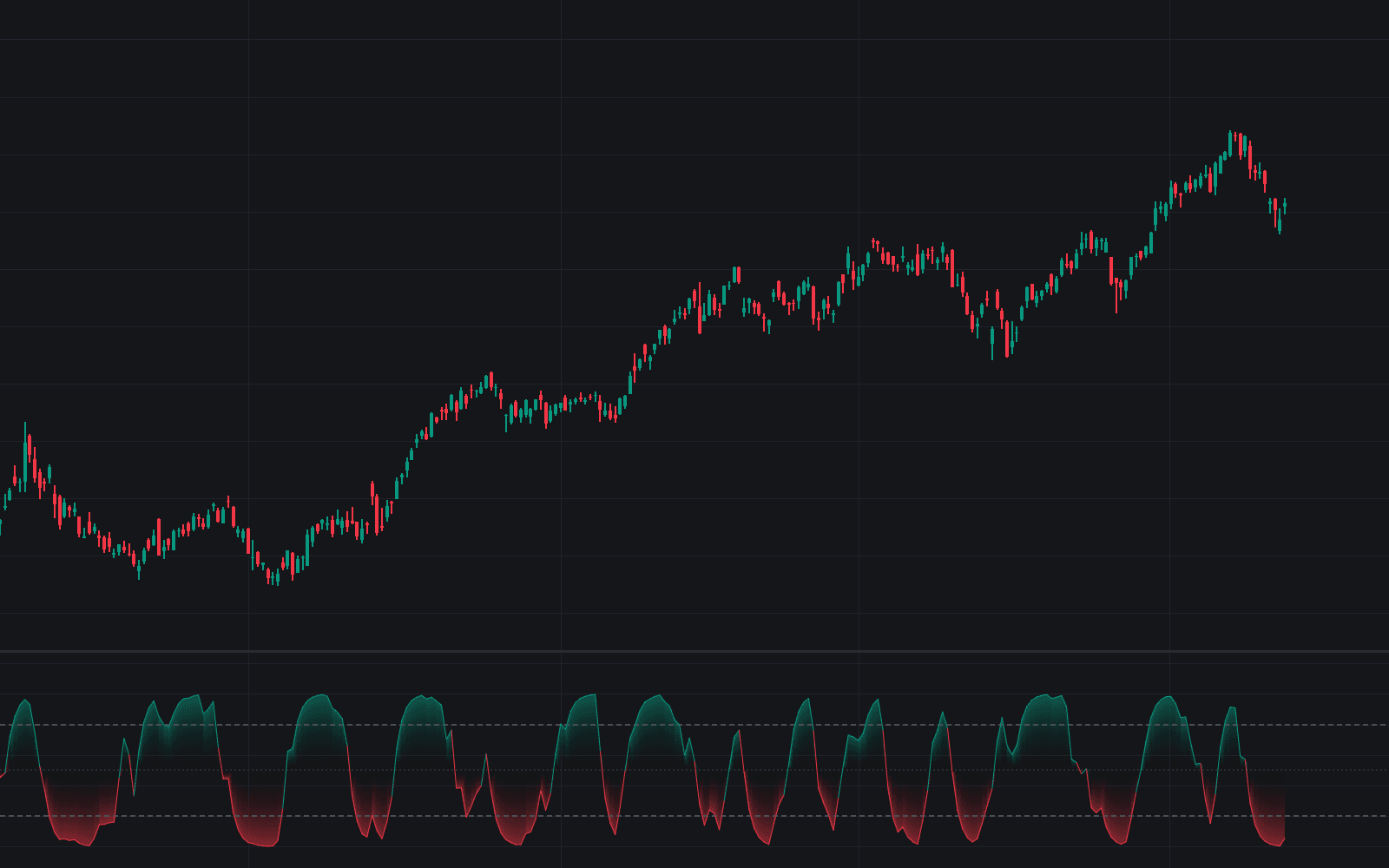
- Difference Oscillator Histogram: A 50-centered histogram fill representing the momentum delta between the two lines.
Bullish Conditions
When the Standard %D moves above and leads the Adaptive %D:
- The Difference Oscillator turns green.
- Expansion of the histogram suggests increasing bullish momentum.
- Strong expansion near overbought zones (80+) may signal a trend continuation rather than immediate reversal.
Bearish Conditions
When the Standard %D drops below and lags behind the Adaptive %D:
- The Difference Oscillator turns red.
- Histogram expansion indicates strengthening bearish pressure.
- Rapid contraction after expansion may signal exhaustion.
Unlike traditional stochastic crossovers that frequently whipsaw in ranging markets, this trading indicator adapts to market intensity, helping filter low-conviction moves.
Advanced Trading Strategy Applications
Because this oscillator measures the spread between momentum and its adaptive mean, it offers multiple strategy uses:
1. Trend Confirmation Strategy
During trending markets:
- Look for sustained histogram expansion.
- Confirm alignment with higher time frame trend.
- Use pullbacks toward the Adaptive %D line for continuation entries.
2. Mean Reversion Strategy
In ranging markets:
- Watch for histogram contraction near 80 or 20.
- Look for reversal patterns when momentum fails to expand.
- Use the adaptive line’s reduced reactivity near the 50 midline to avoid false breakouts.
3. Momentum Acceleration Detection
Sudden histogram expansion often precedes visible price acceleration. This makes the oscillator particularly useful for breakout traders seeking early confirmation.
How the Indicator Reduces Noise While Staying Reactive
Traditional stochastic oscillators suffer from either:
- Excess noise (too reactive)
- Excess lag (too smooth)
This trading indicator solves that problem through two architectural layers.
Smoothness Conservation Mechanism
Before applying the stochastic formula, the indicator:
- Applies SMA pre-smoothing to High, Low, and Close data.
- Filters structural noise at the price-source level.
- Produces smoother foundational oscillations.
By cleaning the inputs before calculation, the oscillator avoids the jagged behavior commonly seen in standard stochastic indicators.
Adaptive Reactivity Model
The Adaptive %D signal line uses variable alpha smoothing:
- Near 50 Midline (Low Conviction): Alpha decreases → signal line becomes more stable and resistant to whipsaws.
- Near 80 or 20 Extremes: Alpha increases → signal line becomes more reactive and tracks price momentum aggressively.
This dynamic behavior allows the oscillator to act conservatively during consolidation and aggressively during strong directional moves.
Indicator Settings Explained
Understanding the settings allows traders to customize the indicator to their trading style and timeframe.
Stochastic Settings
- Stochastic Length: Defines the lookback period for the raw stochastic calculation. Shorter values increase sensitivity; longer values improve smoothness.
- %K Smoothing: Controls the internal smoothing that generates the Standard %D line.
- Price Pre-Smoothing: Applies SMA filtering to price before stochastic computation, significantly improving oscillator clarity.
Adaptive Smoothing Settings
- Attenuation Factor: Controls how strongly the Adaptive %D resists rapid movement.
- Higher values = more conservative signal line
- Lower values = more aggressive and reactive signal line
This allows traders to tune the indicator for scalping, intraday trading, or swing trading strategies.
Visual Customization
- Standard %D Color: Customize the dotted momentum line.
- Adaptive %D Color: Adjust the dashed adaptive signal line.
- Bullish/Bearish Histogram Colors: Define the gradient fill of the Difference Oscillator.
Why This Trading Indicator Stands Out
The Stochastic Adaptive %D Difference Oscillator stands apart from traditional stochastic indicators by:
- Reducing noise at the source level
- Dynamically adapting to volatility
- Providing a histogram-based momentum delta visualization
- Offering earlier momentum shift detection
- Minimizing false signals during sideways markets
It is not just a stochastic crossover tool — it is a structured momentum framework that supports both trend-following and mean-reversion trading strategies.
FAQ
What makes this different from a standard stochastic oscillator?
Unlike traditional stochastic indicators that use fixed smoothing, this version incorporates pre-smoothed price inputs and an adaptive signal line. This significantly reduces noise while improving responsiveness during strong trends.
Is this indicator suitable for scalping?
Yes. By lowering the attenuation factor and stochastic length, traders can increase responsiveness for lower timeframes.
Can it be used for swing trading?
Absolutely. Increasing smoothing parameters makes it highly effective for identifying broader momentum shifts on higher timeframes.
How do I access the Stochastic Adaptive %D Difference Oscillator?
You can get access on the LuxAlgo Library for charting platforms like TradingView, MetaTrader (MT4/MT5), and NinjaTrader for free.
Trading & investing are risky and many will lose money in connection with trading and investing activities. All content on this site is not intended to, and should not be, construed as financial advice. Decisions to buy, sell, hold or trade in securities, commodities and other investments involve risk and are best made based on the advice of qualified financial professionals. Past performance does not guarantee future results.
Hypothetical or Simulated performance results have certain limitations. Unlike an actual performance record, simulated results do not represent actual trading. Also, since the trades have not been executed, the results may have under-or-over compensated for the impact, if any, of certain market factors, including, but not limited to, lack of liquidity. Simulated trading programs in general are designed with the benefit of hindsight, and are based on historical information. No representation is being made that any account will or is likely to achieve profit or losses similar to those shown.
Testimonials appearing on this website may not be representative of other clients or customers and is not a guarantee of future performance or success.
As a provider of technical analysis tools and strategies, we do not have access to the personal trading accounts or brokerage statements of our customers. As a result, we have no reason to believe our customers perform better or worse than traders as a whole based on any content, tool, or platform feature we provide.
Charts used on this site are by TradingView in which the majority of our technical indicators are built on. TradingView® is a registered trademark of TradingView, Inc. www.TradingView.comTradingView® has no affiliation with the owner, developer, or provider of the Services described herein.
Market data is provided by CBOE, CME Group, BarChart, CoinAPI. CBOE BZX real-time US equities data is licensed from CBOE and provided through BarChart. Real-time futures data is licensed from CME Group and provided through BarChart. Select cryptocurrency data, including major coins, is provided through CoinAPI. All data is provided “as is” and should be verified independently for trading purposes.
This does not represent our full Disclaimer. Please read our full disclaimer.
© 2026 LuxAlgo Global, LLC.