Supply Demand Profiles
 By LuxAlgoSep 14, 2023
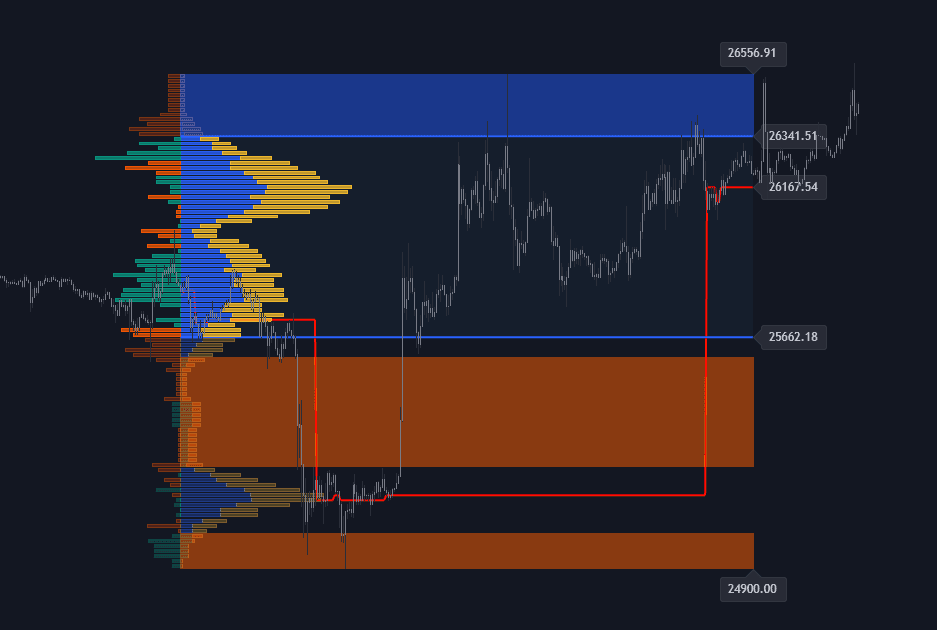
Supply Demand Profiles reads a user-selected range three ways at once. Supply & demand zones appear as horizontal areas inside the range, a volume profile on the right details traded activity at every price, and a sentiment profile on the left splits that activity into bullish and bearish share. The profile marks the point of control, the value area with its high and low, and the profile extremes. And your choice of volume source and polarity method decides how activity is classed as up or down.
How to Trade the Supply Demand Profiles?
- Zones first: the highlighted supply and demand areas show where price repeatedly interacted within the range, reference points for anticipating reactions on a revisit.
- POC and value area boundaries: the point of control and the VAH/VAL lines identify the prices that carried the bulk of trade, prime levels to watch.
- Sentiment check: the left-hand profile reveals which side dominated at each price, a gauge of conviction behind a level.
- Re-frame freely: drag the range points on the chart, or set start and end times manually, to profile any swing or session.
Supply Demand Profiles Settings
- Volume Data Source and Polarity: pick 'volume' or 'volume delta', and one of five polarity methods: bar polarity, bar buying/selling pressure, intrabar polarity, intrabar buying/selling pressure, or heikin ashi bar polarity.
- Lower Timeframe Precision: applies when an 'Intrabar (LTF)' option is selected.
- Value Area Volume %: the percentage of total volume defining the value area.
- Threshold Value %: the cutoff used to identify supply and demand zones.
- Number of Rows & Placement / Profile Width %: govern the profile's granularity, location, and width.
- Visibility and color options cover the zones, both profiles, value areas, price levels, and background fills.
Frequently Asked Questions
Free indicator
Get free access to this indicator on the platforms below.
TradingView
NinjaTrader
MetaTrader 4/5

Original indicatorBuilt in-house by LuxAlgo
The Library is free. Quant makes it yours.
Pull any concept or indicator into Quant: rebuild it, retune it, or turn it into a backtested strategy of your own.