
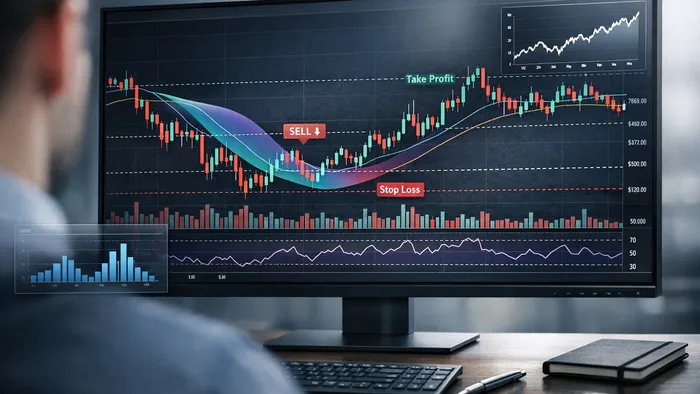

AI has changed how traders research, build, and refine strategies by helping them process large datasets, identify repeatable patterns, prototype logic faster, and evaluate ideas with more consistency. It can also reduce some of the emotional bias that often appears in discretionary decision-making. Here’s a practical overview of the workflow:
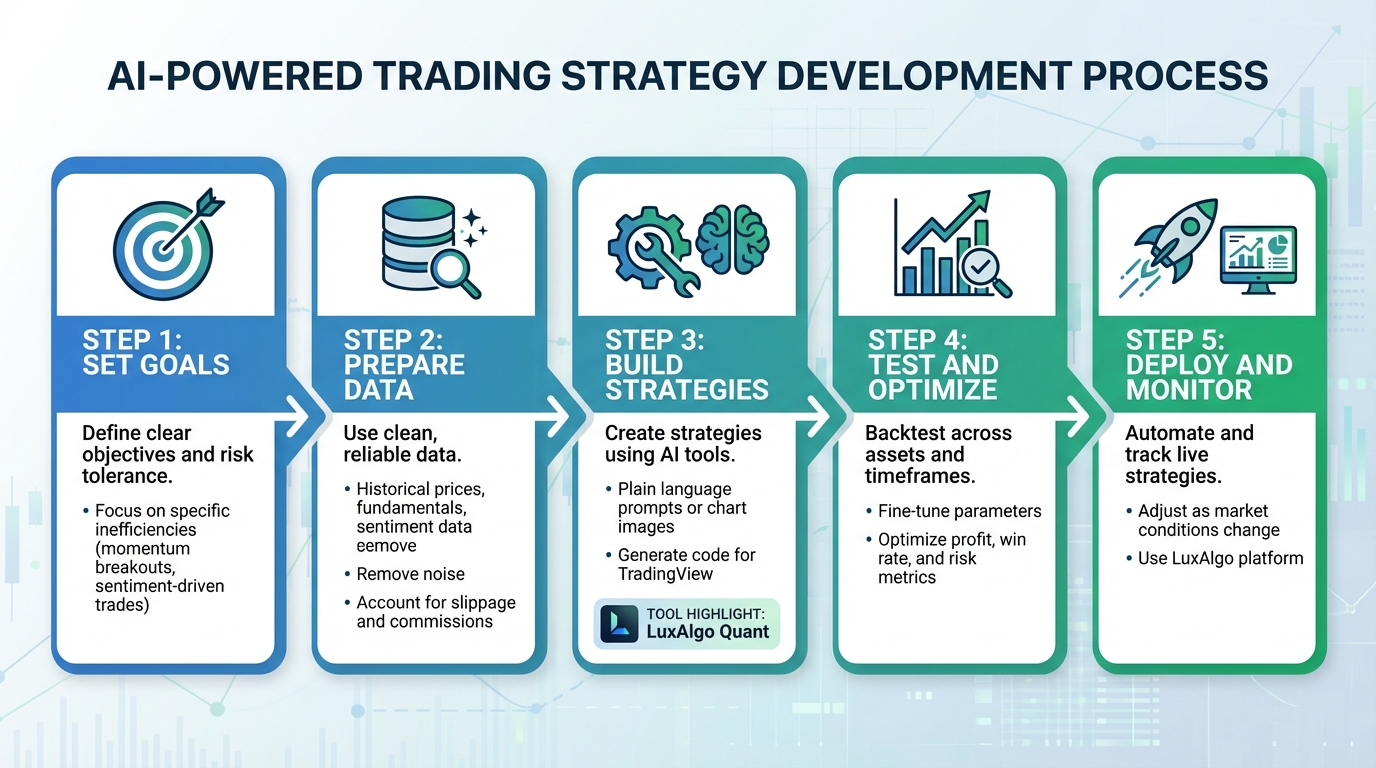
- Set Goals: Define a clear objective, market, and risk tolerance. For example, you might focus on momentum breakouts, mean reversion, trend continuation, or sentiment-driven setups.
- Prepare Data: Use reliable historical price data, volume, fundamentals when relevant, and sentiment or event data when appropriate. Clean the dataset and account for real-world costs like commissions, spreads, and slippage.
- Build Strategies: LuxAlgo Quant helps traders turn plain-English ideas or chart screenshots into Pine Script® indicators and strategies for TradingView.
- Test and Optimize: Use LuxAlgo’s AI Backtesting Assistant and disciplined validation methods to stress test ideas across assets and timeframes while reviewing metrics such as profit factor, win rate, drawdown, and trade distribution.
- Deploy and Monitor: Move promising ideas into paper trading first, then monitor live behavior, execution quality, and changing market conditions before scaling exposure.
Used correctly, AI does not replace trading judgment. It shortens the path from idea to evaluation, helps uncover blind spots in logic, and makes strategy development far more repeatable from research through deployment.
How I Use AI for Trading to Build TradingView Indicators on a Budget

Set Your Trading Goals and Prepare Your Data
To get useful results from AI-assisted trading, you need two foundations: a clear objective and clean, relevant data. Without them, even a strong model can produce attractive-looking outputs that fail in live conditions.
Define Your Trading Goals and Risk Tolerance
Instead of starting with a vague goal like “beat the market,” begin with a testable hypothesis. That could mean exploring statistical arbitrage in equities, trend continuation in index futures, or momentum breakouts after high-volume consolidations. A strong hypothesis points to a specific market behavior you believe can be measured and repeated.
Next, define your trading style and time horizon. A day trader needs fast signals, tighter execution, and stronger protection against noise. A swing trader may care more about stability, regime filters, and avoiding false signals during low-conviction conditions. Be explicit about your priority: maximizing return, protecting capital, lowering drawdown, or improving consistency.
Your risk tolerance should also be translated into rules. These usually include maximum drawdown limits, position sizing constraints, concentration caps, stop-loss logic, and conditions that pause trading after a run of poor performance. AI can accelerate development, but it should always operate inside a clearly defined risk framework.
Collect and Clean Market Data
Once the objective and risk rules are clear, the next step is preparing the data your model or strategy will rely on. That can include historical OHLCV data, volatility measures, company fundamentals, macroeconomic releases, sentiment inputs, and even order book information when your workflow requires it.
Raw market data is rarely ready to use. Missing values, duplicate records, inconsistent timestamps, bad session alignment, and noisy intraday behavior can distort results. Traders often improve signal quality by standardizing sessions, removing obvious errors, and transforming raw inputs into more useful features such as momentum, volatility, trend strength, breadth, or relative performance.
Just as important, backtests should reflect real-world friction. That means modeling spreads, commissions, fills, and slippage rather than assuming perfect execution. A strategy that looks excellent before costs can look average after them.
Your dataset should usually cover multiple market regimes instead of only one strong trend or one quiet consolidation period. AI models and rules-based strategies both need exposure to different conditions so they do not mistake a temporary pattern for a durable edge. Retraining, retesting, and revalidating the logic regularly is part of keeping the system relevant in 2026’s markets.
Use LuxAlgo Quant to Build AI-Powered Strategies
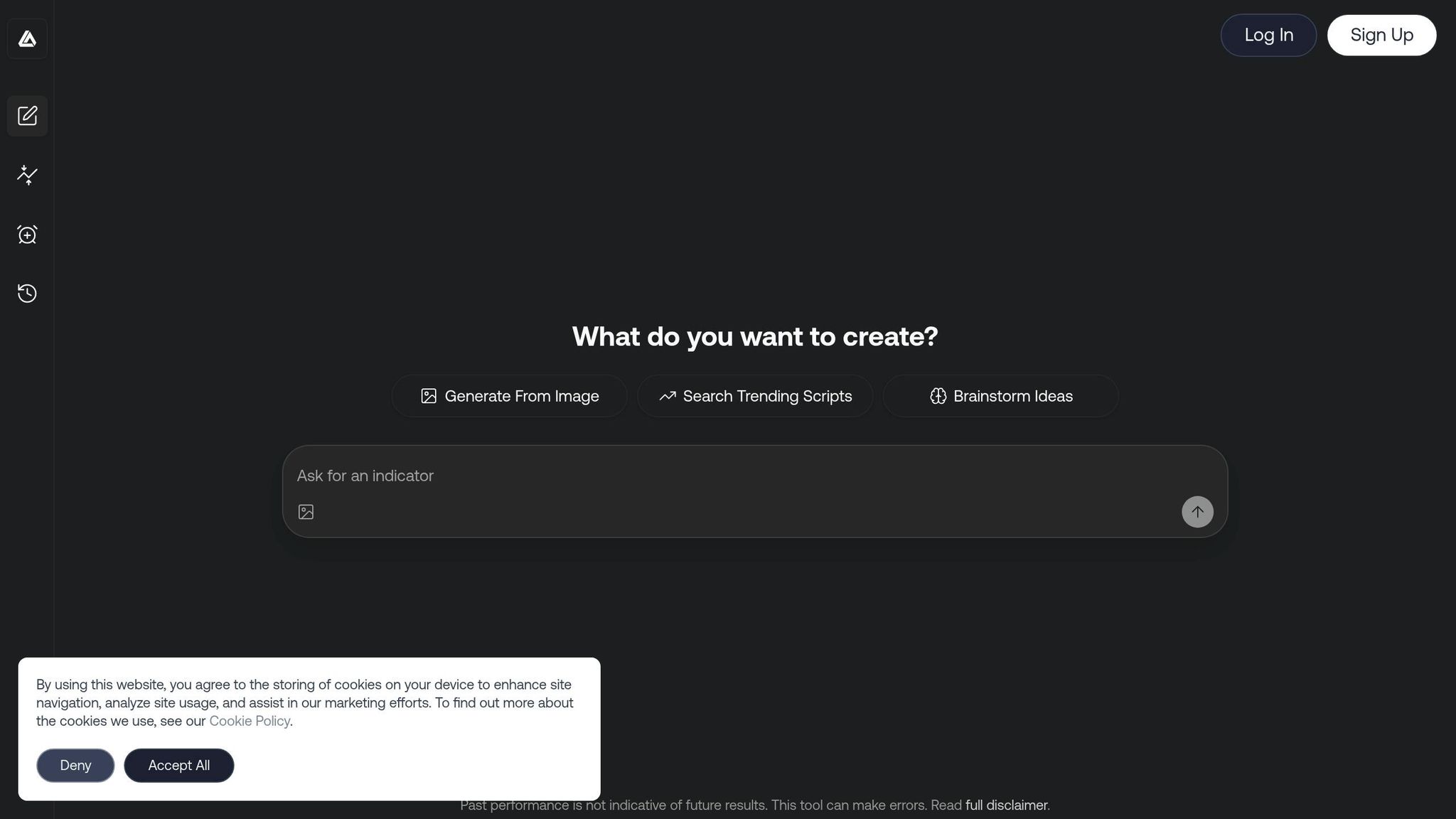
Once your data and idea are in place, one of the fastest ways to move from concept to working script is through LuxAlgo Quant. Quant is an AI coding agent specialized in Pine Script® for TradingView, which makes it especially relevant when you want to create indicators, build strategies, debug scripts, or translate a trading idea into something testable without spending hours on syntax.
Create Trading Strategies with Natural Language Prompts
Instead of manually writing every condition in Pine Script®, you can describe the logic in plain English. For example: “Build a long-only momentum strategy for AAPL that enters when the 20 EMA crosses above the 50 EMA, filters trades with rising volume, and exits on a bearish crossover or ATR-based stop.”
That workflow matters because most traders do not get stuck on the idea. They get stuck on implementation, debugging, and iterative refinement. Quant’s documentation and feature set are built around solving exactly that problem: turning natural-language prompts into structured Pine Script, validating the output, and helping traders refine the script step by step.
The interface also makes iteration easier. You can review the generated code, ask for specific modifications, simplify logic, add filters, or request a cleaner visual layout without starting from scratch. For traders who want better results, prompting well becomes part of the edge: start with a narrow request, verify the behavior, then expand the system gradually.
That is one of the main reasons Quant fits naturally into AI trading workflows. It is not a generic chatbot bolted onto trading. It is purpose-built for creating, validating, and refining TradingView indicators and strategies.
Convert Chart Images into Pine Script Code
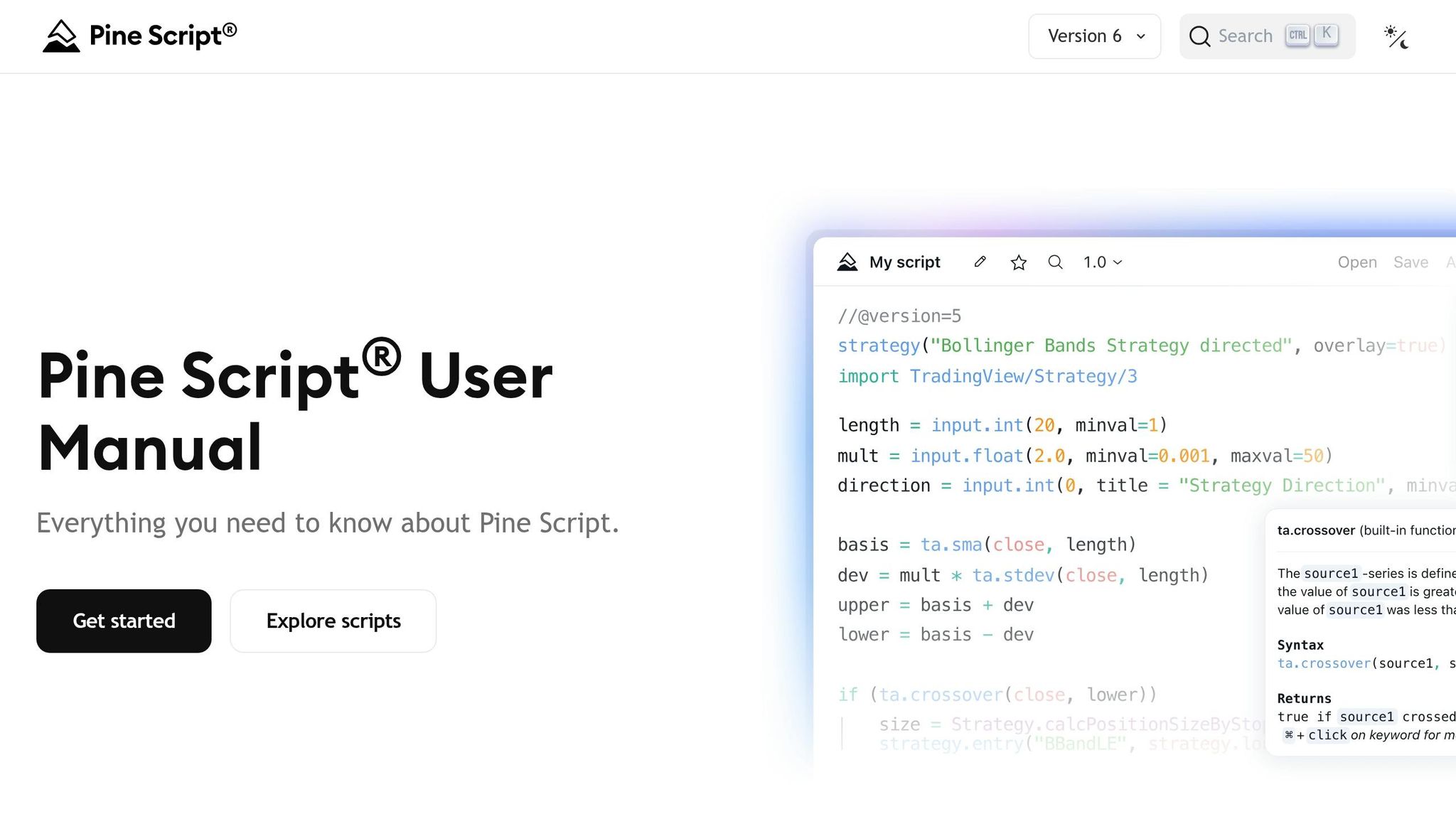
Another practical use case is converting chart screenshots into code. If you have a manually marked setup with support and resistance, breakout zones, trendlines, or pattern structure, Quant can help translate that visual concept into Pine Script logic. That is especially useful for traders who can see a repeatable edge on the chart but do not want the coding friction that normally comes with automating it.
This feature is useful for more than convenience. It can help standardize discretionary ideas so they can be tested objectively across assets and timeframes. A setup you previously recognized by eye can become a repeatable scan, alert condition, or backtestable strategy.
For traders exploring AI-assisted financial analysis, this shortens the path from observation to deployment. Instead of bouncing between screenshots, notes, and partially working scripts, you can go straight from chart concept to code review and then into validation.
That is also where Quant pairs well with the next stage of the workflow: once the logic exists, it can be stress tested and compared using LuxAlgo’s broader strategy-development ecosystem.
Build Custom Strategies with LuxAlgo Features on TradingView

After AI-assisted strategy creation, the next layer is refinement. LuxAlgo provides specialized TradingView features that help traders analyze structure, entries, exits, confirmation, and trend behavior more systematically.
Its TradingView ecosystem centers around three core toolkit families: Price Action Concepts, Signals & Overlays, and Oscillator Matrix. Each serves a different role in turning market context into something actionable.
Use Price Action Concepts for Market Structure Analysis
Price Action Concepts (PAC) focuses on structure. It helps traders identify key areas where liquidity, imbalance, market structure shifts, and pattern formation may matter most. That makes it useful for traders who want more than a simple signal and instead care about why a setup may be forming.
PAC can be especially helpful when you are building breakout, pullback, or mean-reversion strategies that depend on context. For example, a breakout signal near a well-defined structural level can mean more than the same breakout signal in a random part of the chart. Using structure as a filter often improves selectivity and reduces noise.
Add Signals & Overlays for Entry and Exit Points
The Signals & Overlays toolkit is designed for traders who want clearer entry and exit timing. It supports both trend-following and contrarian approaches, and the settings allow traders to adjust responsiveness based on how aggressive or selective they want the signals to be.
That makes it useful both for discretionary confirmation and for system building. A trader can use it to confirm a price-action thesis, or use the same logic as part of a more formal backtesting workflow. The settings around signal sensitivity, exit logic, and optimization also make it easier to adapt the feature to different markets and timeframes.
Apply the Oscillator Matrix for Trend and Divergence Detection
The Oscillator Matrix focuses on trend and divergence analysis. Divergences between price and oscillator behavior can help traders spot weakening momentum, potential reversals, or continuation setups that deserve closer inspection.
Used in isolation, divergence can still be noisy. Used alongside structure, trend bias, and volume context, it becomes more useful. This is one reason traders often combine Oscillator Matrix with other LuxAlgo features instead of treating it as a standalone signal source.
When paired with a rules-based workflow, these tools can help transform broad chart analysis into a repeatable decision process that is easier to review, improve, and eventually automate.
Test and Optimize Strategies with LuxAlgo AI Backtesting Assistant
Once a strategy idea exists, the next job is validation. LuxAlgo’s AI Backtesting Assistant is designed to help traders search through strategy logic more efficiently and compare performance across supported assets and timeframes. According to the official introduction, the assistant is built to retrieve and evaluate strategies created from LuxAlgo’s core TradingView features.
This stage matters because good-looking logic is not the same as robust logic. Backtesting should answer practical questions: How does the system behave during different regimes? Is performance concentrated in one symbol or one period? Does a small parameter change break the result? Does the edge survive after costs?
Run Backtests Across Multiple Tickers and Timeframes
The AI Backtesting Assistant helps traders search and compare strategies across multiple instruments and chart intervals. In practice, that is important because a strategy that only works on one ticker, one regime, or one narrow timeframe may not be durable.
Cross-market testing helps reveal whether the logic is resilient or merely overfit. A breakout system that performs well on one mega-cap stock may behave very differently on a forex pair, a crypto market, or a futures contract. That does not always invalidate the idea, but it does tell you how specialized the edge is.
For traders who want to move faster, the assistant also reduces the manual work of testing endless combinations one by one. That frees more time for reviewing the actual quality of the results instead of just generating them.
Review Performance Metrics
Reviewing performance metrics properly is where many traders separate a compelling idea from a usable strategy. Net profit matters, but it should never be viewed alone. Profit factor, drawdown, average trade value, win rate, trade count, and expectancy all help explain whether the system is actually tradable.
It is also worth paying attention to distribution. A strategy that depends on a handful of outsized winners may be harder to stick with than one with smoother performance, even if the headline return is lower. This is where AI-assisted analysis can help highlight trade-offs faster.
A strong workflow also includes out-of-sample testing, walk-forward validation, and stress testing rather than relying only on a single optimized backtest. Those steps reduce the chance of mistaking overfitted logic for genuine edge.
Optimize Strategy Parameters with AI
Optimization should improve a strategy, not curve-fit it. The goal is usually to identify stable parameter zones rather than one “perfect” setting that only looks impressive on historical data.
That means favoring robustness over precision. If performance collapses when a lookback changes from 19 to 20, or when a stop changes slightly, the strategy may not be stable enough for real use. AI can accelerate the search process, but traders still need to judge whether the result is practical and repeatable.
Once a promising version is identified, it makes sense to replicate the logic on TradingView, review the entries visually, and confirm the strategy still matches the original trading idea.
Deploy and Monitor Strategies with LuxAlgo Plans
After a strategy passes validation, deployment becomes the next challenge. This stage is less about building logic and more about execution discipline, alerting, monitoring, and adapting as conditions change.
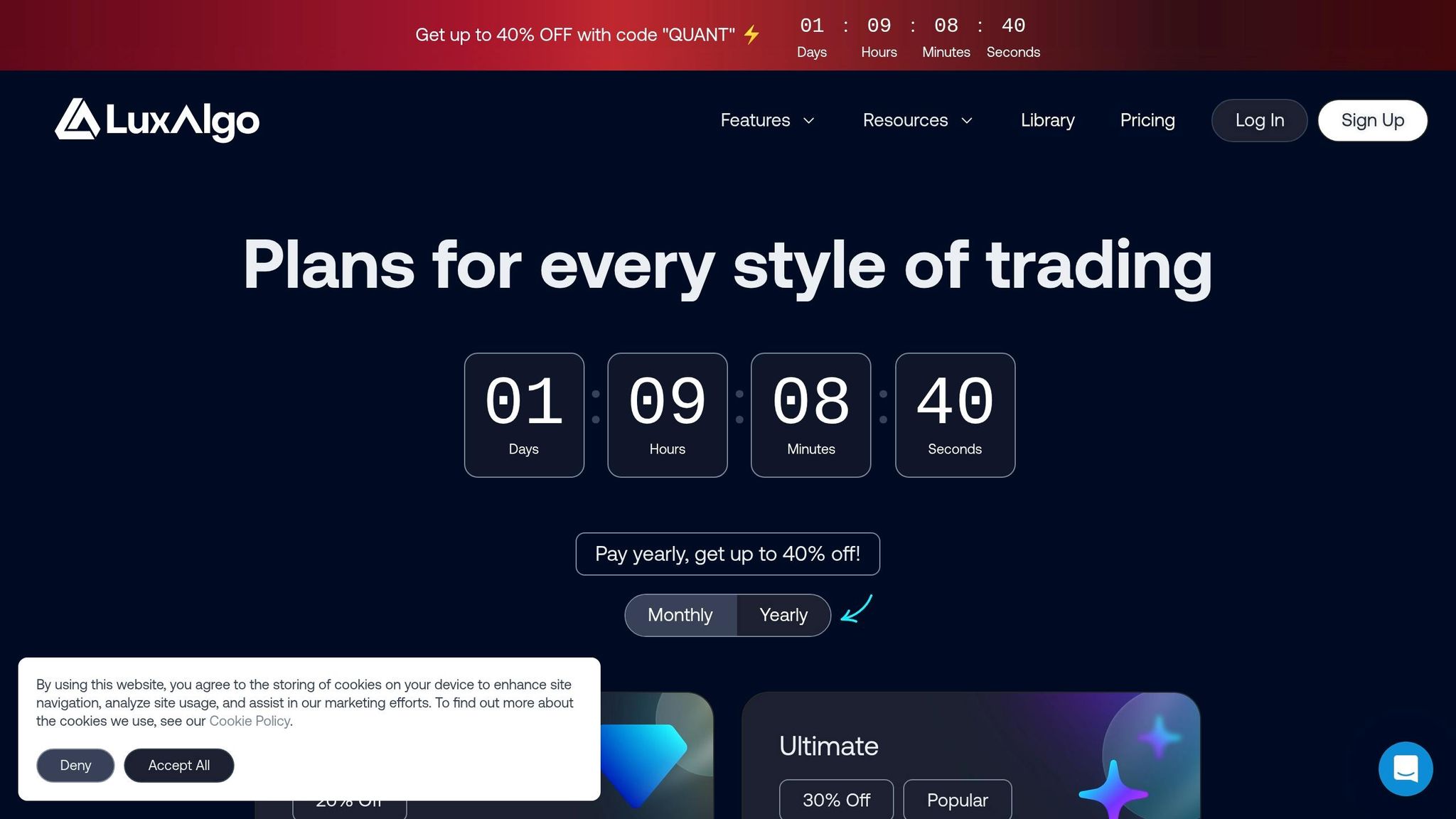
LuxAlgo’s plan structure in 2026 is straightforward: the Free Plan provides lifetime access to hundreds of tools across multiple platforms, Premium adds advanced TradingView signals and higher Quant usage limits, and Ultimate includes AI Backtesting along with higher-tier access across LuxAlgo features. If the strategy-development workflow is central to your process, the choice usually comes down to how heavily you plan to use Quant and AI Backtesting.
Deploy Strategies on TradingView for Live Trading
Going live should begin with paper trading. Before real capital is involved, traders should confirm that the alerts trigger correctly, the logic behaves the same way in real time as it did in testing, and broker or webhook automation does not introduce avoidable errors.
If your workflow relies on TradingView scripts, alerts, or connected automation, it helps to keep the live setup as simple as possible at first. That means fewer moving parts, clearer alerts, and a strong understanding of what conditions create entries, exits, and invalidations.
When a strategy is eventually connected to live execution, make sure the operational side is just as tested as the signal logic itself. A good model with poor routing, poor monitoring, or poorly configured alerts is still a weak trading system.
Track Performance with Ongoing Scans and Reviews
Live strategies need active review. Even a strong system can drift as volatility, participation, spreads, or structural market behavior changes. Weekly and monthly reviews help traders catch that drift before it becomes expensive.
The most useful review process usually combines dashboard metrics with chart-level inspection. If a strategy’s drawdown rises, average trade value falls, or win rate degrades, look deeper. Has the market shifted into a different regime? Is the logic late? Are false positives rising? Are costs becoming a larger percentage of expected edge?
Monitoring should be specific enough to trigger action. For example, you might pause a strategy after a defined drawdown threshold, after a sharp decline in expectancy, or after live results diverge materially from paper trading results.
Maintain Profitability with Risk Management
Risk management remains the foundation of any AI-driven strategy. Position sizing, stop placement, portfolio exposure limits, and maximum drawdown rules matter more than whether the system uses AI, classic indicators, or discretionary pattern recognition.
That also means keeping expectations realistic. AI can help traders reach a testable strategy faster, but it does not eliminate uncertainty, market regime change, or execution risk. A strong process usually includes paper trading first, smaller sizing at launch, and gradual scaling only after the strategy proves itself under live conditions.
For traders building their own logic, this is another place where Quant can help. When the issue is not the core idea but the implementation details, debugging Pine Script, tightening conditions, or restructuring a strategy for clearer alerts can often be done far faster with an AI coding agent that is specialized for TradingView workflows.
Conclusion
AI has made it far easier to move from trading idea to working prototype, but the real advantage comes from combining speed with discipline. The strongest workflows still begin with a clear hypothesis, use clean data, validate across multiple conditions, and respect risk from the start.
That is where LuxAlgo’s ecosystem fits naturally. Quant helps traders architect and refine Pine Script indicators and strategies, while AI Backtesting helps evaluate strategy behavior more efficiently. Together with LuxAlgo’s TradingView features, they can reduce a lot of the friction that used to slow down strategy development.
The edge, however, does not come from automation alone. It comes from using AI to test ideas faster, reject weak assumptions earlier, and spend more time on robust execution and risk control. In that sense, AI does not replace the trader. It helps the trader work with more structure, more speed, and better feedback.
FAQs
What data do I need to build an AI trading strategy?
Start with dependable market data: price, volume, volatility, and instrument-specific context such as sessions or funding behavior when relevant. Depending on the strategy, you may also use fundamentals, macro releases, sentiment, or order-flow-related inputs. The key is not collecting everything possible, but collecting the data that actually supports your hypothesis.
The dataset should also be clean and aligned properly. Bad timestamps, missing records, split-adjustment issues, and unrealistic execution assumptions can distort results before the model even begins learning from them.
How do I avoid overfitting when using AI backtests?
Avoiding overfitting starts with testing on data the model has not seen before, keeping the logic as simple as practical, and checking whether performance stays stable across different market conditions. Walk-forward testing, out-of-sample validation, and parameter stability checks are all useful here.
You should also be cautious with highly optimized settings that look excellent in one narrow slice of history. If a small change in parameters causes a large drop in performance, the strategy may be too fragile for live trading.
How often should I retrain and retest an AI strategy?
There is no universal schedule. The right timing depends on how often the market structure changes, how frequently new data arrives, and whether live performance is drifting from expectations. Shorter-term systems may need more frequent review than slower swing or position strategies.
In practice, many traders review performance weekly, retest strategies monthly or quarterly, and retrain only when the underlying behavior meaningfully changes. The main goal is to respond to evidence, not to retrain on a fixed schedule without a reason.
References
LuxAlgo Resources
- LuxAlgo
- LuxAlgo Quant
- Quant Introduction
- Quant Features
- Quant Prompting Tips
- AI Backtesting Assistant
- AI Backtesting Documentation
- Price Action Concepts
- Oscillator Matrix
- LuxAlgo Pricing