Reinforcement Learning in Market Simulations
Reinforcement learning lets researchers train decision-making agents inside a market simulation. An agent observes information, chooses an action and learns from the reward assigned to the outcome. The simulation determines what can happen, including how orders fill, prices change and participants interact.
The central question is whether an agent learns useful behavior under credible assumptions. Strong simulated results do not establish live profitability or prove that the simulated market is realistic. Separate those two goals: evaluating a trading policy and evaluating the market model in which it operates.
- Define the environment: specify observations, orders, matching rules, costs and constraints.
- Design the reward: connect learning incentives to net outcomes and risk without creating accounting shortcuts.
- Compare fairly: test learned policies against appropriate rule-based references under identical conditions.
- Validate realism: examine market statistics and responses to shocks, not only an agent’s profit.
What RL Adds to a Market Simulation
A policy maps an observation to an action. During training, the algorithm changes the policy using feedback from interactions with the environment. During evaluation, the researcher may freeze those learned parameters. The fixed policy can still respond differently to changing observations; that is different from learning continuously while trading.
Rules can also respond automatically to changing prices, volatility or inventory. For example, a market maker can widen quotes when volatility rises and reduce buying when inventory is high. RL replaces some manually specified decision logic with a learned policy. It does not make every rule-based system static or inferior.
| Question | Rule-based approach | RL approach |
|---|---|---|
| How are decisions defined? | Explicit formulas, thresholds or optimization rules | A policy learned under a specified objective and environment |
| Can behavior change with conditions? | Yes, if conditions enter the rules | Yes, if the observation and policy support that response |
| Does it require live retraining? | No; parameters may be fixed or recalibrated | No; evaluation can use a fixed trained policy |
| What establishes better performance? | Fair tests after costs and risk constraints | The same tests, plus checks for training instability and overfitting |
Build the Observation, Action and Reward
Observation: what the agent can actually know
The full simulator state may contain information no individual trader can observe. Give the agent only its permitted observation: for example, recent quotes, visible order-book depth, recent trades, inventory, cash and outstanding orders. Do not expose future prices or other agents’ hidden intentions simply because the simulator stores them.
Choose an information frequency appropriate to the task. Candle data can support a bar-based strategy experiment, but it does not show the full order queue or every cancellation. A market-making study needs explicit assumptions about order arrivals, depth, priority and delays. More detailed inputs only help if their timestamps and meaning are reliable.
Normalize features using training-period information, handle missing data explicitly and document the observation window. Include inventory and outstanding orders so the agent can respond to existing exposure. When observations omit relevant history, consider whether a history window or recurrent policy is needed instead of assuming the visible snapshot is a complete state.
Action: what orders are allowed
A market-making agent might choose bid and ask offsets, order quantities, cancellations or a pause in quoting. A directional agent might choose buy, sell or hold. An execution agent may choose how to distribute a required order over time. These are different tasks and should not share an unspecified action space.
Enforce tick size, lot size, position and cash limits in the environment. Record order submission, acknowledgment, partial fills and cancellation timing. A requested cancellation may not prevent a fill that occurs before it reaches the simulated exchange. Invalid actions need a defined treatment rather than silently creating impossible positions.
Discrete algorithms choose from a finite menu; continuous methods output numerical actions that still need to satisfy trading constraints. The Stable Baselines3 algorithm reference distinguishes support for these action spaces. Its DQN implementation uses discrete actions, while Proximal Policy Optimization supports both discrete and continuous spaces. Choose according to the modeled decision.
Reward: what the agent is encouraged to do
A useful starting point is the change in marked portfolio value after modeled costs. Include cash and inventory consistently, and specify the valuation price. Additional penalties can discourage excessive inventory, drawdown or turnover, but a penalty is not a hard exposure limit. Enforce required limits separately.
Avoid rewards that count a quoted spread as profit before either order fills. Do not count realized gains and changes in total marked wealth twice. At the episode boundary, value or liquidate remaining inventory under a stated rule; otherwise, the agent may exploit an artificial end-of-test convention.
Dense rewards give frequent feedback, while sparse rewards concentrate it at selected events or the end of an episode. Reward shaping can help learning, but it can also change the behavior being optimized. Inspect both the training reward and the economic outcome you actually care about.
Market Making: Spread Capture and Inventory Risk
Suppose a hypothetical market maker posts a bid at $99.99 and an ask at $100.01, each for 100 shares. If both orders fill completely at those prices, the gross spread capture is $2. At an illustrative fee of $0.003 per share on each side, total fees are $0.60 and the remaining amount is $1.40 before other costs.
Now suppose only the bid fills and the valuation mid-price falls to $99.95. The 100-share position has a $4 mark-to-market loss relative to its $99.99 purchase price, plus the $0.30 purchase fee. The net marked result is −$4.30. The unfilled ask is not a profit. This is why inventory and adverse price moves matter alongside the displayed spread.
A policy may respond by changing quote distances or sizes, reducing exposure or temporarily withholding a side. Wider quotes may improve the price per fill while reducing execution probability. Aggressively reducing inventory can cross the spread and incur costs. Evaluate these tradeoffs under the same fill model for all competing policies.
In Selser, Kreiner and Maurette’s 2021 study, deep Q-learning recovers an optimal market-making agent within the authors’ modeled utility problem and benchmark comparison. This is a scoped research result. It does not demonstrate that RL universally outperforms analytical models, other market makers or live markets after all implementation costs.
Single-Agent and Multi-Agent Experiments
A single-learning-agent experiment trains one policy against a specified environment, which may still contain many simulated participants. A multi-agent experiment models several decision makers, potentially with different goals and learning processes. Not every participant in a multi-agent simulation needs to learn.
| Design choice | One learning agent | Several learning agents |
|---|---|---|
| Other participants | Fixed, scripted, replayed or otherwise modeled | May also change policies through learning |
| Evaluation difficulty | Must validate the environment and policy | Must also account for changing opponents and joint learning behavior |
| Compute requirements | Can be small or very demanding | Often adds training and coordination cost; scale depends on design |
| Realism | Depends on market assumptions and calibration | More agents do not automatically create a realistic market |
| Failure handling | Must be designed explicitly | Must also be designed; multiple agents do not guarantee fault tolerance |
When other agents learn, the environment encountered by one agent can change during training. Keep track of opponent versions and the training schedule. A policy that succeeds only against the exact opponents used in development may fail against a different participant mix.
Historical replay fixes much of the observed order flow or price path. It can help reproduce an episode, but it may not model how the market would have reacted to a large new order. An interactive agent-based market can generate different paths, yet its results depend on the matching engine, participant behavior and calibration. Neither design is automatically realistic.
What a Flash-Sale Simulation Can Show
The March 2024 study by Yao, Li, Thomas and Florescu builds a continuous-double-auction simulation with learning market makers and liquidity takers. Market-maker observations include recent mid-prices, visible book levels, inventory and buying power. The authors compare simulated statistical behavior with rule-based agents and historical Google, Apple and Amazon order-book data from June 21, 2012.
They examine return distributions, dependence patterns and reactions to imposed flash-sale events, and report that continual-learning agents produce more realistic behavior within their experiments. This supports investigating how modeled participants respond to shocks. It does not identify the cause of every historical flash crash, predict the next one or establish live trading returns.
Use such studies as a template for questions to test. Check the distribution of returns, volatility clustering, spreads, depth and the recovery after a large order. Matching one historical statistic is insufficient: different mechanisms can generate similar patterns. Test additional periods and stress scenarios that were not used to tune the simulator.
Specify shock size, duration, order type and the background participant mix. Compare the same shock across policies and seeds. Report both the agent’s outcome and market-level effects, such as temporary liquidity loss. A visually plausible price drop alone does not validate the model.
A Practical Research and Evaluation Sequence
- Start with one narrow task. Define the instrument, decision interval, action set, costs and risk limits. Build a simple reference policy first.
- Check accounting and execution. Hand-calculate no-trade, one-fill, two-fill, partial-fill and terminal-inventory cases. Confirm that cash and holdings reconcile.
- Separate development from evaluation. Use earlier data or scenarios for training, a validation set for selecting settings, and a final untouched evaluation set.
- Repeat runs. Compare the distribution across training seeds and market scenarios rather than selecting the best run. Record software and environment versions.
- Stress the assumptions. Change fees, latency, fill probability, volatility, participant mix and liquidity. Investigate whether small changes reverse the result.
- Review operational behavior separately. Paper operation can reveal feed and execution failures, but it is not proof that simulated returns will transfer to live trading.
The SB3 evaluation guidance recommends separate test environments and repeated runs. For market research, also preserve chronological information boundaries and distinguish random seeds from independent market history. Replaying one day many times does not create many independent trading regimes.
Report net profit, drawdown, inventory distribution, fill rates and turnover alongside the training objective. For an execution task, include completion and the chosen execution-cost benchmark. For market realism, report market-level statistics separately. A large cumulative-return percentage from an unrelated experiment is not a comparable benchmark without its period, leverage, costs and selection process.
Tools for Building the Experiment
Gymnasium provides a maintained environment interface for RL. OpenSpiel is a collection of environments and algorithms for learning and planning in games, including single-player, multi-player and imperfect-information settings. It also provides tools for studying learning dynamics. These are research building blocks; installing them does not create a calibrated exchange or a production trading system.
Financial RL examples such as FinRL’s portfolio-allocation tutorial can help explain the workflow, but inspect each example’s assumptions. That tutorial explicitly simplifies away transaction costs. Portfolio weights, bar-based directional trades and order-book market making require different environments and validation.
Do not infer deployment or profitability from an institution’s homepage or from general AI investment. A specific production claim needs evidence of the task, system and measured result. The existence of game-learning research does not establish that the same organization operates a live RL trading desk.
Use LuxAlgo for the Chart-Based Research Layer
Use LuxAlgo’s native charts and data documentation to inspect market context and understand the available feed. A price chart can help formulate a hypothesis, but candles do not expose a complete event-level order book. Do not treat a volume study or footprint visualization as raw order-message data for a queue simulation.
Ask Quant, our coding agent to develop an explicit chart-based rule, then inspect the code and run it yourself. Use native strategy testing to check supported rules with realistic costs and a separate evaluation period. This workflow can test a related chart hypothesis; it does not train a multi-agent order-book simulation.
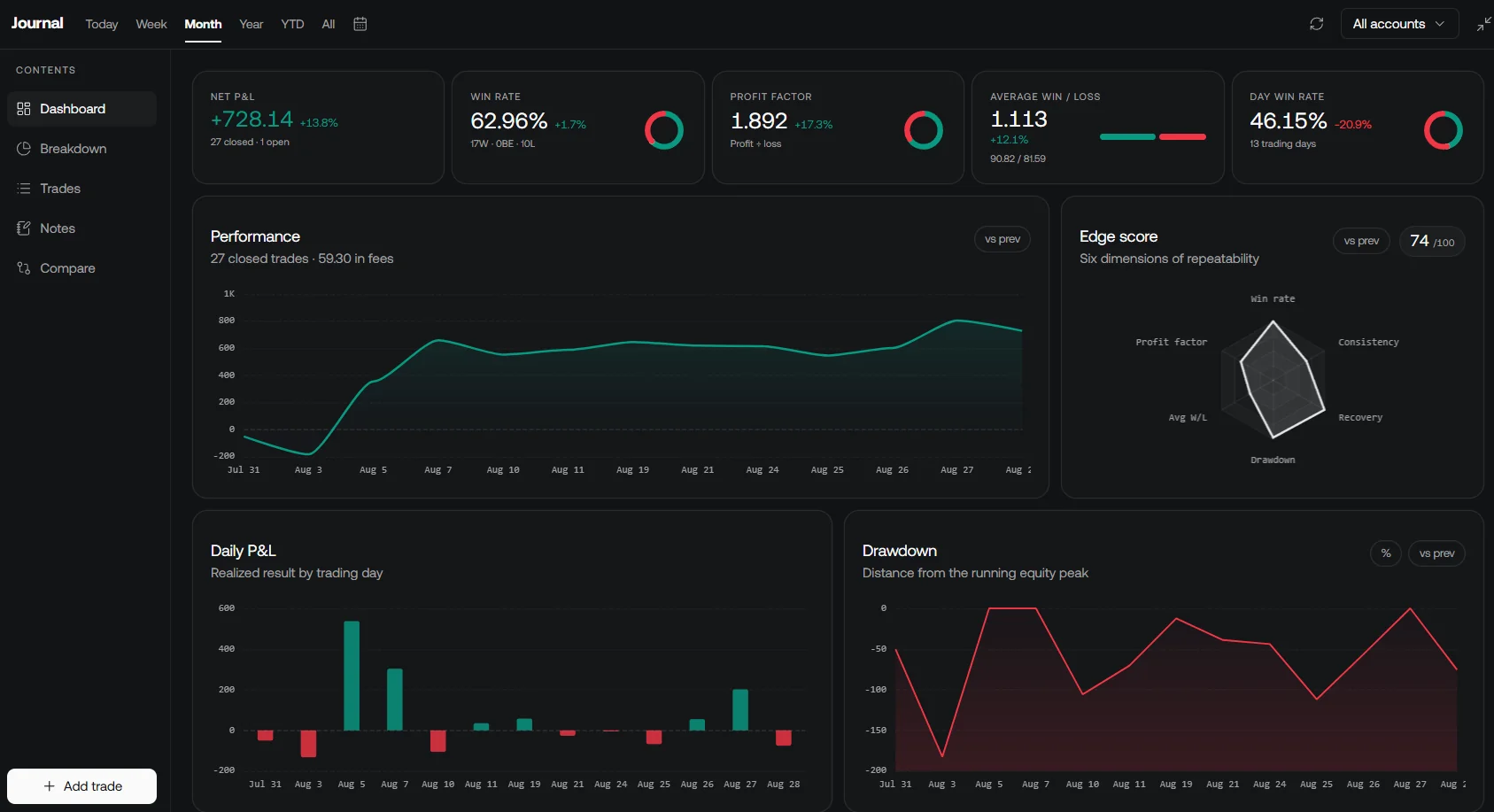
The native LuxAlgo journal supports review of compatible trade records. Keep detailed simulated orders, queue events, inventory and rewards in the experiment’s own logs. A trade journal does not replace the event-level evidence needed to validate a matching engine.
Quant can backtest a coded rule against years of history, but no chart tool is automatic validation of an arbitrary RL agent. Explore the Library for chart-study ideas and current plans for relevant access.
Video: Implementing RL in Trading Strategies
This Quantra recording, published January 23, 2024, introduces RL trading concepts, input features and reward design. Treat it as historical educational context. Its examples and course promotions do not establish the results of your own model, and its software setup may differ from current libraries.
Frequently Asked Questions
Does reinforcement learning require continuous live learning?
No. Training changes policy parameters, while a fixed trained policy can still respond to changing observations. Online learning is an additional design choice that requires separate controls and evaluation.
Does a multi-agent simulation automatically resemble a real market?
No. Realism depends on participants, information, matching rules, costs and calibration. Compare market statistics and shock responses with suitable evidence rather than relying on the number of agents.
Why is spread capture not enough to evaluate a market maker?
Both sides may not fill, inventory can lose value, and fees or adverse price moves can exceed the quoted spread. Evaluate marked wealth, execution and risk together.
Can a flash-sale experiment predict the next flash crash?
No. It explores responses under a specified model and scenario. Similar-looking price behavior does not establish a unique cause or reliable forecast for a real event.
Can LuxAlgo train a multi-agent market simulator?
The documented native workflow supports chart research, coding and testing explicit chart-based rules with Quant. Keep RL training, order-book simulation and event-level validation in a dedicated research environment.
Read next