MAE/MFE-informed Management
 By LuxAlgoAug 9, 2026
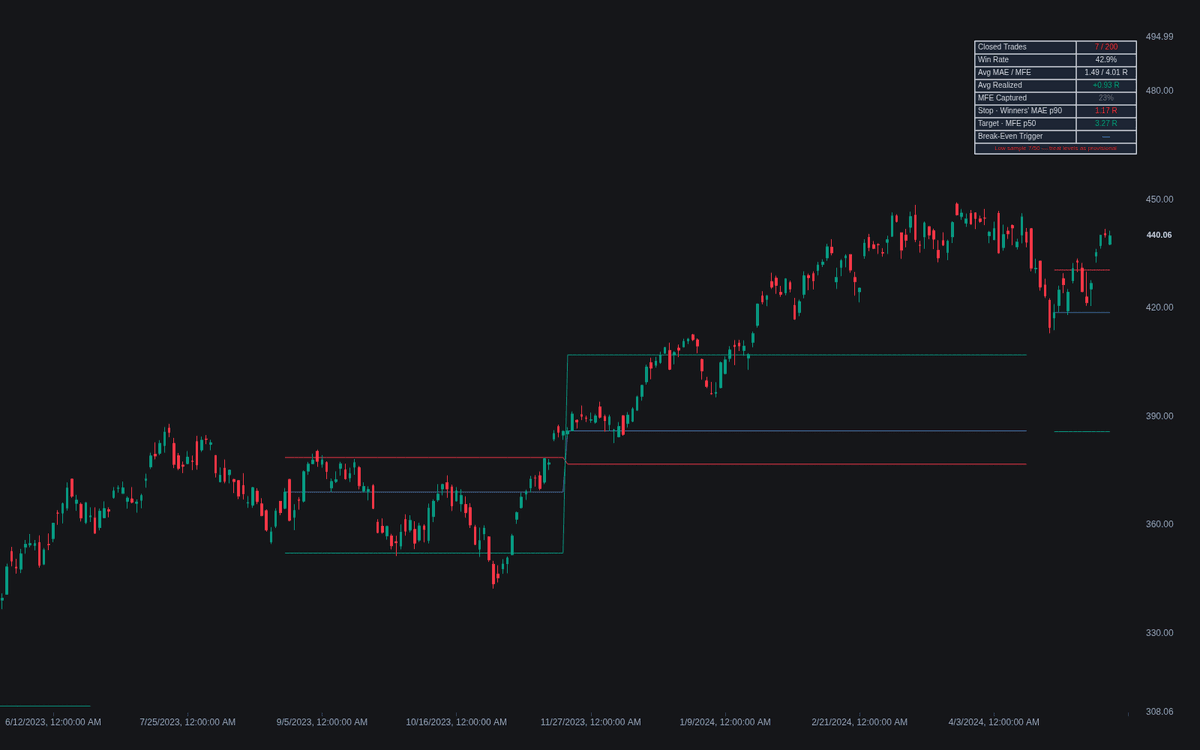
MAE/MFE-informed Management turns excursion history into on-chart trade management. An entry model simulates trades, closed-trade excursions join a rolling sample, and from it come the three levels of MAE/MFE-informed management: a stop just past the region that held most winners, a target where trades typically run, and a break-even trigger at the level from which trades rarely returned to entry. All three project in price while a trade is open; at the trigger the stop moves to entry.
How to Trade the MAE/MFE-informed Management?
- Data-Informed Stop: the winners' MAE percentile plus buffer - beyond it, few past winners recovered; touches alert while the simulation runs to its own exits.
- Data-Informed Target: the chosen MFE percentile - how far trades typically reach.
- Break-Even Trigger: the lowest MFE level (0.1-unit grid, 10+ qualifying trades) from which no more than the tolerated share closed at or below entry.
MAE/MFE-informed Management Settings
- Entry Model (default Moving Average Cross; also Donchian Breakout, External Source) with Fast MA Length (default 20), Slow MA Length (default 50), Breakout Length (default 20) and External Signal (default close).
- Trade Direction (default Long & Short), Exit on Opposite Signal (on), Max Holding Bars (default 100), Disaster Stop (Units) (default 3).
- Excursion Units (default R (Initial Risk); also ATR at Entry) with ATR Length (default 14) and Initial Risk 1R (ATR x) (default 1.5).
- Sample Window (Trades) (default 200) and Minimum Reliable Sample (default 50).
- Stop = Winners' MAE Percentile (default 90), Stop Buffer (Units) (default 0.1), Target = MFE Percentile (default 50), Break-Even Give-Back Tolerance % (default 25).
- Excursion Dashboard (on, Top Right, Small) plus Managed Levels, Break-Even Trigger Line, Risk / Reward Gradient (on) and Trade Markers & Excursion Labels (off).
Frequently Asked Questions
What does MAE/MFE Distributions offer that this build doesn't?
MAE/MFE Distributions draws the histograms and scatter these levels are read from - the place to confirm winners and losers actually separate.
Why doesn't the simulation exit at the suggested stop?
Deliberately - exiting there would truncate future excursion statistics at the level under test. Only the disaster stop, opposite signals and the time exit end simulated trades.
How many trades before the levels mean anything?
Everything reads provisional below the Minimum Reliable Sample, 50 by default. Excursion statistics are sample- and regime-dependent - re-check periodically, not as fixed truths.

The Library is free. Quant makes it yours.
Pull any concept or indicator into Quant: rebuild it, retune it, or turn it into a backtested strategy of your own.