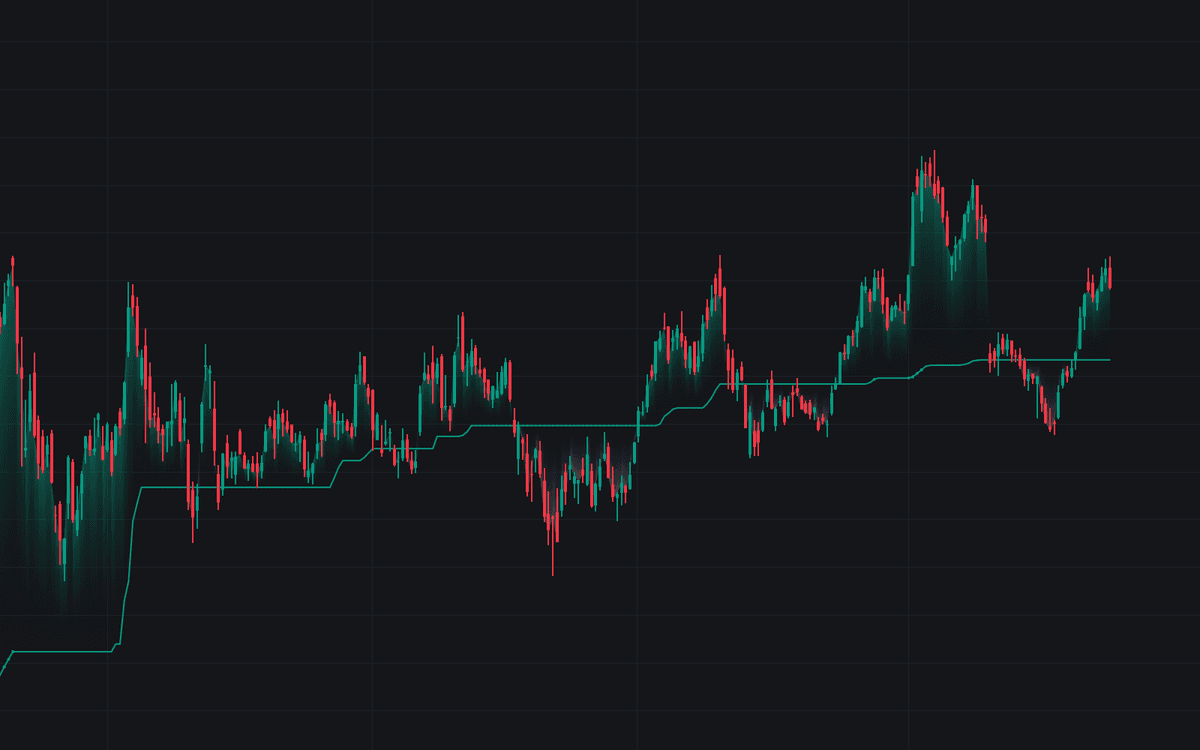
Neighboring Trailing Stop
Feb 18, 2026

The Neighboring Trailing Stop indicator is a data-driven trading indicator that builds a dynamic trailing stop-loss using local price distribution instead of traditional volatility formulas. By applying a k-nearest neighbors approach to historical price clusters, it identifies statistically relevant support and resistance zones near the current market level. The result is an adaptive trading strategy tool that reacts to real price structure rather than relying solely on ATR or moving averages.
This makes it especially powerful for traders looking to combine quantitative price analysis with practical trade management, whether in trend-following systems or reversal-based trading strategies.
How to Trade with the Neighboring Trailing Stop Indicator
This trading indicator is designed to help you:
- Identify current market direction
- Detect potential trend reversals
- Manage open positions with an adaptive trailing stop
- Protect profits using data-driven structural levels
Instead of calculating stops from volatility alone, the indicator analyzes where price has historically “clustered” near the current level. These clusters form natural support and resistance zones that serve as intelligent trailing boundaries.
Trend Interpretation
The trailing stop dynamically switches between bullish and bearish modes:
-
Bullish Trend (Green Stop Below Price):
When the stop-loss line appears below price and is colored green, the market is considered bullish.
The stop will only move upward as price establishes new higher distribution clusters. This “ratcheting” effect locks in profits during strong uptrends. -
Bearish Trend (Red Stop Above Price):
When the stop-loss line appears above price and is colored red, the market is in a bearish state.
The stop will only move downward, tracking lower price clusters and protecting short positions.
This directional constraint ensures the trailing stop never moves against your open trade, making it ideal for systematic trade management.
Buy & Sell Signals
The script plots:
- “B” (Buy) labels when a bullish reversal is detected
- “S” (Sell) labels when a bearish reversal is triggered
These signals occur when price breaks through its current neighboring distribution boundary, suggesting a structural shift in local market conditions.
This makes the indicator useful not only as a trailing stop tool, but also as a standalone trading strategy component for detecting momentum shifts.
Indicator Methodology: A Statistical Approach to Trailing Stops
Unlike traditional trading indicators that rely on fixed multipliers or lagging averages, the Neighboring Trailing Stop is built on non-parametric statistics and price distribution analysis.
Price Distribution & K-Nearest Neighbors Logic
At its core, the indicator maintains a Historical Buffer of recent prices stored in a sorted structure.
For every new bar:
- The current price is positioned within this sorted historical distribution.
- The algorithm selects k neighbors above and k neighbors below the current price.
- These neighboring prices form a local statistical “zone” that represents where price has recently found acceptance.
This k-nearest neighbors framework allows the trailing stop to adapt to real market structure rather than arbitrary volatility measures.
Percentile-Based Stop Levels
Within the selected neighborhood, the indicator calculates a specific percentile.
This achieves two important goals:
- Filters out extreme outliers
- Focuses on where the majority of trading activity has occurred
For example:
- A higher percentile (e.g., 90%) will place the stop further from price, allowing more breathing room.
- A lower percentile tightens the stop closer to price, making it more reactive.
If price moves beyond the range of its historical neighbors (a “distribution discovery” phase), a trend reversal is triggered. This mechanism helps identify structural breaks early.
Ratcheted Trailing Logic
To prevent erratic behavior:
- The raw distribution levels are smoothed using an SMA.
- The stop is ratcheted, meaning:
- In a bullish trend → it can only move up
- In a bearish trend → it can only move down
This ensures the trailing stop continuously protects unrealized gains while adapting to new distribution clusters.
Why Use This Instead of ATR?
Traditional ATR-based trailing stops expand and contract purely based on volatility.
The Neighboring Trailing Stop:
- Anchors stops to real price congestion zones
- Reacts to structural shifts in distribution
- Reduces reliance on arbitrary multipliers
- Adapts dynamically to changing market regimes
This makes it particularly attractive for traders who prefer structure-based trading strategies over purely volatility-driven systems.
Indicator Settings Explained
Understanding the settings allows you to fine-tune the trading indicator to your strategy and timeframe.
-
Historical Buffer (Bars):
Defines how many historical prices are stored in memory.- Larger buffer → smoother, more stable stops
- Smaller buffer → faster, more reactive behavior
-
Neighboring Range (K):
Determines how many neighboring price points are analyzed above and below the current price.- Smaller K → more sensitivity to local fluctuations
- Larger K → broader structural zones
-
Percentile:
Controls how deep into the neighborhood the stop is placed.- Higher percentile → wider stop, fewer whipsaws
- Lower percentile → tighter stop, faster reversals
-
Smoothing (SMA):
Applies a Simple Moving Average to reduce abrupt jumps and create a clean trailing line suitable for systematic trading.
Who Is This Trading Indicator For?
The Neighboring Trailing Stop is suitable for:
- Swing traders managing multi-day trends
- Intraday traders looking for adaptive stop-loss levels
- Quant-oriented traders interested in distribution-based methods
- Traders building rule-based trading strategies
It can be used as:
- A standalone trend-following system
- A dynamic stop-loss overlay
- A confirmation tool alongside structure-based entries
FAQ
What makes this trading indicator different from ATR-based stops?
ATR uses volatility to estimate stop distance, while the Neighboring Trailing Stop uses statistical price distribution and k-nearest neighbors logic to identify real structural levels near the current market position.
Can this indicator be used as a full trading strategy?
Yes. With its built-in Buy (“B”) and Sell (“S”) signals, it can function as a complete trend-following trading strategy or as a complementary trade management tool.
How do I access the Neighboring Trailing Stop indicator?
You can get access on the LuxAlgo Library for charting platforms like TradingView, MetaTrader (MT4/MT5), and NinjaTrader for free.
Trading & investing are risky and many will lose money in connection with trading and investing activities. All content on this site is not intended to, and should not be, construed as financial advice. Decisions to buy, sell, hold or trade in securities, commodities and other investments involve risk and are best made based on the advice of qualified financial professionals. Past performance does not guarantee future results.
Hypothetical or Simulated performance results have certain limitations. Unlike an actual performance record, simulated results do not represent actual trading. Also, since the trades have not been executed, the results may have under-or-over compensated for the impact, if any, of certain market factors, including, but not limited to, lack of liquidity. Simulated trading programs in general are designed with the benefit of hindsight, and are based on historical information. No representation is being made that any account will or is likely to achieve profit or losses similar to those shown.
Testimonials appearing on this website may not be representative of other clients or customers and is not a guarantee of future performance or success.
As a provider of technical analysis tools and strategies, we do not have access to the personal trading accounts or brokerage statements of our customers. As a result, we have no reason to believe our customers perform better or worse than traders as a whole based on any content, tool, or platform feature we provide.
Charts used on this site are by TradingView in which the majority of our technical indicators are built on. TradingView® is a registered trademark of TradingView, Inc. www.TradingView.comTradingView® has no affiliation with the owner, developer, or provider of the Services described herein.
Market data is provided by CBOE, CME Group, BarChart, CoinAPI. CBOE BZX real-time US equities data is licensed from CBOE and provided through BarChart. Real-time futures data is licensed from CME Group and provided through BarChart. Select cryptocurrency data, including major coins, is provided through CoinAPI. All data is provided “as is” and should be verified independently for trading purposes.
This does not represent our full Disclaimer. Please read our full disclaimer.
© 2026 LuxAlgo Global, LLC.