Non-price Exits
 By LuxAlgoJun 23, 2026
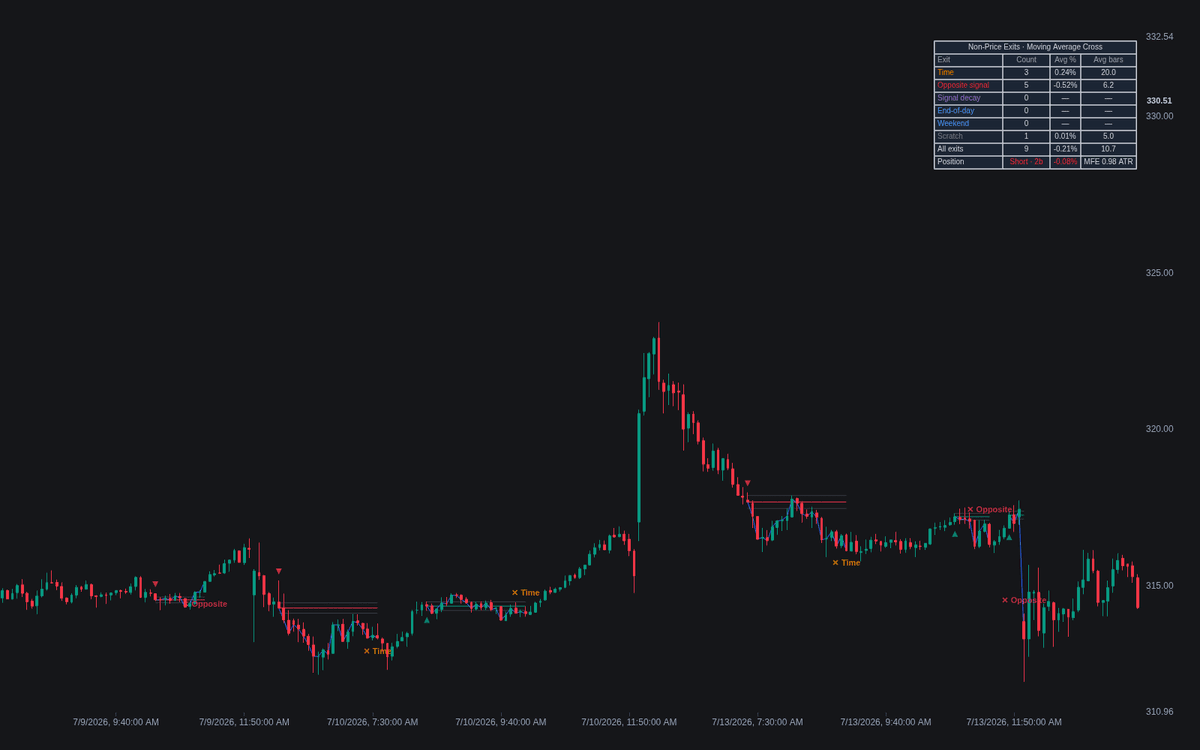
Non-price Exits wires the whole family of non-price exits to a live signal engine so each rule can be watched and tuned. A selectable model opens simulated positions — moving-average cross, Donchian breakout, or any external plot through its zero crosses — and the exit rules alone close them: a maximum holding time, opposite signals, decay of the entry premise, end-of-day and weekend flat windows, and scratch discipline near breakeven when the anticipated early follow-through never appears. Every exit prints a marker naming its reason; a dashboard keeps per-rule statistics.
How to Trade the Non-price Exits?
- Exit labels: each close is tagged Time, Opposite, Decay, EOD, Weekend or Scratch — a readable audit of why trades ended.
- Scratch band: the shaded breakeven zone shows where a flagged trade may be scratched; a trade that reaches the Required MFE is no longer eligible, so working trades are not cut out of fear.
- Dashboard calibration: per-rule counts, average return and average bars held calibrate time stops and scratch windows from how the setup actually pays.
Non-price Exits Settings
- Signal Engine (default Moving Average Cross) with MA Type (EMA), Fast MA Length (10), Slow MA Length (30), Donchian Length (20), External Signal (close) and ATR Length (14).
- Time Exit (on) with Max Holding Bars (20).
- Opposite-Signal Exit (on), Full-Strength Opposite Only (off) and Min Signal Conviction (0.5).
- Signal-Decay Exit (on) with Premise Floor (0) and Decay Confirmation Bars (3).
- End-of-Day Flat (on) with Flat Window (1545-1600), and Weekend Flat (off).
- Scratch Discipline (on) with Scratch Window Bars (5), Required MFE (0.5) and Breakeven Band (0.25).
- Dashboard and style toggles cover markers, the entry line and P/L fill, the band, engine lines and flat-window shading.
Frequently Asked Questions
How do these exits relate to a trailing stop?
A trailing stop such as the Chandelier Exit answers where a trade ends; non-price exits answer when and why. A complete plan usually pairs a price-based exit with a rule from this family.
Which rule wins when several trigger at once?
A fixed priority: weekend flat, then end-of-day, opposite signal, signal decay, scratch, and finally the time stop; one reason is recorded per exit, keeping the statistics clean.
Can it watch my own system's signals?
Point the External Source engine at any plotted series: crosses above and below zero open longs and shorts, and the raw value doubles as the premise the decay rule monitors. Positions stay simulated; the tool studies exit rules.

The Library is free. Quant makes it yours.
Pull any concept or indicator into Quant: rebuild it, retune it, or turn it into a backtested strategy of your own.