Throughput Stats
 By LuxAlgoAug 9, 2026
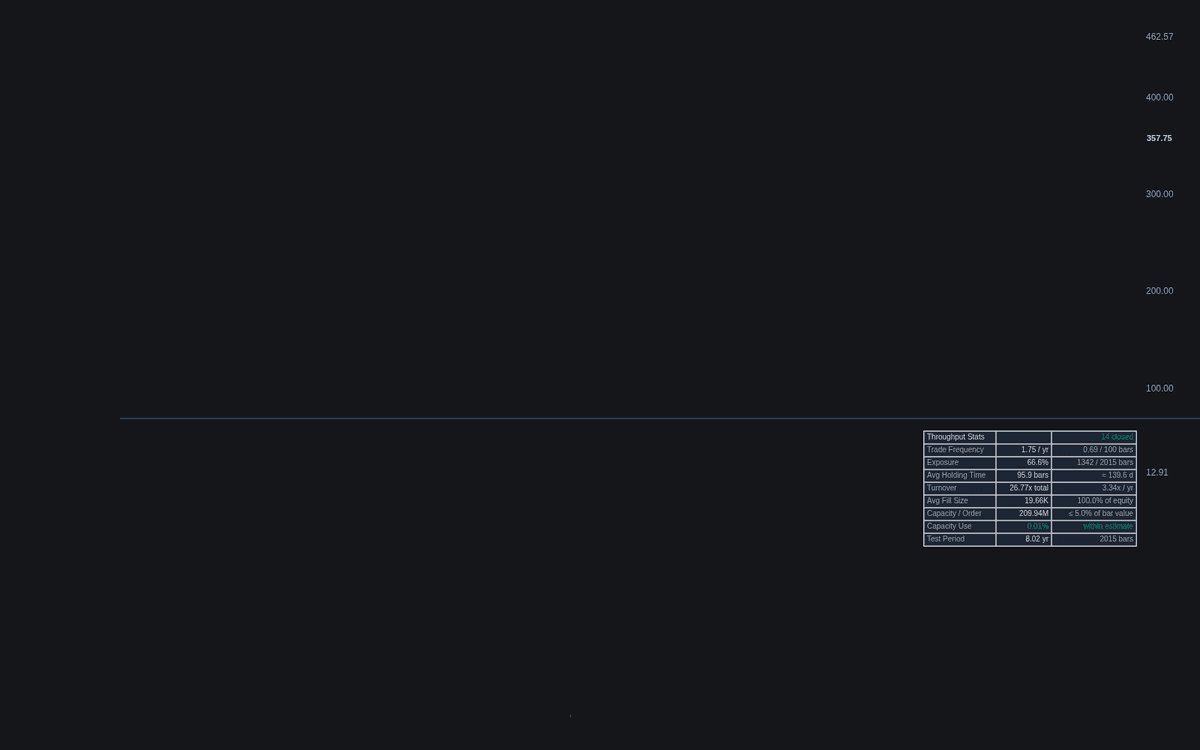
Throughput Stats measures how a strategy spends time and capital — frequency, holding time, exposure, turnover, workable size — rather than whether it wins. A reference system generates the trade list the throughput stats family is measured on: a moving average cross or Donchian breakout, simulated single-position with fills at signal closes. It reads beside the rest of the validation toolkit.
How to Trade the Throughput Stats?
- Rolling Exposure %: the share of the recent window spent holding a position, the background tinted while one is open; above the alert level, capital is near continuously deployed.
- Turnover: notional traded over average equity, total and per year — the number behind commission drag; High Turnover marks cost-sensitive territory.
- Capacity / Order: the Participation Limit times typical traded value sampled at entries, versus the average fill; a breach flips the verdict and fires Capacity Exceeded. The verdict and the turnover and capacity alerts stay silent below Minimum Closed Trades.
Throughput Stats Settings
- Entry Rule (default Moving Average Cross; also Donchian Breakout) with Average Type (default EMA), Fast Length (default 20), Slow (default 50), Breakout Length (default 20).
- Trade Direction (default Long & Short): Long Only exits to flat instead of reversing.
- Initial Capital (default 10000) and Position Size (% Of Equity) (default 100): the account model behind turnover.
- Rolling Exposure Window (Bars) (default 200), Exposure Alert Level (%) (default 80), Turnover Alert Level (x / Year) (default 20), Minimum Closed Trades (default 10).
- Participation Limit (%) (default 5) and Liquidity Window (Bars) (default 100): the capacity estimate.
- Show Dashboard (default on) with Position (Top Right) and Size (Small), plus in-market tint and trade-marker toggles.
Frequently Asked Questions
Why measure throughput separately from expectancy?
Because they answer different questions. Expectancy prices the average trade; the throughput family reports how often that trade arrives, how long capital stays committed, and what it costs to run.
Does the choice of reference system matter?
Only as a generator. The measurements are rule-agnostic, so pick the rule closest to your own cadence and read the stats, not the simulated equity.
How seriously should I take the capacity figure?
As a first-pass estimate, not a promise. Capacity has no closed-form expression, so the build multiplies a participation ceiling by the typical traded value where entries occurred. Symbols without volume data report no capacity.

The Library is free. Quant makes it yours.
Pull any concept or indicator into Quant: rebuild it, retune it, or turn it into a backtested strategy of your own.