HTF Volume Spike & Imbalance Projection
Mar 26, 2026

The HTF Volume Spike & Imbalance Projection [LuxAlgo] is a multi-timeframe trading indicator built to help traders read higher timeframe price action without leaving their current chart. By projecting higher timeframe candle structure, volume spikes, stacked imbalances, and a volume profile directly onto the active chart, it gives a clearer view of where institutional activity, supply and demand, and directional order flow may be developing. This makes it useful for traders looking for confirmation, context, and higher-probability trading strategy ideas across fast and slow market conditions.
How to Trade the HTF Volume Spike & Imbalance Projection Trading Indicator
Understanding the Core Idea Behind This Trading Indicator
Most charts only show the final shape of a candle: open, high, low, and close. But a single higher timeframe candle can contain a lot of important internal behavior that a normal chart does not reveal. This trading indicator breaks that candle apart and analyzes what happened inside it using lower timeframe data.
That means instead of only seeing that a 1-hour candle closed bullish or bearish, you can also see where strong buying or selling pressure appeared, where volume accelerated, and where aggressive market participants repeatedly stepped in at the same prices.
For traders using a discretionary or systematic trading strategy, this added context can help answer questions like:
- Where did meaningful participation occur?
- Was the move backed by strong volume or weak conviction?
- Are there supply and demand zones inside the higher timeframe candle that price may react to later?
- Did buyers or sellers dominate specific price levels?
How to Read the Projection on the Chart
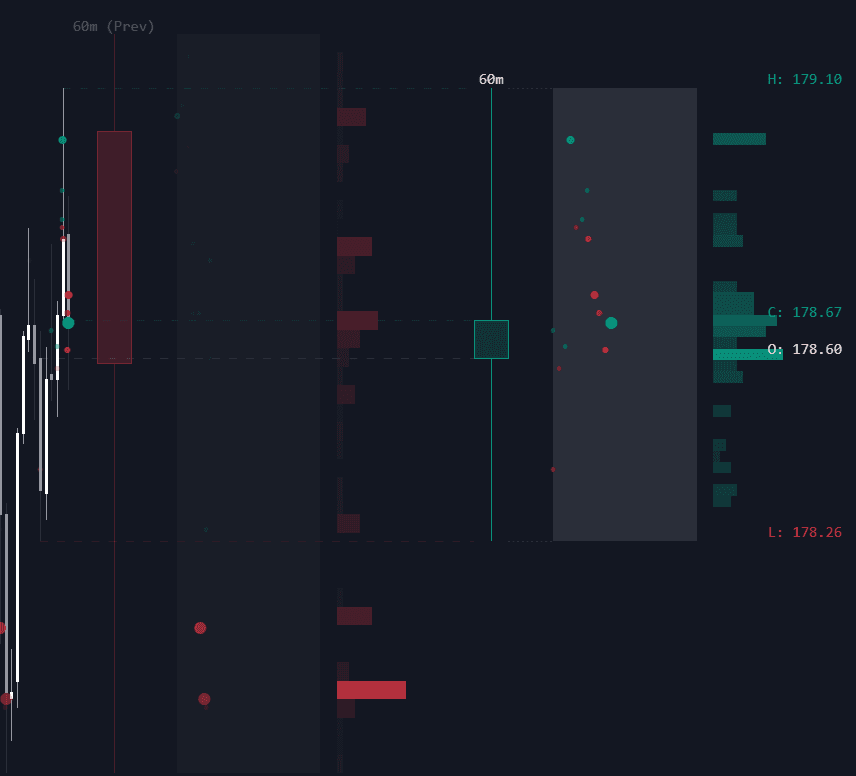
The indicator draws two projected blocks to the right side of current price action so traders can quickly compare the past higher timeframe candle with the one currently forming.
- Ghost Bar (Left Block): Displays the prior completed higher timeframe candle. It is shown in a faded style to provide historical context and help traders understand where previous value and participation were concentrated.
- Current Bar (Right Block): Displays the active higher timeframe candle in real time. This block updates as new lower timeframe data comes in, allowing traders to monitor how the current higher timeframe structure is developing.
These projected zones allow traders to keep a higher timeframe view in front of them at all times, which is especially helpful for intraday trading, scalping, and trend trading strategies where switching between charts can slow decision-making.
What Each Projection Section Means
Each projected block contains three important components that work together to tell the full story of the candle.
- HTF Candle: A standard visual representation of the higher timeframe candle, showing open, high, low, and close.
- Scatter Plot (Bubbles): Each bubble marks a lower timeframe volume spike detected within the higher timeframe candle. Bigger bubbles represent stronger volume events. Color shows directional pressure, with green typically representing buying pressure and red representing selling pressure.
- Volume Profile (Histogram): Shows how total volume was distributed across the candle’s full price range, helping reveal areas where the market accepted price and where trading activity was concentrated.
Together, these features turn a single higher timeframe candle into a much richer market structure tool. Instead of looking at a plain candle, traders can analyze where real participation happened and where price may revisit important levels later.
How to Use Volume Spikes in Your Trading Strategy
Volume spikes are one of the most useful elements in this indicator because they show moments when activity increased sharply relative to normal conditions. In trading, unusual volume often matters because it can signal interest from larger participants, panic activity, breakout attempts, absorption, or exhaustion.
When reading the bubbles:
- Large green bubbles may suggest strong buying aggression at that price area.
- Large red bubbles may suggest aggressive selling pressure.
- Clusters of bubbles often indicate repeated interaction at a level, which can make the zone more important later.
- Sparse or missing bubbles may suggest the move has weak participation and lower conviction.
This makes the indicator especially valuable for traders who want a volume-based trading indicator that goes beyond raw volume bars and instead shows where participation happened inside the candle itself.
How to Trade Stacked Imbalances
One of the standout features of this trading indicator is the detection of Stacked Imbalances. These appear as solid colored boxes behind the bubble cluster when three or more same-direction volume spikes occur at the same price level inside a single higher timeframe candle.
This is important because repeated directional activity at one level can suggest a meaningful supply or demand zone.
- Bullish Stacked Imbalance (Green Box): Suggests concentrated buying interest and may act as support on a retest.
- Bearish Stacked Imbalance (Red Box): Suggests concentrated selling interest and may act as resistance on a retest.
For many traders, these imbalance zones can become key parts of a trading strategy. A common approach is to watch how price behaves when it revisits an old imbalance zone from the Ghost Bar. If price returns and reacts cleanly, that may support a reversal, continuation, or rejection setup depending on the broader market context.
Reading the On-Chart Bubbles
The indicator can also display the same volume spikes directly on your live chart candles. This gives traders immediate visual feedback without having to look only at the projected blocks.
These on-chart bubbles can help with short-term trade timing:
- Large bubbles near candle highs may point to exhaustion, rejection, or heavy selling overhead.
- Large bubbles near candle lows may suggest responsive buying or a floor being defended.
- Repeated bubbles in one region can help identify a battle zone where buyers and sellers are actively competing.
This can be especially helpful for price action traders who want cleaner entries using both structure and volume-based confirmation.
Why This Multi-Timeframe Trading Indicator Matters
A big challenge in trading is balancing local chart detail with higher timeframe context. Traders often miss good setups because they focus too much on the current timeframe and ignore where the broader market found value or imbalance.
This indicator helps solve that by combining several useful concepts into one view:
- Higher timeframe candle projection
- Lower timeframe volume spike analysis
- Volume profile mapping
- Imbalance zone detection
- Real-time higher timeframe development
For traders building a multi-timeframe trading strategy, that makes this tool useful for identifying confluence. It can help confirm whether a breakout has real participation, whether a pullback is returning to a previously active zone, or whether a move is forming in low-conviction conditions.
Indicator Logic and Technical Details
The script uses:
request.security_lower_tf()
to access lower timeframe data inside a larger anchor candle. This allows the trading indicator to analyze granular price and volume behavior within each higher timeframe bar.
Volume spikes are identified when lower timeframe volume exceeds a moving average by a user-defined multiplier. Once detected, those spikes are mapped by price level and direction, then displayed visually in the projection and optionally on the main chart.
This gives traders a more detailed view of where meaningful activity occurred, instead of relying only on the final candle shape.
Trading Ideas and Practical Use Cases
Use the Volume Profile to Find Value
The volume profile section of the projection helps reveal the price levels where the most business was done during the higher timeframe candle. These high-volume nodes often act like magnets, since price tends to revisit accepted value areas.
This can be useful when planning entries, profit targets, or reversion trades.
Use Ghost Bar Imbalances as Reaction Zones
A previously completed higher timeframe candle often leaves behind clues. If the Ghost Bar shows a stacked imbalance zone, that level may matter when price returns in the future.
Many traders will wait for price to revisit that area, then look for extra confirmation such as rejection wicks, loss of momentum, or candle confirmation before entering a trade.
Judge Conviction Through Bubble Activity
A candle with many large bubbles often signals stronger participation and more meaningful directional pressure. A candle with very little bubble activity can suggest a weaker move that may be more vulnerable to reversal or drift.
This makes the indicator useful not just for finding levels, but for judging the quality of a move.
Combine With Trend and Structure
This trading indicator can be even more effective when combined with market structure, trend bias, and higher timeframe direction. For example, a bullish stacked imbalance inside a broader uptrend may carry more weight than the same signal appearing in a choppy or bearish environment.
SETTINGS
Higher Timeframe Projection Settings
- HTF Anchor Timeframe: Sets the main higher timeframe used for the projection. The Auto option selects a logical higher timeframe based on the current chart, making the indicator easier to use across different markets and trading styles.
Volume Spike Detection Settings
- Spike Granularity: Defines the lower timeframe used to detect individual volume spikes inside the anchor candle.
- Volume Spike Multiplier: Controls how strong volume must be relative to the average before it is classified as a spike.
- Volume MA Length: Sets the lookback period for the volume moving average used in spike detection.
These settings let traders make the indicator more sensitive or more selective depending on their market and trading strategy.
Advanced Visualization Settings
- Show Ghost (Previous) Bar: Displays the prior higher timeframe candle for historical context.
- Highlight Stacked Imbalances: Enables the detection and display of repeated directional volume clusters at the same price level.
- Show Anchor Connection Lines: Draws reference lines linking key chart levels to the projected block.
- Show Bubbles on Chart Candles: Displays lower timeframe volume spikes directly on the live chart candles.
FAQ
What is the HTF Volume Spike & Imbalance Projection [LuxAlgo] used for?
It is a multi-timeframe trading indicator used to analyze higher timeframe candle structure, lower timeframe volume spikes, stacked imbalances, and volume distribution in one view. Traders use it to identify institutional interest, supply and demand zones, and high-conviction order flow areas without changing timeframes.
How do traders use stacked imbalances?
Stacked imbalances can be used as potential support or resistance zones. When price revisits one of these areas, traders often watch for confirmation of a reaction, reversal, or continuation setup.
Is this indicator good for intraday trading?
Yes. It is especially useful for intraday traders because it keeps higher timeframe context visible while still showing detailed lower timeframe activity inside each projected candle.
What do the bubbles mean on this trading indicator?
The bubbles represent lower timeframe volume spikes. Their size reflects relative activity, and their color helps show whether buying or selling pressure was dominant at that price level.
How do I access HTF Volume Spike & Imbalance Projection [LuxAlgo]?
You can get access on the LuxAlgo Library for charting platforms like TradingView, MetaTrader (MT4/MT5), and NinjaTrader for free.
Trading & investing are risky and many will lose money in connection with trading and investing activities. All content on this site is not intended to, and should not be, construed as financial advice. Decisions to buy, sell, hold or trade in securities, commodities and other investments involve risk and are best made based on the advice of qualified financial professionals. Past performance does not guarantee future results.
Hypothetical or Simulated performance results have certain limitations. Unlike an actual performance record, simulated results do not represent actual trading. Also, since the trades have not been executed, the results may have under-or-over compensated for the impact, if any, of certain market factors, including, but not limited to, lack of liquidity. Simulated trading programs in general are designed with the benefit of hindsight, and are based on historical information. No representation is being made that any account will or is likely to achieve profit or losses similar to those shown.
Testimonials appearing on this website may not be representative of other clients or customers and is not a guarantee of future performance or success.
As a provider of technical analysis tools and strategies, we do not have access to the personal trading accounts or brokerage statements of our customers. As a result, we have no reason to believe our customers perform better or worse than traders as a whole based on any content, tool, or platform feature we provide.
Charts used on this site are by TradingView in which the majority of our technical indicators are built on. TradingView® is a registered trademark of TradingView, Inc. www.TradingView.comTradingView® has no affiliation with the owner, developer, or provider of the Services described herein.
Market data is provided by CBOE, CME Group, BarChart, CoinAPI. CBOE BZX real-time US equities data is licensed from CBOE and provided through BarChart. Real-time futures data is licensed from CME Group and provided through BarChart. Select cryptocurrency data, including major coins, is provided through CoinAPI. All data is provided “as is” and should be verified independently for trading purposes.
This does not represent our full Disclaimer. Please read our full disclaimer.
© 2026 LuxAlgo Global, LLC.