Concept
Fair Value Gap
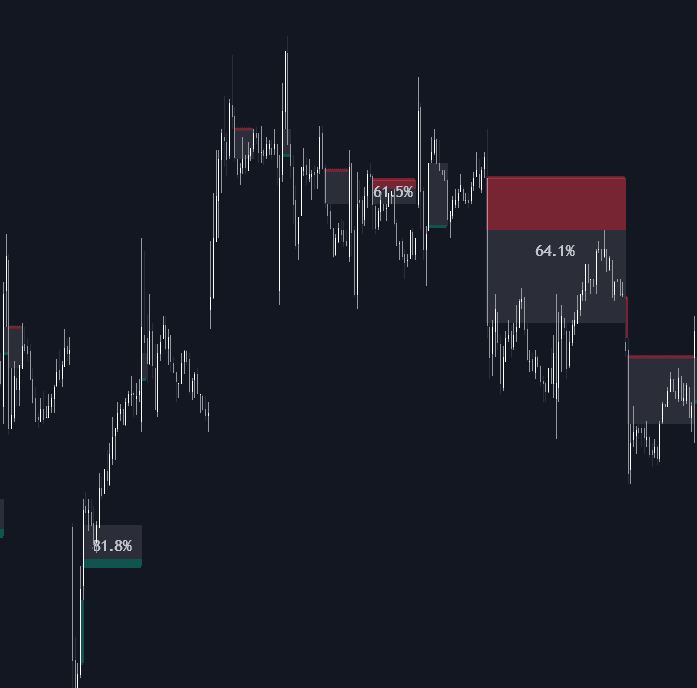
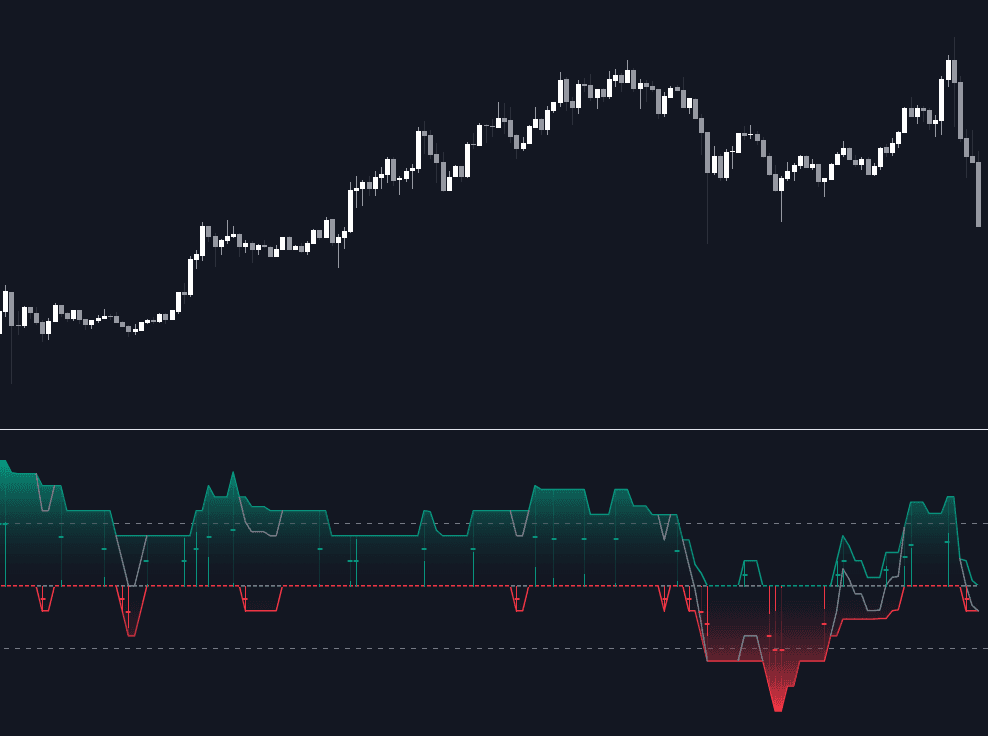
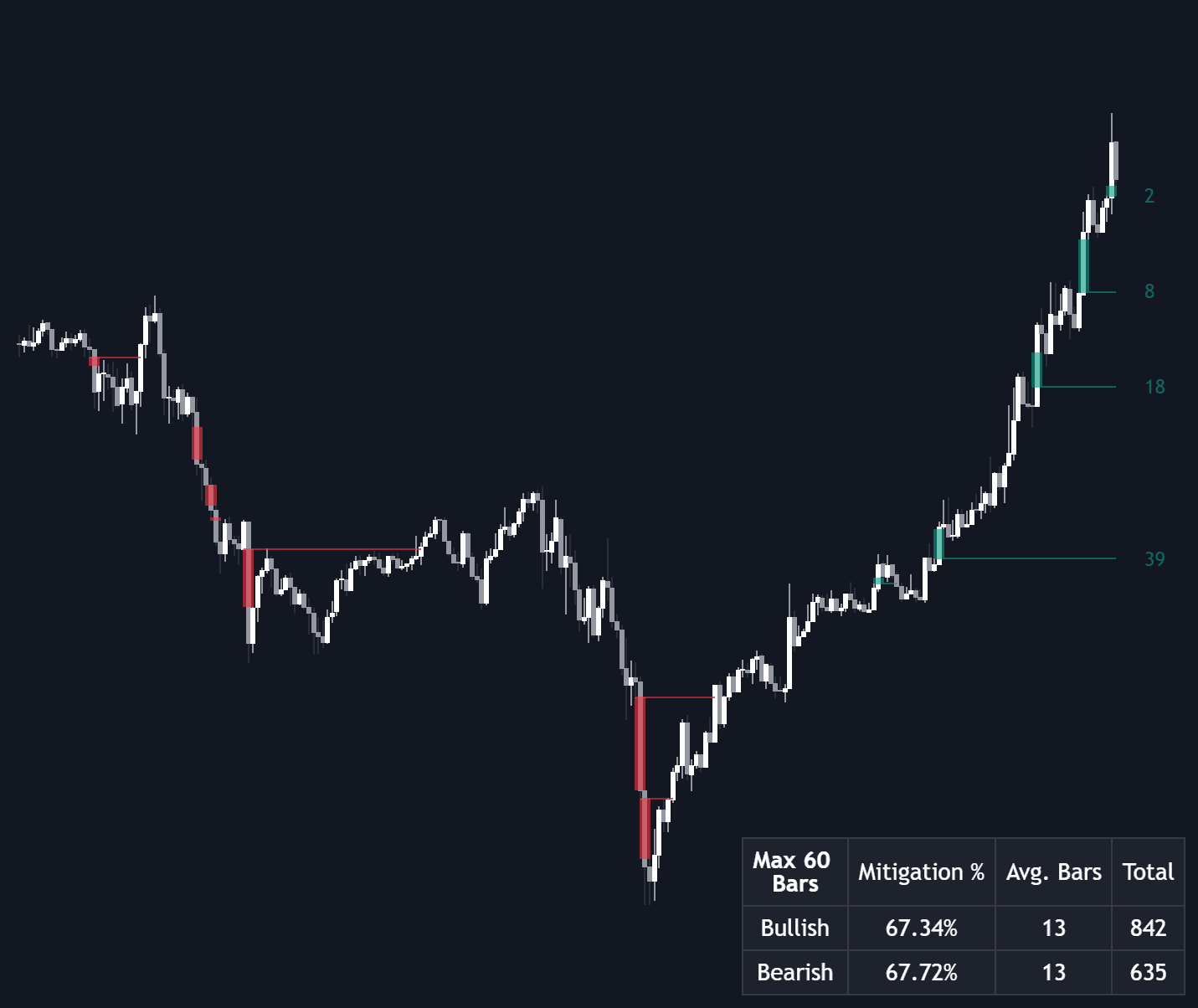
Fair Value Gap, also known as FVG, imbalance, inefficiency, liquidity void, is a Smart Money Concepts / ICT concept. The Library holds 39 implementations, each one a working definition you can pull into Quant.
Top Fair Value Gap indicators
The top custom implementations, built on the original standard Fair Value Gap formula.
Every Fair Value Gap implementation here is strategy-ready: open one in Quant, set your rules, and it backtests automatically.
What is a Fair Value Gap?
A fair value gap is a three-candle imbalance. When the middle candle moves so fast that the first candle’s high and the third candle’s low never overlap (in the bullish case), the untraded span between them is the gap: price skipped through those levels without auctioning both sides. Smart Money Concepts / ICT traders read that as an inefficiency, one-sided delivery the market may later revisit and rebalance.
The concept treats the gap as a footprint of displacement: a move aggressive enough to outrun available liquidity, usually attributed to institutional participation. Traders mark the gap as a zone on the chart, treat its midpoint (the consequent encroachment) as the decision line, and judge the market by how price behaves when it trades back into it.
Why it matters is auction logic: a span where only one side traded is a span where the market never established two-sided fair value. That gives price a reason to return and finish the auction, and it gives traders a mappable, objective zone to plan around. It is why the FVG became one of the most implemented concepts in modern technical analysis.
How to identify a fair value gap
The pattern is a three-candle scan. Here is the bullish case; mirror every condition for a bearish gap:
- 1Find a displacement candle: a wide-range middle candle moving decisively in one direction.
- 2Compare the first candle’s high with the third candle’s low. If the third candle’s low sits above the first candle’s high, the span between those two levels is a bullish fair value gap.
- 3Draw the zone across that span and mark its midpoint, the consequent encroachment. Many models treat a touch of the midpoint as “filled enough.”
- 4Filter for significance. Raw three-candle gaps print constantly, so most tools require a minimum size (ATR- or percentage-based) or confluence with market structure before a gap makes the chart.
How traders use it
- As a retracement target: continuation setups wait for price to trade back into the gap (a mitigation or fill) before rejoining the direction of the original displacement.
- As an entry zone: entries inside the gap, commonly at the midpoint, with invalidation beyond the far edge, often inside premium or discount context for direction.
- As a read on strength: gaps that hold on the first return suggest the displacement is being defended, while gaps that trade straight through and invert (inversion FVGs) flip the bias.
- In confluence: FVGs are rarely traded alone. They pair with order blocks, liquidity sweeps, and shifts in structure like a change of character.
Fair value gap vs related concepts
Inversion FVG: a fair value gap that fails and flips. Price closes through it and the zone’s role inverts; broken support becomes resistance, and vice versa.
Volume imbalance: a gap between candle bodies whose wicks still overlap. Thinner than an FVG: price technically traded there, just one-sidedly.
Opening gap: a session-boundary gap between one close and the next open. FVGs, by contrast, print intraday from pure displacement, with no session boundary involved.
Balanced price range: two opposing FVGs overlapping: the same span rebalanced from both directions, which traders read as a completed two-way auction.
More Fair Value Gap implementations
- HTF Fair Value Gap
- Inversion Fair Value Gaps (IFVG)
- ICT Implied Fair Value Gap (IFVG)
- Liquidity Voids (FVG)
- FVG Channel
- FVG Sessions
- Imbalance Detector
- FVG Positioning Average
- FVG Trailing Stop
- FVG + Liquidity Sweep + CISD
- FVG Instantaneous Mitigation Signals
- FVG Price & Volume Graph
- Dynamic Delta FVG
- Significant Breakout Levels (FVG)
- AMD FVG Trade Setup
- HTF Volume Spike & Imbalance Projection
Concept family
Smart Money Concepts / ICT
54 concepts mapped · 54 in the Library
Fair Value Gap FAQ
Turn Fair Value Gap into a trading strategy.
Take any implementation from this page into Quant, then build on it, backtest it on real data, and keep refining it in conversation.