Mental vs Hard Stop
 By LuxAlgoApr 29, 2026
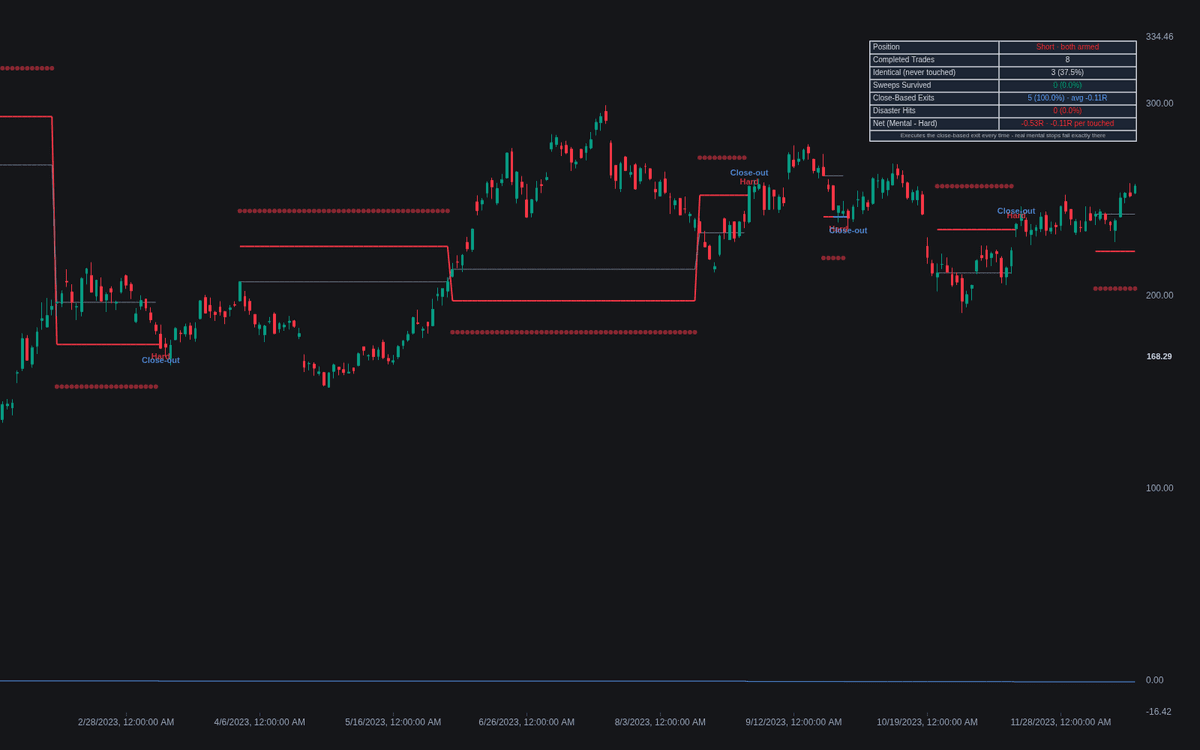
Mental vs Hard Stop puts the execution question on the chart: same level, different trigger fingers. A generic moving-average cross opens simulated trades and places one shared stop; a resting hard order that fills the instant the level trades then races a mental exit acting only on a close beyond it, backed by a disaster stop further away — the mental vs hard stops debate settled trade by trade in R on the ledger.
How to Trade the Mental vs Hard Stop?
- Hard label: the touch filled the resting order — gaps fill at the open, as real stops do — while the mental side may still hold.
- Sweep markers and Survived: crosses mark bars that pierce the level but close back inside; riding a swept level to the signal exit prints Survived — the mental stop's benefit case.
- Close-out: a close beyond the level is acceptance — the mental exit fills at that close, worse than the level itself: the price of filtering wicks.
- Disaster: the backstop filled because the close-based exit never came — the fast-market tail the hybrid exists to cap.
Mental vs Hard Stop Settings
- Trade Direction (default Long & Short) with Fast MA Length (default 20) and Slow MA Length (default 50): the demo entry engine; the comparison is about exits.
- Placement (default ATR Multiple) with ATR Length (default 14), ATR Multiple (default 2) and Percentage (default 1): where the shared level goes, defining the risk unit R.
- Disaster Backstop (on) with Disaster Distance (R) (default 1): the resting order behind the mental exit.
- Comparison Dashboard (on) with position and size; toggles Event Labels, Sweep Markers and Level / Price Gradient (on), Entry Markers (off).
Frequently Asked Questions
What does Net (Mental − Hard) measure?
The sum across completed trades of the mental exit minus the hard exit, in R. Positive means surviving sweeps outweighed the worse acceptance fills on this chart's history; negative means the resting order was the better tool here — a per-chart record, not a verdict about markets.
Doesn't stop placement matter more than execution?
Placement is a separate question with its own tooling — ATR-based stop distance covers sizing a level to volatility. Here placement is infrastructure: both styles defend the same level however placed, so every divergence comes from execution alone.
What does the simulation deliberately get wrong?
Discipline. It executes every close-based exit without hesitation — precisely where real mental stops break down, migrating at the worst emotional moment. Read the ledger as the mental stop's best case, run by software that never renegotiates.

The Library is free. Quant makes it yours.
Pull any concept or indicator into Quant: rebuild it, retune it, or turn it into a backtested strategy of your own.