Concept
Mental vs Hard Stop
Mental vs Hard Stop is a Risk, Sizing & Exits concept. The Library holds 1 implementation, a working definition you can pull into Quant.
behavioral. labeled
Top Mental vs Hard Stop indicator
The top custom implementation, built on the original standard Mental vs Hard Stop formula.
1 total
The Mental vs Hard Stop implementation below can become a backtested trading strategy — describe your rules and Quant writes the code.
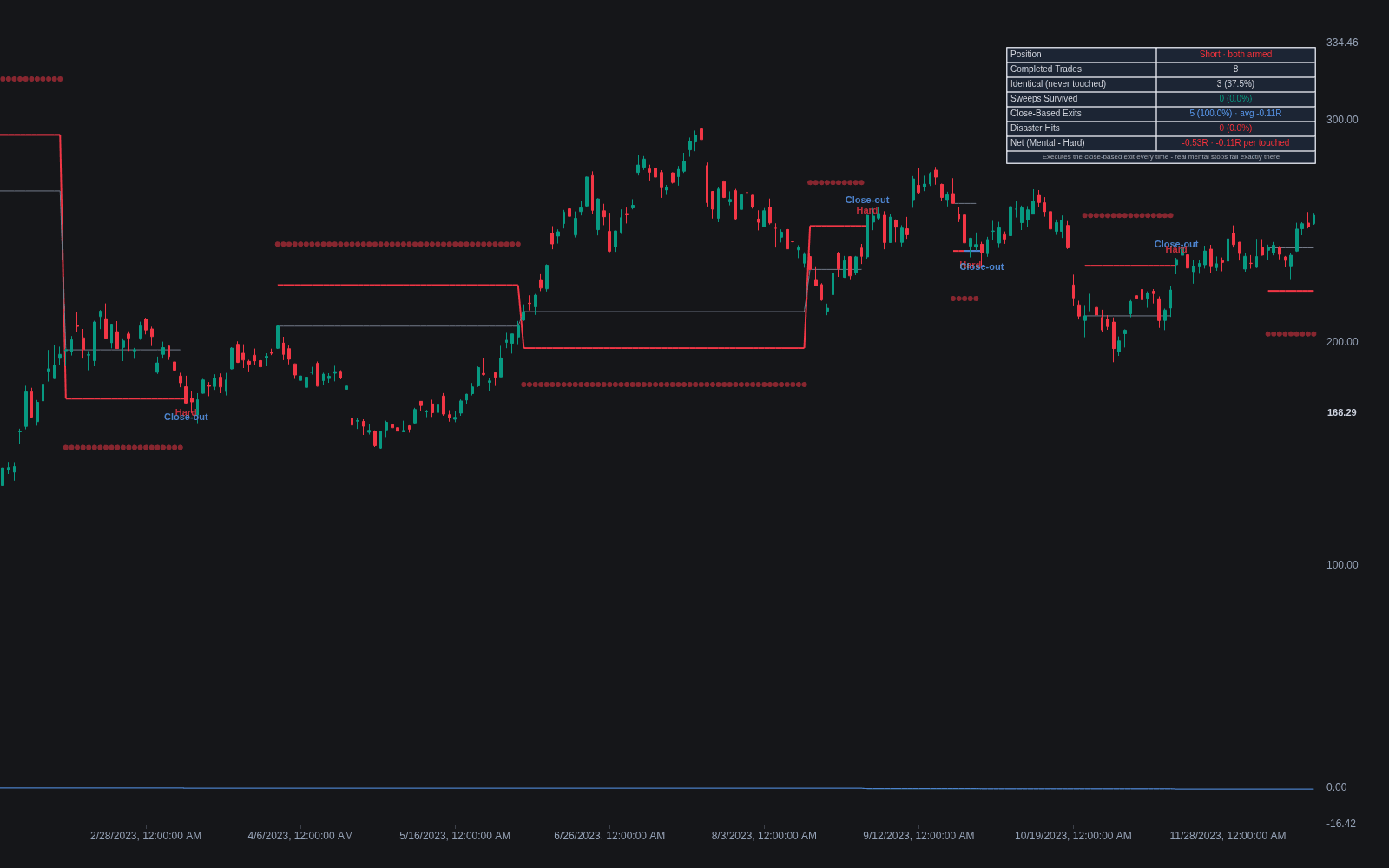
What are Mental and Hard Stops?
A hard stop is a resting stop order held at the broker or exchange: if price touches the level, the position is closed mechanically, no decision required. A mental stop is the same predefined exit level kept in the trader's head or on a chart alert, with the exit executed manually when price gets there. The distinction is not about where the stop is but about who pulls the trigger, software or the trader, at the worst possible emotional moment.
The argument for mental stops is real but narrow. Resting stops are visible commitments: they concentrate around obvious levels, and price frequently trades through those pools before reversing, the dynamic described in stop placement vs liquidity pools and expressed in events like a liquidity sweep. A mental stop cannot be swept because there is no order to sweep, and a trader watching the tape can distinguish a momentary wick from genuine acceptance beyond the level. Traders working large size also avoid showing their exit to the book.
The argument against them is behavioral, and it is the one that decides the matter for most people. A mental stop only works if it is executed without renegotiation, and the moment of execution is precisely when the incentives to renegotiate peak: the loss is about to become real, hope is cheap, and "one more tick" costs nothing yet. In practice mental stops tend to migrate, and a migrated stop is functionally trading without one while believing otherwise. The honest default is: hard stops unless you have specific, demonstrated reasons and the discipline record to justify manual execution.
How traders use it
- The default configuration for most retail traders is hard stops, ideally placed with size and level decided before entry, because it removes in-trade discretion at the moment discretion is least trustworthy.
- Mental stops are used by experienced discretionary traders in specific contexts: very liquid products watched full-time, exits conditioned on closes or acceptance rather than touches, or size large enough that a visible resting order would be information leakage.
- A common hybrid is a mental stop backed by a disaster stop: the intended exit is discretionary, but a hard stop rests further away so that a connectivity failure, a halt reopen, or a fast market cannot produce an unbounded loss.
- Close-based rules formalize the mental stop's main advantage: exiting on a bar close beyond the level rather than a touch filters some wick noise, and it can be automated, which removes the discipline dependency that makes pure mental stops fail.
- With honest limits: every account should assume its own discipline will be worst exactly when it matters most. If a mental stop has ever migrated even once, that is evidence the hard stop is the correct tool, and loss-control rules at the account level are the backstop for the days execution fails.
Mental and hard stops vs related choices
Fixed Stops: Answers a different question: where the stop goes and whether it moves. Fixed, structural, or volatility-based placement can each be implemented as either a hard or a mental stop.
No-Stop Hedging: The failure state a migrated mental stop drifts toward: no defined loss point at all, with an offsetting position substituted for a decision. A mental stop is at least a stop; hedging instead of stopping is not.
Stop Placement vs Liquidity Pools: Explains the sweep problem that motivates mental stops in the first place: resting orders pool at obvious levels. Placement beyond the pool often solves the problem without giving up the hard order.
Concept family
Risk, Sizing & Exits
37 concepts mapped · 37 in the Library
Mental vs Hard Stop FAQ
Turn Mental vs Hard Stop into a trading strategy.
Take the implementation from this page into Quant, then build on it, backtest it on real data, and keep refining it in conversation.