Wave Trend Oscillator
 By LuxAlgoMay 9, 2026
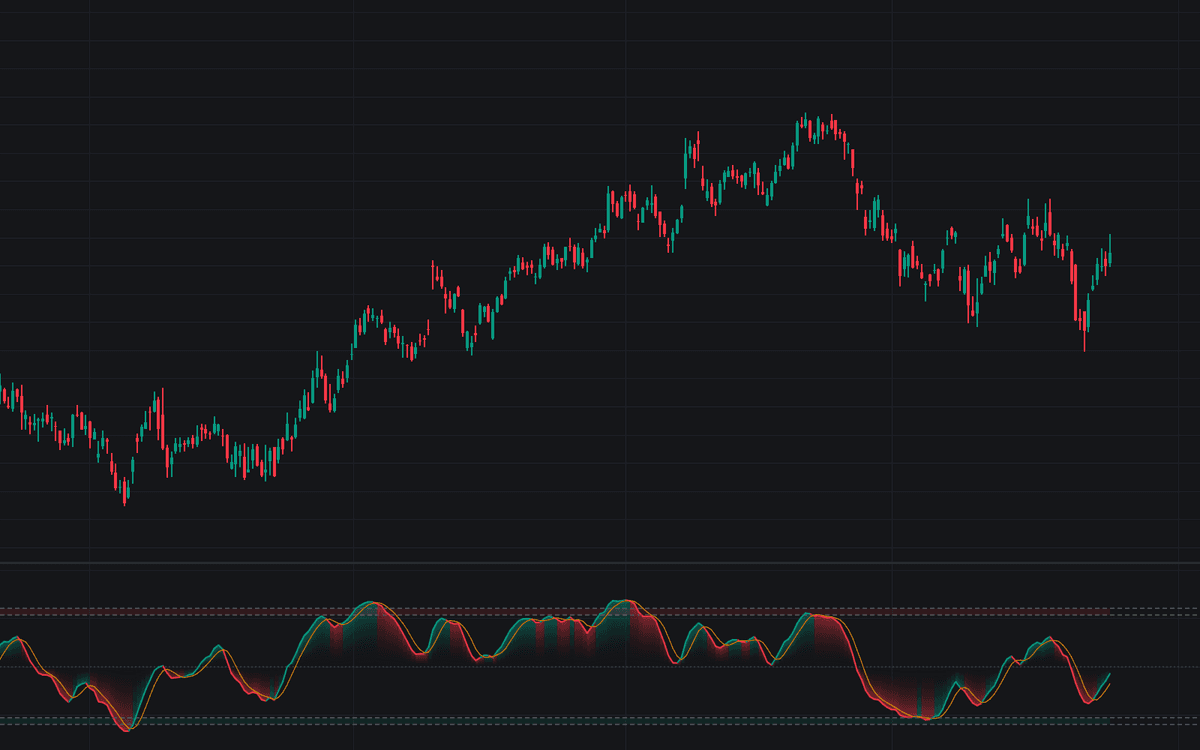

Wave Trend Oscillator is the definitive clean build of the Wave Trend Oscillator, plotting the WT1 wave and its WT2 signal line in a dedicated pane. Price's distance from an exponential mean is scaled by its typical size, then smoothed into legible waves around zero. WT1 is colored by its side of WT2, a gradient fill ties it to zero, and dashed levels at 53/60 and -53/-60 frame the extreme zones.
How to Trade the Wave Trend Oscillator?
- Bearish extreme cross: WT1 crossing under WT2 with both above Overbought 1 is the classic overbought reversal trigger; the bullish mirror fires below Oversold 1.
- Zero-line regime: WT1 crossing above zero marks waves unfolding on the bullish side of the centerline; crossing below flips the read.
- Zone traversal: WT1 pushing above Overbought 1 flags stretch; its cross back below signals the stretch unwinding.
Mid-range crosses are left to the line coloring, where follow-through is poorest. Eight alerts cover extreme crosses, zone entries and exits, and zero crosses.
Wave Trend Oscillator Settings
- Source (default HLC3): price series measured.
- Channel Length (default 10): length of the exponential mean and deviation averages.
- Average Length (default 21): smoothing that turns the scaled deviation into WT1.
- Signal Length (default 4): bars in the WT1 average forming WT2.
- Overbought 1 / Overbought 2 (defaults 53 and 60): inner level qualifying extreme crosses and zone alerts, outer level bounding the shaded band.
- Oversold 1 / Oversold 2 (defaults -53 and -60): the mirrored levels below zero.
- Extreme Cross Markers (default off): circles where extreme crosses fired; alerts work regardless.
- Style toggles: Gradient Fill and Extreme Zone Fill (both on by default).
Frequently Asked Questions

Original indicatorBuilt in-house by LuxAlgo
The Library is free. Quant makes it yours.
Pull any concept or indicator into Quant: rebuild it, retune it, or turn it into a backtested strategy of your own.