Williams Alligator
 By LuxAlgoApr 13, 2020
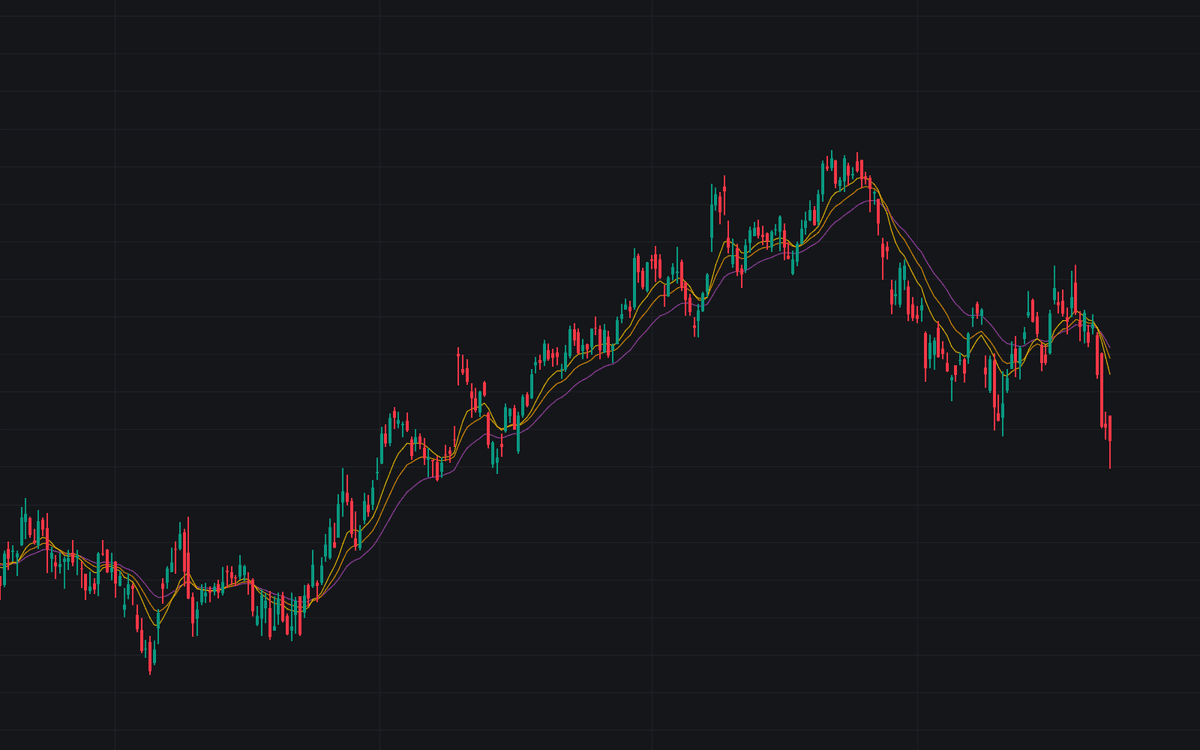

The Williams Alligator plots three smoothed moving averages of median price (the Jaw, the Teeth, and the Lips), each shifted forward in time, so their order, spread, and slope show whether the market is trending or ranging. Defaults follow Bill Williams' classic setup: SMMA lengths of 13, 8, and 5 applied to hl2, displaced 8, 5, and 3 bars into the future. This is the standard implementation, with the smoothing computed exactly as Williams specified.
Williams' animal metaphor supplies the vocabulary, but on the chart it reduces to geometry: braided lines mean stand aside, an ordered fan means trend.
How to Trade the Williams Alligator?
- Lines intertwined and flat: a ranging market where crosses between the averages carry no information, the phase Williams said to sit out.
- Lips crossing above the Teeth: the first sign of an upside awakening, strongest when the Jaw follows and the lines spread in order.
- Lips crossing below the Teeth: the bearish mirror image, with the fan inverting beneath a falling Jaw.
- An open, ordered fan: continuation is favored; pullbacks holding above the Jaw are watched as re-entry zones.
- Lines converging after a run: a cue to tighten stops or take profits rather than add.
Williams Alligator Settings
- Jaw Length (default 13): smoothing of the slowest line; raising it steadies the read but delays phase changes.
- Teeth Length (default 8): the middle average.
- Lips Length (default 5): the fastest line; shortening it produces earlier but noisier awakenings.
- Jaw Offset (default 8), Teeth Offset (default 5), Lips Offset (default 3): bars each plot is shifted into the future, display only.
Frequently Asked Questions

Original indicatorBuilt in-house by LuxAlgo
The Library is free. Quant makes it yours.
Pull any concept or indicator into Quant: rebuild it, retune it, or turn it into a backtested strategy of your own.