5 Key Strategies for Successful Algo Trading

Algorithmic trading applies explicit rules through software. A reliable process requires more than fast calculations: refine the algorithm, size and control exposure, use appropriate data, test honestly, and monitor changes. These five practices improve the quality of the process; none guarantees profitable trades.
1. Fine-tune Your Trading Algorithm
Start with a fixed baseline. Record the rules, version, symbol, timeframe, data source, costs and position-sizing policy. Inspect individual entries and exits before changing settings. A favorable result cannot tell you whether a signal used information that was actually available at the time.
Change one material assumption at a time. A moving-average parameter change, a new filter and a different fill model answer different questions. Keep earlier results so you can explain what improved and whether that improvement survives later data.
Profile before optimizing speed. Faster calculations may help a latency-sensitive process, but they do not guarantee faster fills or better prices. Broker connectivity, venue conditions, queue position and liquidity can dominate execution. Automation can also repeat an error consistently; manual trading is not inherently less disciplined, nor is automated trading inherently low-error.
Begin chart research in Vela. It’s our next-generation charting platform, free to start. Ask Quant, our coding agent, to implement a precise rule or explain a suspected error. Inspect the generated code and run it yourself. Record the assumptions behind the result before comparing alternatives.
2. Control Trading Risk
Define maximum position size, aggregate exposure, working-order exposure and the action associated with a loss threshold. A limit that considers only filled positions can miss several pending orders that could fill together.
For a hypothetical $20,000 account, a 0.5% planned loss budget is $100. An entry at $100 and planned stop at $98 implies 50 shares before fees and slippage. If a gap produces an exit at $95, the loss is $250, or 1.25% of the account, before costs. Position sizing translates an assumed exit into quantity; it does not cap every possible realized loss.
Investor.gov’s order-types guide explains that a stop order becomes a market order once triggered and its execution price can differ from the stop price. A stop-limit order can remain unfilled. Review these tradeoffs for the actual instrument rather than promising that stops prevent excessive drawdown.
There is no universal best reward-to-risk target. In a simplified model with a 3R average win and 1R average loss, a 30% win probability gives 0.2R expectancy before costs. Subtracting 0.1R average cost per trade leaves 0.1R. The pre-cost break-even win probability is 25%; with that cost it is 27.5%. A chart target three times the stop distance does not establish those realized averages or probabilities.
Diversification can reduce concentration, but strategies can share factor, liquidity and funding exposures. Review them jointly. Define stop-new-orders, cancel-orders and close-position procedures separately; stopping a local process does not necessarily remove broker exposure.
3. Use Market Data Effectively
Match the dataset to the question. OHLC bars describe aggregated prices over an interval. Executed-trade data describes transactions, while order-book data describes displayed resting liquidity at observed times. They are not interchangeable, and neither guarantees what will be available for the next order.
A price-action indicator infers structure from its inputs; it is not an independent market-data source. Likewise, many money-flow indicators are price/volume transformations. Their name does not mean they directly identify institutional buyers or actual capital transfers between assets.
Review symbol identity, sessions, timezone, adjustments, volume units, missing observations and publication timing. Preserve the raw data. A dataset's label or visual detail is not evidence of complete historical coverage or point-in-time availability.
LuxAlgo’s native data documentation explains source and coverage details. Keep those assumptions aligned when comparing native charts, TradingView and an external backtest.
| Data | What it describes | What it does not prove |
|---|---|---|
| OHLC bars | Aggregated prices for an interval | Exact intrabar event order or fill availability |
| Executed volume | Transactions recorded by the source | All resting orders or future liquidity |
| Order-book observations | Displayed resting interest at observed times | Guaranteed execution at that price |
| Price/volume indicators | Transformations or inferred structures | Identified institutional flows |
4. Test Trading Strategies
Separate development data from later evaluation data. Fit transformations and feature selection only on training observations, then apply them to evaluation data. Repeatedly changing a strategy after seeing the same test period turns that period into part of development.
Include commissions, spread, slippage and relevant funding or borrowing costs. Check when the signal becomes available and when the model allows a fill. Daily candles cannot establish the exact sequence of every intraday stop and target touch.
Evaluate return alongside exposure, drawdown, sample size and uncertainty. Stress coherent scenarios such as wider spreads, price gaps, reduced liquidity and rejected orders. Synthetic or resampled paths reflect their assumptions; they do not guarantee coverage of unknown crises.
Backtest the strategy with Quant using explicit inputs and costs, after inspecting and running the code. Strategy Alerts are alerts, not proof of a broker fill. A tool's optimization result is not independent validation.
5. Track and Update Strategies
Monitor both research outcomes and operations. Distinguish a losing trade from stale data, an order rejection, a duplicated submission or a changed calculation. Keep the strategy version, event timestamps and order-state records needed to investigate.
Track net results after costs, equity drawdown, closed-trade win proportion, exposure and turnover. Define units: trading volume may mean quantity or notional value depending on the report. A Sharpe estimate also needs a stated return frequency, risk-free convention and adequate sample size.
Do not automatically tighten stops in volatility or widen them in choppy markets. Those changes alter the distribution of exits and loss size. Compare a documented alternative with the existing rule, adjust quantity consistently when risk distance changes, and evaluate the change on data not used to choose it.
Review compatible recorded trades in LuxAlgo’s native journal and keep simulated records distinct from actual fills. Use a workspace to organize baselines and related experiments. Community discussion can suggest questions, but another trader's screenshot or testimonial does not verify your implementation.
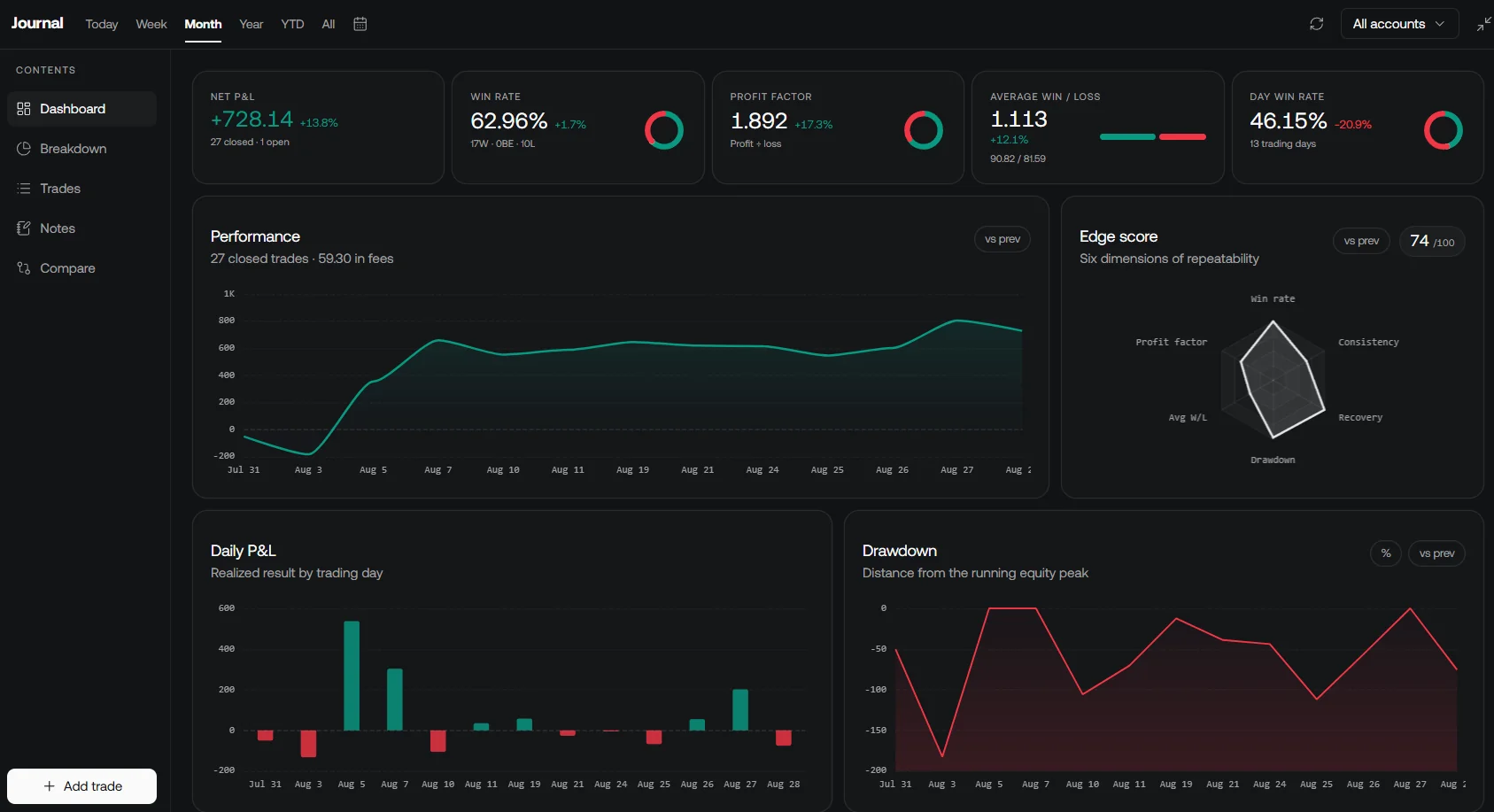
A practical update record should state the observed problem, proposed change, expected effect, evidence and rollback condition. Deploy a reviewed version deliberately rather than assuming constant retuning produces continuous improvement.
A Practical Review Checklist
| Practice | Keep this evidence | Review question |
|---|---|---|
| Refine the algorithm | Versioned rules and a baseline ledger | What changed, and does it explain the result? |
| Control risk | Sizing assumptions and aggregate exposure | What happens if the planned exit does not fill? |
| Use appropriate data | Source, timestamps and coverage | Was the information available at the decision time? |
| Test honestly | Costs and later evaluation results | Did repeated selection contaminate the test? |
| Monitor deliberately | Orders, fills and change records | Is this strategy behavior or an operational fault? |
QuantConnect Tutorial and Next Steps
The original QuantProgram QuantConnect tutorial was published July 29, 2023, although its title now says 2024. It provides a longer introduction to the platform. The creator’s “Worlds Best” description is not a comparative conclusion of this article, and older interface or API details may differ from the current platform.
Use QuantConnect’s current getting-started documentation for its Python/C# workflow. Tutorial demonstrations are not evidence that a strategy is ready for live trading. Review the actual data, brokerage and execution assumptions before connecting an account.
Choose one weakness to investigate, preserve the baseline and make the result reproducible. The five practices work together: better data cannot repair incorrect order handling, and faster code cannot turn an untested assumption into an edge.
Frequently Asked Questions
What are the five key practices for algorithmic trading?
Refine a documented algorithm, control aggregate risk, use appropriate data, test with realistic assumptions, and monitor results and changes. These practices improve the process but do not guarantee profits.
Does a stop-loss order cap my loss?
No. A stop can execute at a worse price after a gap or rapid market move. A stop-limit order can remain unfilled. Position sizing depends on assumed execution and does not establish a maximum possible loss.
Is a 1:3 risk-reward target always best?
No. Profitability depends on realized average wins, losses, win probability and costs. A target three times the stop distance does not prove the strategy achieves those payoffs.
Should I retune a strategy after every losing trade?
No. First distinguish expected variation from data or execution faults. Evaluate a documented change against a fixed baseline and later data rather than repeatedly fitting the same recent outcomes.
How can LuxAlgo support this workflow?
Use native charts to research setups, ask Quant for a precise implementation, inspect the generated code and run it yourself. Review compatible recorded trades in the journal and keep backtesting, alerts and broker execution distinct.
Read next