Prop Firms with the Fastest Payouts in 2026

The fastest prop-firm payout depends on three separate clocks: becoming eligible, getting a request approved, and receiving the money. A firm advertising an eight-hour average after approval can still require two weeks before a request. A daily option may pay a smaller profit share or impose a tighter buffer than a slower option.
This review compares FunderPro, Tradeify, Blue Guardian, Goat Funded Trader, and FTMO using official terms checked in September 2026. Tradeify’s section covers its futures programs; the other sections cover their CFD or forex-style programs. Do not transfer these terms to a separately branded futures or forex offering. Evaluation and simulated funded balances are not cash deposits you can withdraw.
Quick Comparison: Eligibility vs. Processing
| Firm / relevant program | When a request becomes possible | Published processing information | Share and key conditions |
|---|---|---|---|
| FunderPro Pro | Daily or weekly option after required profit | Typically within 24 hours after review/approval on business days; firm reports eight-hour average | Daily 60%; weekly 90%; 1% profit threshold |
| Tradeify Select Daily | After buffer and account conditions; subsequent cycles need new net profit | Daily policy describes 24–48 hours; distinguishes eligibility from processing | 90%; $250 minimum; size- and purchase-date-specific caps |
| Blue Guardian funded CFD | 14 days from first trade; seven-day add-on available | Within 24 business hours | 85% default; 90% add-on; 3% processing fee |
| Goat Funded Trader first on-demand | Eligible option, 3% profit, and three qualifying profit days | Two business days; first request clock begins after KYC | 40% first on-demand share; 2% processing fee |
| FTMO CFD account | Day 14 or later after first placed trade | Review: 1–2 business days; sending: usually another 1–2 after invoice approval | 1-Step 90%; 2-Step 80%, potentially 90%; positions/orders closed |
These are provider policies and stated averages, not an independently measured league table. Weekends, holidays, identity checks, requests for more information, and payment-provider onboarding can change the time to receipt. Compare the standard account you intend to buy, not a testimonial about someone else’s fastest withdrawal.
1. FunderPro: Daily Speed Comes with a Different Split
FunderPro’s reward-processing page says approved rewards are typically paid within 24 hours on business days, and gives an eight-hour average processing time. The clock follows review and approval. That does not establish an eight-hour journey from passing an evaluation to receiving funds, or prove it is faster than every other provider.
The frequency and eligibility policy separates One-Phase, Classic, and Pro. One-Phase and Classic normally allow a request every 14 days and require at least $100 profit. A First Reward in 7 Days add-on can shorten the first wait; it does not turn the entire schedule into daily withdrawals.
Pro offers a choice at checkout: daily rewards with a 60% profit share or weekly rewards with a 90% share. Eligibility requires profit equal to at least 1% of starting account balance. On a $100, 000 account, that is $1, 000. The choice changes how much the trader retains as well as how frequently a request can be made.
| FunderPro 100K example | Listed challenge fee | Evaluation targets | Standard reward structure |
|---|---|---|---|
| One-Phase | $539 | 10% | 80% share; biweekly |
| Classic 2-Phase | $539 | 10%, then 5% | 80% share; biweekly |
| Pro 2-Phase | $659 | 10%, then 8% | Daily 60% or weekly 90% |
These examples come from the current product selector, which lists $5, 000–$200, 000 challenge sizes. One-Phase 100K lists a 3% daily and 6% overall loss allowance; Classic and Pro list 5% and 10%. Swing options and add-ons must be compared separately, replacing the older Regular/Swing price matrix. The headline “up to 90%” is not the daily Pro share.
The fee-credit policy says Classic and One-Phase fees can be added to or credited after the first qualifying reward, while Pro challenge fees are not eligible for that credit. It also distinguishes upgrades and failed challenges. Do not treat every listed fee as refundable after any first payout.
FunderPro lists USDC on ERC 20 and Riseworks as payout routes. Verify the supported method and onboarding before requesting. Its current site also advertises a separate Instant program; Instant access, challenge pricing, and Pro daily rewards should not be combined into a single offer.
Practical tradeoff: for the same hypothetical $1, 000 eligible profit, a 60% share is $600 and a 90% share is $900 before any other applicable charges. That arithmetic does not mean waiting is always better: additional trading can lose money. Choose a schedule and risk plan together instead of chasing a payout deadline.
2. Tradeify: Select Daily, Select Flex, Growth, and Lightning
Tradeify’s payout-policy collection separates Select, Growth, and Lightning Funded. The main futures site lists standard Select evaluations at 25K, 50K, 100K, and 150K, with a separately documented 300K offer subject to availability. The original comparison’s Advanced label and single payout ladder do not describe every current program.
The Select pricing selector currently lists $109, $165, $265, and $369 standard one-time fees for 25K through 150K, before discounts, with no activation fee. The 50K evaluation lists a $3, 000 target, $2, 000 EOD trailing drawdown, no daily loss limit, and 40% consistency. After passing, the Daily or Flex payout choice is permanent for that account.
Select Daily vs. Select Flex
Under the Select policy, Daily uses a fixed buffer and daily loss limit; Flex permits a request after five qualifying winning days and has no separate daily loss limit. Both retain their drawdown rules and require positive net profit in subsequent payout cycles. Recovering a loss in the current cycle is necessary even if the overall balance remains above the buffer.
| 50K Select feature | Daily | Flex |
|---|---|---|
| Payout frequency | Daily eligibility after conditions | After five winning days of at least $150 |
| Drawdown / daily loss limit | $2, 000 EOD / $1, 000 daily | $2, 000 EOD / no separate daily limit |
| Buffer | Retain $52, 100 balance | No additional payout-buffer requirement |
| Current request formula | Up to 2× new cycle profit, within buffer and cap | Up to 50% of total profit position, within cap |
| Cap for purchases after September 1, 2026 | $1, 250 | $2, 500 |
| Minimum request / trader share | $250 /90% | $250 /90% |
A 50K Daily account at $53, 500 with $250 new cycle profit could request up to $500 under the 2× rule, provided the buffer remains intact. The 90% share would then be $450. A payout cap is the maximum request, not necessarily the amount deposited into the trader’s bank account.
Tradeify changed several Select caps around September 1, 2026. The older 50K Daily cap is $1, 000 rather than $1, 250, and the older Flex cap is $3, 000 rather than $2, 500. The policy uses before/after wording; accounts purchased on the boundary date should follow their dashboard and confirmed terms. The 300K program has separate formulas and should not be extrapolated from this table.
Growth and Lightning Have Different Requirements
The Growth policy requires five qualifying profit days, 35% consistency, and a minimum account balance. A current 50K Growth account needs $53, 000 balance; its first request ranges from $500 to $1, 500. Later maxima rise to $2, 000, $2, 500, and $3, 000 from the fourth payout. The earlier six-row table belongs to legacy accounts and should not be presented as the current universal ladder.
The Lightning policy separates profit goals from withdrawal caps. For a current 150K account, the first profit goal is $9, 000 but the first request is capped at $3, 000. The next cycle needs $4, 500 of new profit. Current consistency thresholds progress from 20% to 25% to 30%; there is no separate minimum-day count, but consistency still prevents a single large win from qualifying by itself. Lightning’s minimum payout is $1, 000.
Lightning says payments are issued within 24 hours after the approved withdrawal is processed; Growth says 24–48 hours. Requests outside stated business hours can take up to 72 hours to process. Select’s page includes both a 24-hour guarantee summary and 24–48-hour operating guidance, so a precise bank-arrival promise is not warranted. Rise and Plane are listed methods, with provider-specific setup and transfer timing.
Tradeify may fit a trader seeking frequent futures rewards, but withdrawing reduces the remaining risk cushion. A move to Elite Live is subject to review; reaching payout-count eligibility is not automatic live placement. Do not combine a marketing claim of daily payouts with Lightning’s separate profit goals or assume every plan has no funded consistency rule.
3. Blue Guardian: Check the Method Minimum and Fee
Blue Guardian’s current CFD payout policy makes standard funded accounts eligible after required trading days and 14 calendar days from the first trade. Subsequent requests are normally 14 days apart. The seven-day add-on shortens the first and later schedule according to its terms. Instant accounts have their own minimum-day and consistency requirements despite the “instant” label.
The policy states processing within 24 business hours. The account becomes read-only after the request, and trading resumes after approval. All positions and pending orders must be closed, the account must be in profit, and rule compliance still applies. The website’s claimed one-hour average for approved payouts is a different measurement from the full time to eligibility and payment.
| Blue Guardian CFD option | Default trader share | Payout detail |
|---|---|---|
| Standard funded | 85%; 90% add-on | 14-day schedule; seven-day add-on |
| Instant Standard | 80%; 90% add-on | Account-specific minimum days and consistency |
| Instant Starter | 90% fixed | One payout, maximum $250, then account closes |
| Crypto method | Applicable account share | Minimum $100; available for amounts under $5, 000 |
| Rise method | Applicable account share | Minimum $500; no method maximum stated |
All payouts carry a 3% processing fee under the current policy. A trader should therefore compare net receipts, not just the headline split. Accounts of $200, 000, $300, 000, and $400, 000 have their first two payouts capped at $10, 000 each; the cap is removed afterward, subject to the remaining account conditions.
The current forex selector shows 1-Step Standard/Nano, 2-Step Standard/Nano, and Instant. For 2-Step Standard, listed base prices are $32, $75, $154, $232, $463, and $930 for 5K through 200K, before promotions. The 100K example has 8% and 4% phase targets, 4% daily loss, and 8% static drawdown. Instant lists sizes through 400K, but has different trailing-loss and reward rules. These replace the old Unlimited/Elite/Rapid/3-Step matrix.
Check challenge versus funded permissions: the displayed 2-Step Standard 100K example permits news trading during evaluation but shows it prohibited when funded. The difference can matter more than shaving hours off payout processing. Blue Guardian’s CFD and futures platforms and policies should also be read separately.
4. Goat Funded Trader: The First On-Demand Share Is 40%
Goat Funded Trader’s first Reward on Demand policy requires an eligible option, at least 3% total profit, and at least three trading days earning 0.5% or more each. The first on-demand reward pays a 40% split. Even the 100% split add-on does not change that first on-demand share.
On a 100K account, those thresholds mean $3, 000 total profit and at least three qualifying days of $500 or more. Simply trading for three days does not qualify. This is a first-reward option, not a promise that every later payout becomes available on demand at 80–95%.
The reward and split overview lists biweekly schedules for several evaluation models, with an 80% standard share and optional 100% upgrade where offered. Instant models have separate schedules and shares; the live selector also contains newer model variants. Match the exact program and purchase agreement rather than applying one general split to all GFT accounts.
The processing policy states two business days, excluding weekends and public holidays. For the first request, that window begins after identity verification is complete. A stated $1, 000 late-processing bonus excludes delays from incomplete KYC or additional information requests. The first payout also requires signing the Trader Agreement.
| GFT method | Per-request method maximum | Important condition |
|---|---|---|
| Rise | No maximum stated | Rise verification required |
| Bank transfer | $10, 000 | Available only in listed supported countries |
| Skrill | $5, 000 | Identity verification required |
| Crypto | $4, 000 | Identity verification required |
The minimum reward request is $100. Requests must cover the full profit amount, partial withdrawals are not offered, and only one request can be pending per account. If profit exceeds the chosen method’s limit, the policy directs the trader to Rise. Bank transfer availability is currently limited to Kenya, South Africa, Egypt, Nigeria, Côte d’Ivoire, Tanzania, Cameroon, and Ghana.
The same policy imposes a 2% processing fee after the profit split and any deductions. It lists a $3, 000 daily profit cap on funded accounts and first-two-reward caps of 6% of starting balance or $10, 000, with a 4% exception for qualifying 5K Two-Step purchases from July 25, 2026. Excess profit can be deducted, so the requestable amount may be smaller than the displayed trading result.
Net-reward example: $3, 000 eligible profit at the 40% first on-demand share gives $1, 200; after the 2% processing fee, that is $1, 176, assuming no other deductions. At an 80% share the same profit would yield $2, 352 after that fee, but later eligibility, caps, and market risk still matter. An expedited option should be evaluated as a tradeoff, not a free improvement.
5. FTMO: A Clear 14-Day Eligibility Clock
FTMO’s CFD reward policy permits a claim on the 14th day or later after the first placed trade on the specific FTMO Account. All open positions and pending orders must be closed. The clock is tied to that funded simulated account, not the original evaluation purchase.
FTMO then reviews the request and says it will notify the trader within 1–2 business days. After approval and submission of the required withdrawal details, the reward is typically sent within another 1–2 business days after invoice approval. Bank arrival can take additional time. Describing this simply as “FTMO pays in 1–2 days” leaves out both eligibility and review.
The policy lists bank wire, Visa Direct/Mastercard Send up to $20, 000, Skrill up to $3, 000, and cryptocurrency. FTMO says it charges no additional reward-withdrawal commission, while minimum closed profit of $20 for bank wire or $50 for crypto covers transaction costs. Method availability and regional terms should be checked for the account actually offered.
The current 1-Step versus 2-Step comparison changes the share: 1-Step pays 90%, while 2-Step starts at 80% and can rise to 90% when qualified. Only 2-Step allows reward rollover to build the account balance under its conditions. Standard and Swing are account types, with Swing available through 2-Step, and differ in holding and news permissions.
Current CFD starting account sizes are 10K–200K, with fees from €79 for 1-Step and €89 for 2-Step. A $2 million figure is a conditional scaling ceiling, not a starting account. Likewise, the 1-Step fee is not refunded, while the 2-Step fee can be reimbursed with the first reward. A slower claim schedule may still suit a trader who prefers the selected loss rules and account structure.
How to Compare Payouts Without Rushing Your Trades
- Eligibility: record the first-trade date, minimum profit, winning-day thresholds, consistency formula, buffer, and request schedule.
- Approval: check identity verification, agreement signing, closed-position requirements, review windows, and whether trading must stop while the request is pending.
- Receipt: check business-day definitions, payment-provider onboarding, method limits, bank arrival time, and any network or processing charge.
- Net amount: apply the account’s profit split, payout cap, deductions, and fees. Keep enough room above the loss floor for the remaining strategy risk.
Treat promotional averages and guarantees as provider claims with conditions. A testimonial about receiving money in minutes cannot establish a dependable typical outcome. Nor does faster payment make a firm’s evaluation easier, its operations safer, or its contract more suitable. Keep dated copies of the selected rules and compare them with the dashboard before requesting.
The original article paired frequent payouts with scalping and slower schedules with swing trading. That is too broad: holding permissions, drawdown mechanics, execution costs, and news restrictions determine strategy fit. A swing trader may prefer periodic withdrawals, but a monthly payout schedule does not make overnight holding permissible.
Use LuxAlgo to Prepare a Repeatable Trading Plan
LuxAlgo is a charting and AI platform. Study market context on native charts, then work with Quant, our coding agent to develop explicit entries, exits, sessions, and position sizing. Inspect the generated code and run the strategy yourself. Historical results do not automatically enforce a prop firm’s loss floor, eligibility formula, or payout rules.
Use native strategy backtesting with standard candles, realistic commission and slippage, and sufficient history across different conditions. Reserve a separate sample for evaluation after development. Record session losses, losing streaks, open-trade exposure, and the effects of excluding prohibited news windows.
For example, an account with a $2, 000 remaining loss cushion should not be sized as though its nominal 50K balance were fully available to lose. Four $250 planned losses consume half that cushion before costs. If a payout reduces the balance or a trailing floor rises, recalculate the cushion before the next trade. Alerts can support the routine; they do not guarantee stop execution or rule compliance.
Market-structure, trend and momentum tools from the Library are one click from a Quant Chart. A signal or pattern label is not proof of an institutional position and does not guarantee a qualifying payout.
Verify platform compatibility and automation permissions with the chosen firm. Check current LuxAlgo pricing for access and billing terms rather than mistaking an annual-equivalent monthly price for month-to-month billing.
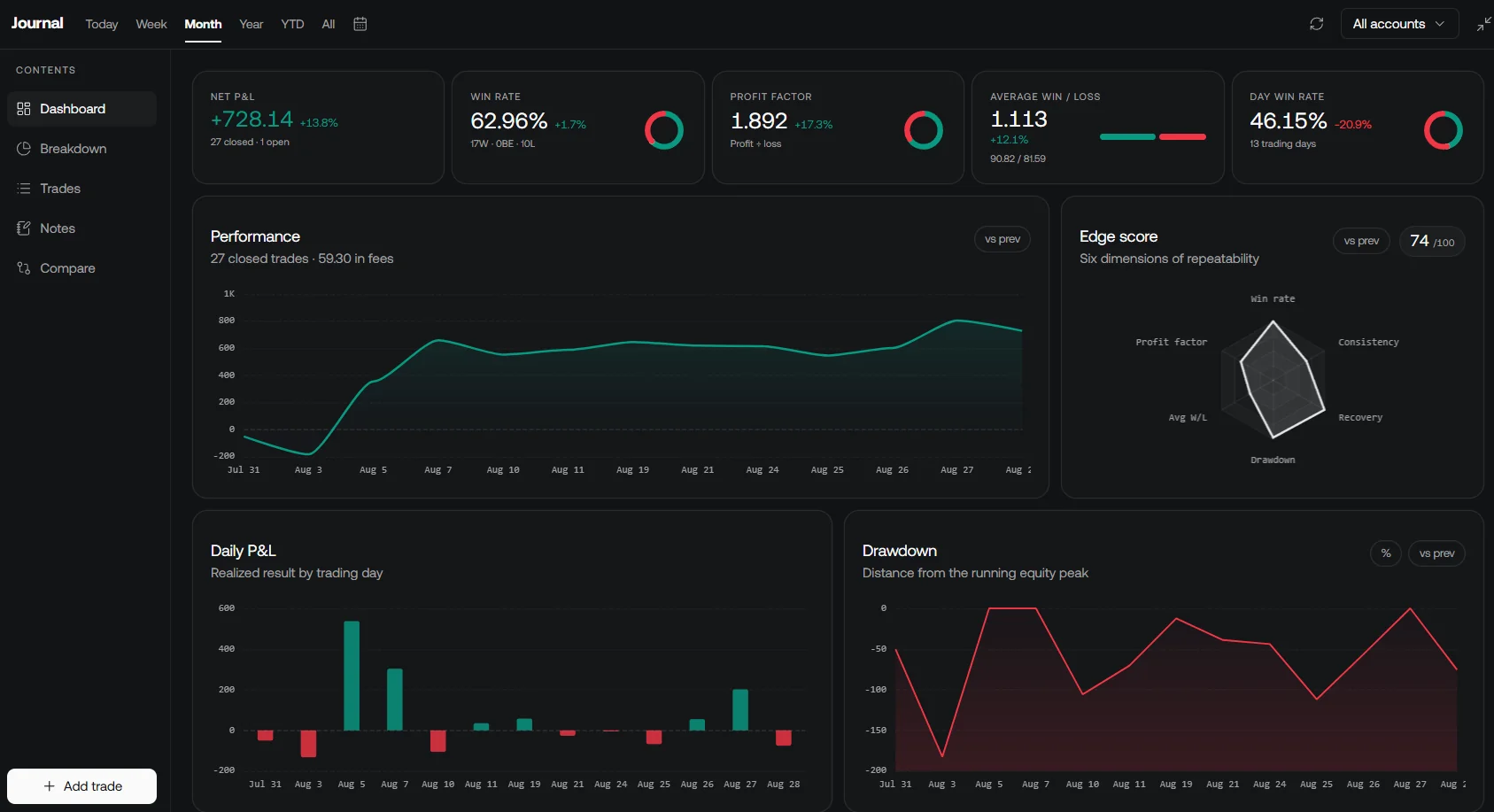
Use supported imports in the native LuxAlgo journal to compare actual trading with the plan. Look for oversized positions, trades added to meet a deadline, and differences between tested and actual costs. Improving the process is more useful than repeatedly changing a strategy to fit the next withdrawal date.
The LuxAlgo Prop Firms portal can help compare offers and explore modeled scenarios. Its assumptions and reference rule profiles must match the current program; modeled results are not an observed personal pass probability. Verify a promotion and its add-ons against the official terms before deciding that the cheapest entry produces the best net outcome.
Frequently Asked Questions
Which prop firm pays the fastest?
Compare the specific program’s eligibility, approval, and transfer clocks. Provider averages measured after approval are not directly comparable with a waiting period before the first request.
Are daily payouts always better?
No. Daily options may have a lower profit share, tighter risk limits, a retained buffer, or smaller request caps. Compare net proceeds and the risk cushion left after withdrawal.
Can I request Goat Funded Trader rewards after just three trading days?
Not automatically. Its first on-demand option requires at least 3% total profit and at least three days earning 0.5% or more each. The first on-demand share is 40%, and processing and other account conditions still apply.
Can LuxAlgo guarantee payout eligibility?
No. Charts, Quant, the Library, and the journal support strategy research and review. The prop firm’s current rules, account performance, and approval process determine eligibility.
Read next