Dead Cat Bounce
 By LuxAlgoOct 9, 2026
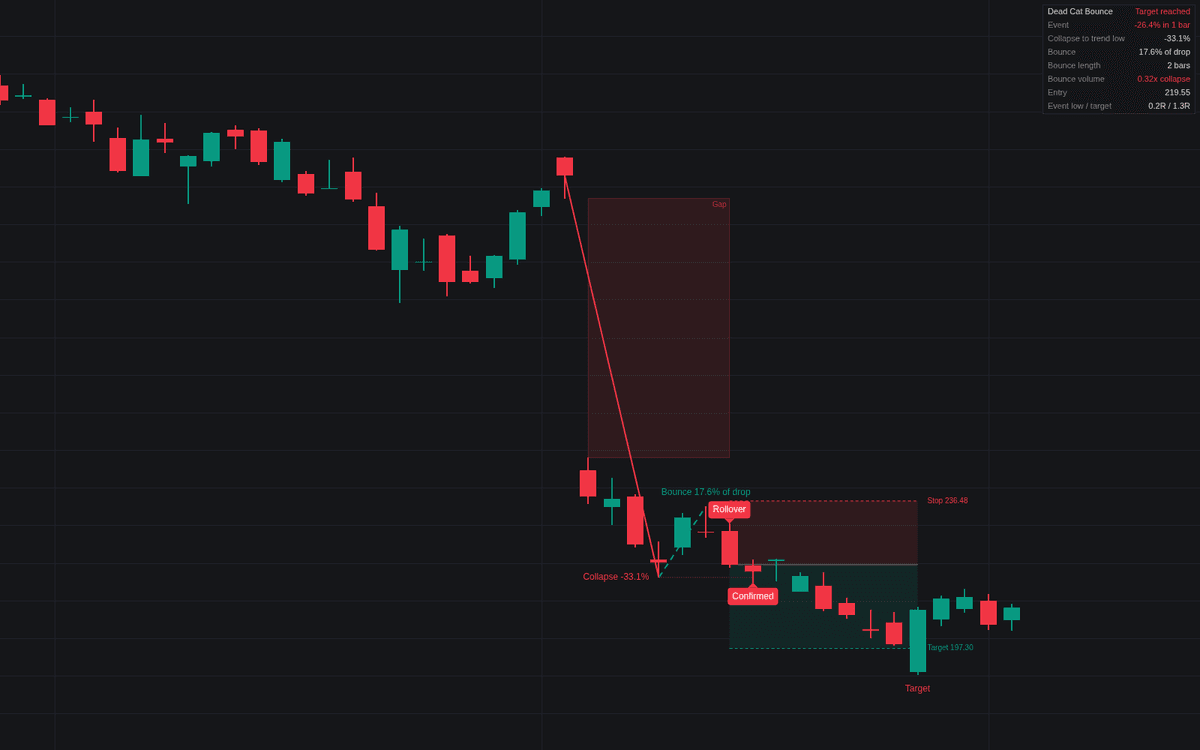

The Dead Cat Bounce indicator provides a systematic approach to identifying and trading the classic technical pattern characterized by a rapid price collapse followed by a weak, temporary recovery. By monitoring price action through a set of strict, user-defined criteria, this tool helps traders isolate potential short-selling opportunities as a temporary rebound loses momentum. It automatically tracks the event from the initial shock, through the subsequent bounce, and provides entry signals when the price rolls over to resume its downtrend, offering clear trade planning with predefined stop-loss and target levels.
How to Trade the Dead Cat Bounce?
To utilize this indicator effectively, wait for the algorithm to detect a significant, sudden price collapse that meets your defined percentage and ATR-based thresholds. Once the collapse is identified, the indicator marks the "Event Low," which serves as a critical pivot for the upcoming trade.
The strategy focuses on the rebound phase: if the price rallies but fails to recover the entire decline before rolling over, it confirms the "dead cat" nature of the move. You should look for the rollover signal, which occurs when the price closes below the lowest low of recent bounce bars. This is your primary entry trigger.
The indicator automatically calculates the stop-loss based on the bounce high plus a buffer, and defines profit targets at either the initial event low or a measured move beneath it. A short position is considered confirmed once the price breaks back below the established event low. If the price manages to recover too much of the initial drop, the indicator voids the setup, helping you avoid premature entries into what might instead be a V-shaped recovery.
Dead Cat Bounce Settings
Collapse
- Collapse (%): Sets the minimum and maximum decline percentage required to classify an event as a valid collapse.
- Collapse Window (Bars): Defines the duration allowed for the collapse to occur.
- Minimum Collapse (ATR): Ensures the drop is significant relative to recent volatility.
- Event Low Window (Bars): The number of bars after the initial event during which new lows are allowed to extend the reference point for the bounce.
Bounce & Rollover
- Minimum Bounce (% of Drop): The minimum rebound percentage from the event low required to qualify the move as a bounce.
- Recovery Void (% of Drop): The percentage of the collapse that, if recovered, invalidates the pattern.
- Maximum Bounce Length (Bars): The time limit for the bounce before it is considered a failed setup.
- Rollover Length (Bars): The period of recent bounce bars used to determine the rollover trigger; a close below the low of these bars signals a short entry.
Trade Plan
- Final Target: Choose between exiting at the Event Low or projecting the bounce height below it for a further objective.
- Stop Buffer (ATR): The multiplier applied to the ATR to set the protective stop above the bounce high.
- Maximum Attempts: Limits the number of short entries allowed per event.
- Maximum Hold (Bars): Closes the trade if neither the stop nor the target is reached within this period.
Frequently Asked Questions
Free on Vela
Run it on Vela. Go further with a paid plan.
- Up to 500 strategy alerts, with webhook automation
- Up to 10× the chart history of Free
- Orderflow lookback up to full history
- Up to 100,000 monthly credits for Quant to customize it
- Futures data alongside crypto, stocks, forex and commodities

Run it on Vela. Make it yours with Quant.
Open this indicator free on Vela, our next-generation charting platform. Then ask Quant, our coding agent built into Vela, to retune it or turn it into a backtested strategy of your own.