Dead-cat Bounce
Dead-cat Bounce, also known as DCB, inverted dead-cat bounce, is a Chart & Candlestick Patterns concept. The Library holds 1 implementation, a working definition you can pull into Quant.
Top Dead-cat Bounce indicator
The top custom implementation, built on the original standard Dead-cat Bounce formula.
1 total
The Dead-cat Bounce implementation below can become a backtested trading strategy — describe your rules and Quant writes the code.
What is a Dead-cat Bounce?
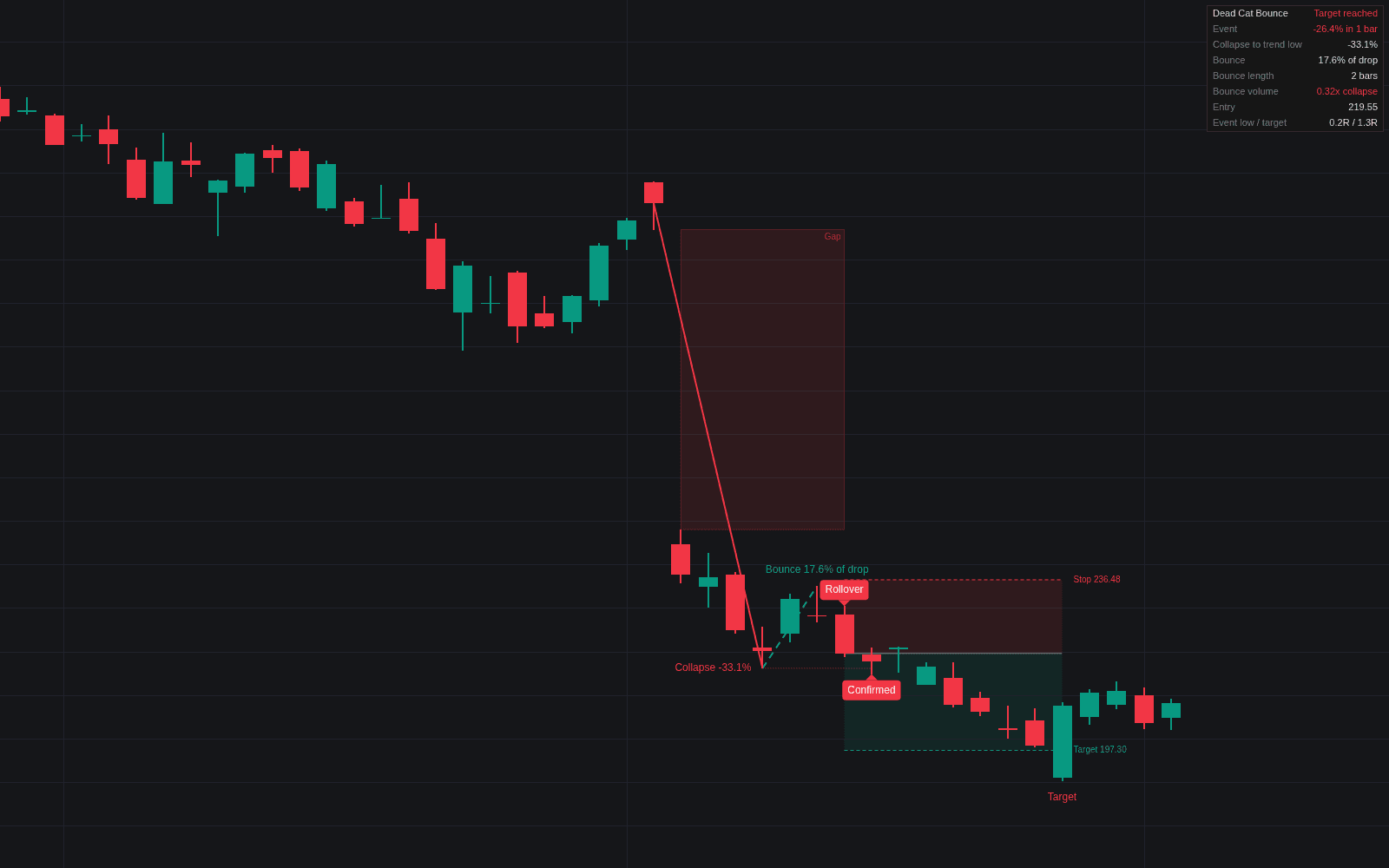
A dead-cat bounce is a short-lived recovery after a steep collapse that fails and gives way to further decline. The name comes from the market saying that even a dead cat will bounce if it falls from a great height; its earliest widely cited appearance in print is a December 1985 Financial Times report on the Singapore and Malaysian stock markets, which kept falling after the rebound it described. In loose usage the label covers any relief rally inside a downtrend, and it is always applied in hindsight: a bounce only becomes a dead-cat bounce once it fails.
Thomas Bulkowski gave the term a testable definition as an event pattern in the second edition of his Encyclopedia of Chart Patterns. His version starts with a one-day collapse, a stock closing 15 to 70 percent below the prior day's close, usually on a downward gap. Price often keeps sliding for a few more sessions to an event trend low, then bounces, then rolls over into a post-bounce decline that in most of his samples carried price below the event low. The book's third edition drops event patterns, but his pattern site still documents the definition.
The mechanics explain why the bounce happens even when the bad news is real. A collapse that ends in capitulation exhausts the urgent sellers and leaves short sellers on large gains, so covering and bargain-hunting lift price off the low. Nothing in that flow repairs the reason for the collapse. When the buying dries up, holders trapped by the gap sell into the higher prices, and the decline resumes.
How to identify a dead-cat bounce
Bulkowski's event version on a single stock is the strict form; the same sequence on an index is the loose form.
- 1Find the event: a one-day collapse, often on bad news such as an earnings miss, in Bulkowski's terms a close 15 to 70 percent below the prior close, usually on a downward gap.
- 2Mark the event trend low; price often extends lower for several sessions after the event day before a low holds.
- 3Watch the bounce: a rebound that retraces part of the collapse but stalls below the pre-event price, often under the gap and on lighter volume than the collapse.
- 4Look for the failure: the bounce rolls over into a lower high, the bearish step in swing structure, and heads back toward the event low.
- 5Settle the label only in hindsight: a break of the event trend low confirms it, and until then the bounce could still be the start of a bottom.
How traders use it
- As an exit for trapped holders: Bulkowski's suggestion for owners is to sell into the bounce, near its peak if it can be judged, rather than at the event low.
- As a short setup for experienced traders: short the bounce's failure, after a lower high or a rejection at the gap, with the stop above the bounce high and the event low as the first objective.
- As a brake on bottom-fishing: buying the first rebound after a collapse is the trade this pattern punishes. Bulkowski limits bounce buying to short-term swing trades near the event low after very large declines, which he puts at over 30 percent.
- As a structure test: a rebound that reclaims the gap and then holds a higher low argues for a base or a V-bottom; one that fails into a lower high argues for continuation.
Dead-cat bounce vs related moves
Bull/bear Flag: A bear flag is a brief, shallow drift after a sharp pole that resolves quickly in the pole's direction. A dead-cat bounce is a larger rebound after an event collapse, defined by its failure rather than by a channel shape.
Pullback: A pullback is any countertrend move inside an intact trend; the dead-cat bounce is the specific case after a collapse, named for the expectation that the low will be revisited.
V-top/V-bottom: A V-bottom is the opposite outcome: the rebound retraces the collapse at comparable speed and keeps going. A dead-cat bounce recovers only part of the decline before failing.
Exhaustion Gap: An exhaustion gap ends a move, so its extreme should hold. When a bounce fails and the event low breaks, the gap was not exhaustion.
Concept family
Chart & Candlestick Patterns
88 concepts mapped · 88 in the Library
Dead-cat Bounce FAQ
Turn Dead-cat Bounce into a trading strategy.
Take the implementation from this page into Quant, then build on it, backtest it on real data, and keep refining it in conversation.