Garman-Klass–Yang-Zhang Hybrid
 By LuxAlgoJun 25, 2026
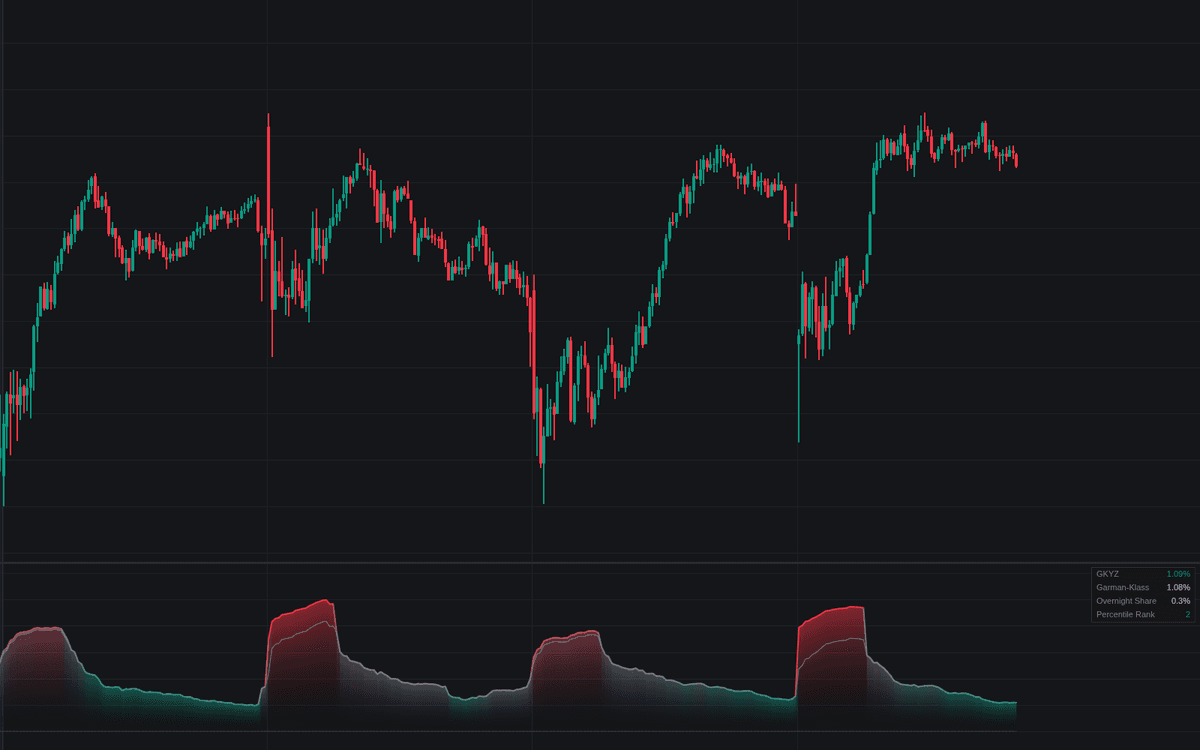

Garman-Klass–Yang-Zhang Hybrid extends range-based volatility to the hours the market is closed: each bar's variance adds the squared overnight (close-to-open) jump to the classic high-low-and-body formula, and the window average is annualized into the line. As a build of the Garman-Klass–Yang-Zhang hybrid, its signature is the gap-share read: plain Garman-Klass runs alongside, and the spread between the lines is exactly the variance arriving overnight.
How to Trade the Garman-Klass–Yang-Zhang Hybrid?
- Compression: the rank under the low threshold marks a quiet stretch, where quiet includes calm overnights, the kind that precedes expansion.
- Expansion: the rank crossing over the high threshold confirms broadening movement.
- Overnight Share Rising: the close-to-open term crossing your alert share of variance says gap risk is in charge.
- Line spread: GKYZ jumping while the comparison line stays flat isolates a gap event from session churn.
Garman-Klass–Yang-Zhang Hybrid Settings
- Window Length (default 20): bars averaged; the overnight term adds information per bar, so short windows stabilize quickly.
- Annualize (default enabled) with Bars Per Year (default 252): the comparability scaling. Intraday charts must count actual bars per year.
- Garman-Klass Comparison (default enabled): the identical formula minus the overnight term.
- Overnight Share Alert Level % (default 50): the share of window variance above which the gap-risk alert fires; 50 marks more variance arriving closed than open.
- Percentile Lookback (default 100) with High Percentile (80), Low Percentile (20) and Show Percentile Levels (default disabled).
- Show Dashboard (default enabled); colors and Gradient Fill are cosmetic.
Frequently Asked Questions

Original indicatorBuilt in-house by LuxAlgo
The Library is free. Quant makes it yours.
Pull any concept or indicator into Quant: rebuild it, retune it, or turn it into a backtested strategy of your own.