Swing Index
 By LuxAlgoApr 21, 2026
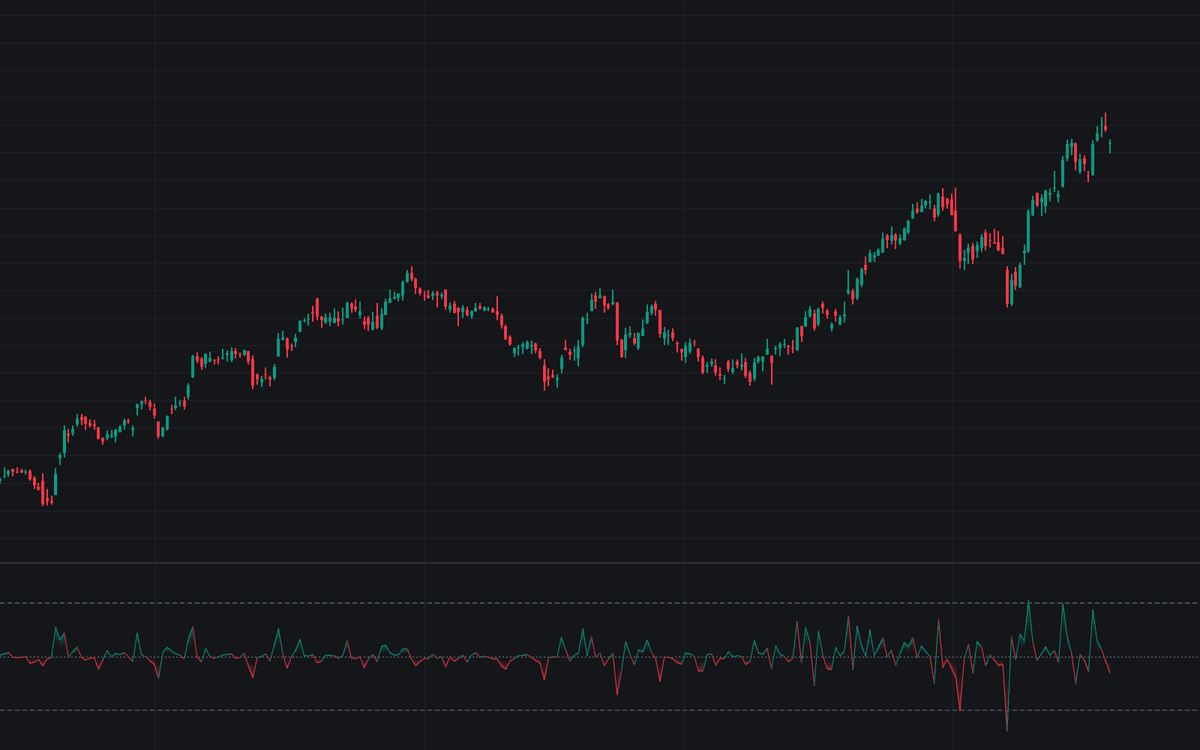

Swing Index computes Wilder's per-bar reading as published, then solves its one modern problem: the scale. The Swing Index folds the close-to-close change, both bars' open-close positions and the dominant excursion from the prior close into one signed number, scaled by the limit move T that his era's futures exchanges provided and most modern markets do not. Auto mode in this first faithful build sets T to the highest excursion over a lookback, so the largest recent swing reads near the extremes; the line colors by sign over a gradient fill, framed by dashed strong-swing levels.
How to Trade the Swing Index?
- Sign: above zero the net two-bar change is bullish, below zero bearish. Zero crossings carry alerts both ways.
- Strong swings: readings beyond the Strong Swing Levels mark single bars doing unusual directional work, with crossing alerts on each side.
- Breakout validation: a fresh high over the Breakout Lookback met by a strong positive reading fires Validated New High, Wilder's argument that the extreme is genuine rather than a spike; the mirrored check covers new lows.
Where no limit move exists T is a convention, so the sign and the relative size of readings do the work. The effective T is exposed in the data window.
Swing Index Settings
- Limit Move (T) (default Auto (Highest Excursion)): how the scaling factor is set; Fixed Value uses the entered constant.
- Fixed Limit Move Value (default 1.0): T in price units for Fixed Value mode.
- Auto Scaling Lookback (default 252): bars inspected for the highest excursion in Auto mode.
- Strong Swing Levels (default 50 / -50): thresholds used by the strong-swing and validation alerts; tune them to the instrument.
- Breakout Lookback (default 20): window defining the new highs and lows the validation alerts test.
Frequently Asked Questions

The Library is free. Quant makes it yours.
Pull any concept or indicator into Quant: rebuild it, retune it, or turn it into a backtested strategy of your own.