Concept
Swing Index
Swing Index is a Momentum & Oscillators concept. The Library holds 1 implementation, a working definition you can pull into Quant.
Wilder
Top Swing Index indicator
The top custom implementation, built on the original standard Swing Index formula.
1 total
From studying Swing Index to trading it: take the implementation below into Quant and backtest it instantly.
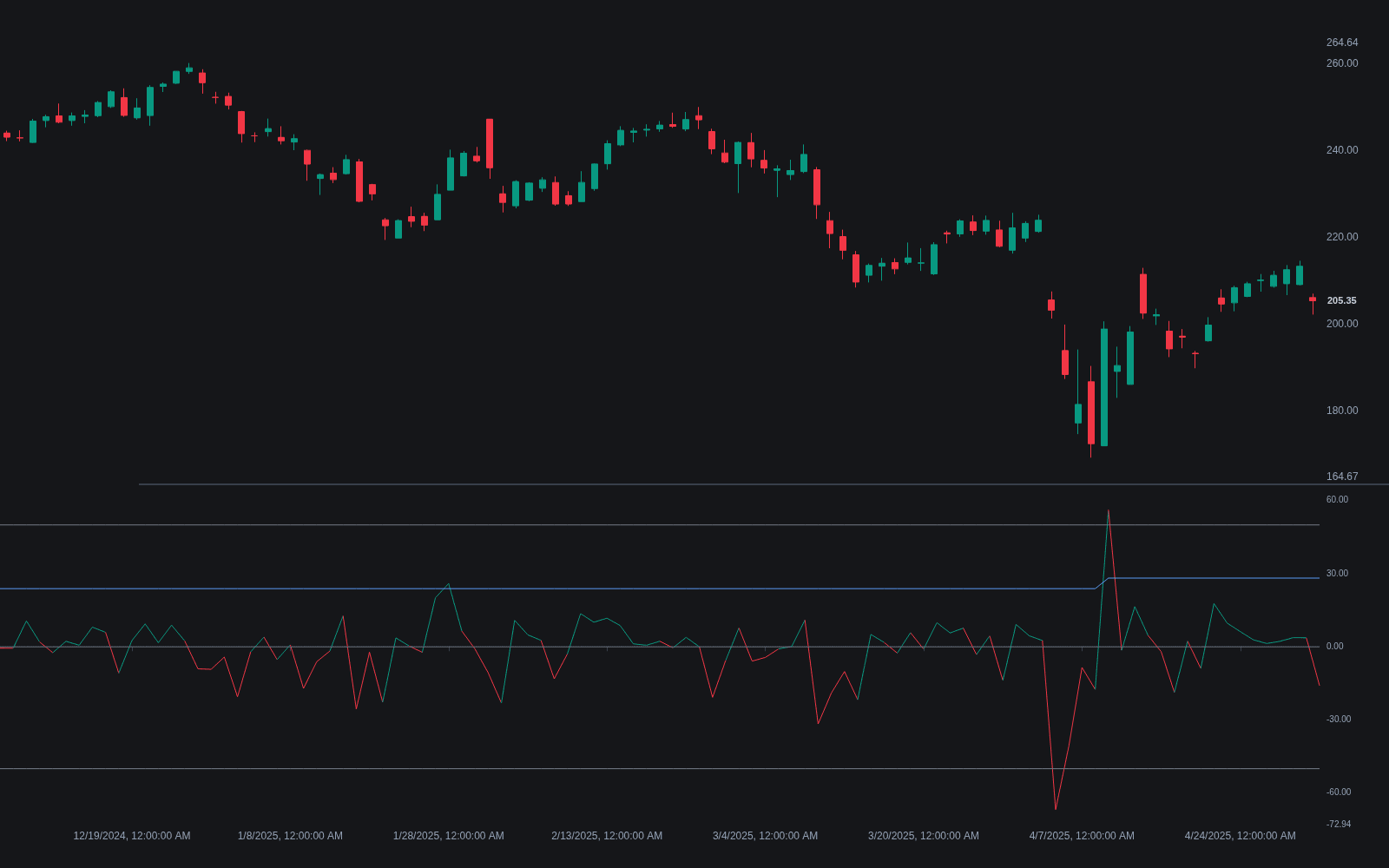
What is the Swing Index?
The Swing Index is J. Welles Wilder's attempt to distill the 'real' price change between two consecutive bars into a single number, using the current bar's open, high, low, and close together with the previous bar's open and close rather than just the closes. Published in New Concepts in Technical Trading Systems (1978) alongside RSI, ATR, and Parabolic SAR, it weighs the close-to-close change, the close-to-open positions of both bars, and the dominant excursion of the current bar against the prior close, then scales the result to a range of roughly -100 to +100 per bar.
Wilder built it for commodity futures of his era, which is visible in the formula: the scaling factor T is the value of a limit move, the maximum amount an exchange allowed a contract to move in one session. A bar that used its entire permitted move registered near the extremes. On modern markets without limit moves, T becomes an arbitrary scaling constant that implementations set in different ways, which is the single largest practical caveat when comparing readings across platforms.
On its own, a one-bar reading is noisy and rarely traded directly. The Swing Index's enduring role is as the raw material for the Accumulative Swing Index, the running total Wilder used to draw a cleaner version of the price chart itself, one whose trendline breaks and swing points he considered more trustworthy than the same features on raw price.
How it's calculated
Wilder's formula compares the current bar with the previous one, normalizes by a range term R, and scales by the limit-move factor.
Because T has no natural value on non-limit markets, absolute SI levels are not comparable across platforms; the sign and relative magnitude carry the information.
How traders use it
- Primarily as the input to the Accumulative Swing Index, where the running total of daily SI values forms a derived line that traders analyze with trendlines and swing highs and lows in place of raw price.
- As a gap-aware strength reading: because it uses opens and the prior close, the SI credits gaps that close-only momentum misses, useful on daily bars of gap-prone instruments.
- As a confirmation check on individual bars: a wide-range bar with a modest SI reading suggests the bar's travel was mostly intrabar churn rather than net progress from the prior close.
- In breakout validation, Wilder's own use: a new price high accompanied by a strong positive SI (and a new ASI high) argued the breakout was genuine rather than a spike.
- With realistic limits: it is a two-bar statistic, so it says nothing about larger structure, and on markets without limit moves its scale is a convention rather than a measurement.
Swing Index vs related measures
Accumulative Swing Index: The ASI is simply the running sum of Swing Index values. The SI is the per-bar reading; almost all charting and signal work happens on the accumulated line, not the raw one.
Williams A/D: Williams' accumulation/distribution also builds a cumulative line from bar-versus-prior-bar relationships, but from simpler true-range-style terms. Wilder's SI weighs opens explicitly and scales to a bounded per-bar reading first.
Momentum: Plain momentum is the close-to-close difference over a lookback. The Swing Index confines itself to two adjacent bars but uses six of their prices (both opens and closes plus the current high and low), trading breadth of window for depth of bar detail.
Concept family
Momentum & Oscillators
91 concepts mapped · 91 in the Library
Swing Index FAQ
Turn Swing Index into a trading strategy.
Take the implementation from this page into Quant, then build on it, backtest it on real data, and keep refining it in conversation.