Three Rising Valleys & Falling Peaks
 By LuxAlgoOct 9, 2026
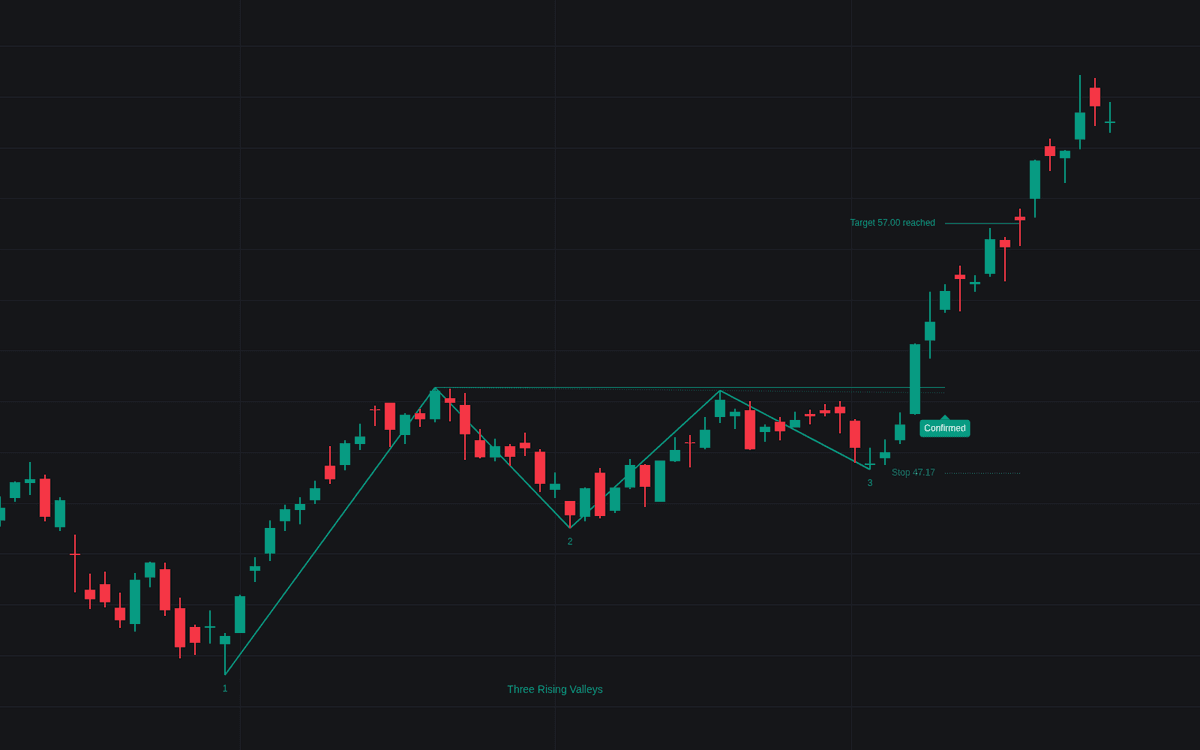

The Three Rising Valleys & Falling Peaks indicator is a sophisticated pattern detection tool designed to identify specific price structures derived from classical technical analysis research. This indicator automates the identification of three sequential valleys that progressively rise or three sequential peaks that progressively fall. By quantifying these patterns through volatility based metrics and proportional tolerance, it provides traders with objective confirmation levels, potential early entry signals, and statistically derived price targets, helping to remove subjective guesswork when evaluating market reversals and continuations.
How to Trade the Three Rising Valleys & Falling Peaks?
Trading these patterns relies on identifying the completion of the three-point structure and waiting for the confirmed breakout. For Three Rising Valleys, the pattern identifies a series of higher lows, suggesting potential bullish momentum. The pattern is officially confirmed when the price closes above the highest peak formed between these valleys. Some traders may opt for an early entry if the price breaks above a descending trendline drawn across the peaks before the official confirmation occurs.
For Three Falling Peaks, the indicator tracks a series of lower highs, which often indicates bearish pressure or a weakening rally. This pattern is confirmed when the price closes below the lowest valley formed during the structure.
Once confirmed, the indicator displays a target level and a stop level based on the pattern height and volatility. The stop is generally placed near the third extreme of the pattern, while the target is calculated as a percentage of the pattern height. Traders should monitor the post confirmation window to ensure the price moves toward the target before the pattern expires or is invalidated by a break of the stop level.
Three Rising Valleys & Falling Peaks Settings
Pattern Detection
- Swing Length: Defines how many bars to the left and right a high or low must dominate to be considered a confirmed swing.
- Minimum Step (ATR): Sets the required distance in average true range units between each valley or peak.
- Maximum Span (bars): The maximum number of bars allowed from the first to the third valley or peak.
- ATR Length: The period used for calculating volatility for step and stop distance measurements.
Shape & Context
- Proportion Tolerance (x): Controls the consistency of the pattern. It ensures the height and width of each leg remain within a specific ratio to maintain structural similarity.
- Prior Trend Window (bars): The period used to determine the price direction before the pattern begins, which helps classify the sequence as a continuation or reversal.
Confirmation & Targets
- Early Entry Trendline: Enables an early buy signal for rising valleys when the price closes above a trendline connecting the two highest peaks.
- Confirmation Window (bars): The time allowed for a price close to breach the confirmation level before the pattern is considered invalid.
- Rising Valleys Target %: The projected target for bull patterns based on the pattern height.
- Falling Peaks Target %: The projected target for bear patterns based on the pattern height.
- Stop Buffer (ATR): Adds a buffer to the stop loss level, placed just beyond the third valley or peak.
- Post-Confirmation Watch (bars): How long the indicator tracks the target and stop levels after the initial confirmation.
Frequently Asked Questions
Free on Vela
Run it on Vela. Go further with a paid plan.
- Up to 500 strategy alerts, with webhook automation
- Up to 10× the chart history of Free
- Orderflow lookback up to full history
- Up to 100,000 monthly credits for Quant to customize it
- Futures data alongside crypto, stocks, forex and commodities

Run it on Vela. Make it yours with Quant.
Open this indicator free on Vela, our next-generation charting platform. Then ask Quant, our coding agent built into Vela, to retune it or turn it into a backtested strategy of your own.