Volume Flow Indicator
 By LuxAlgoApr 17, 2026
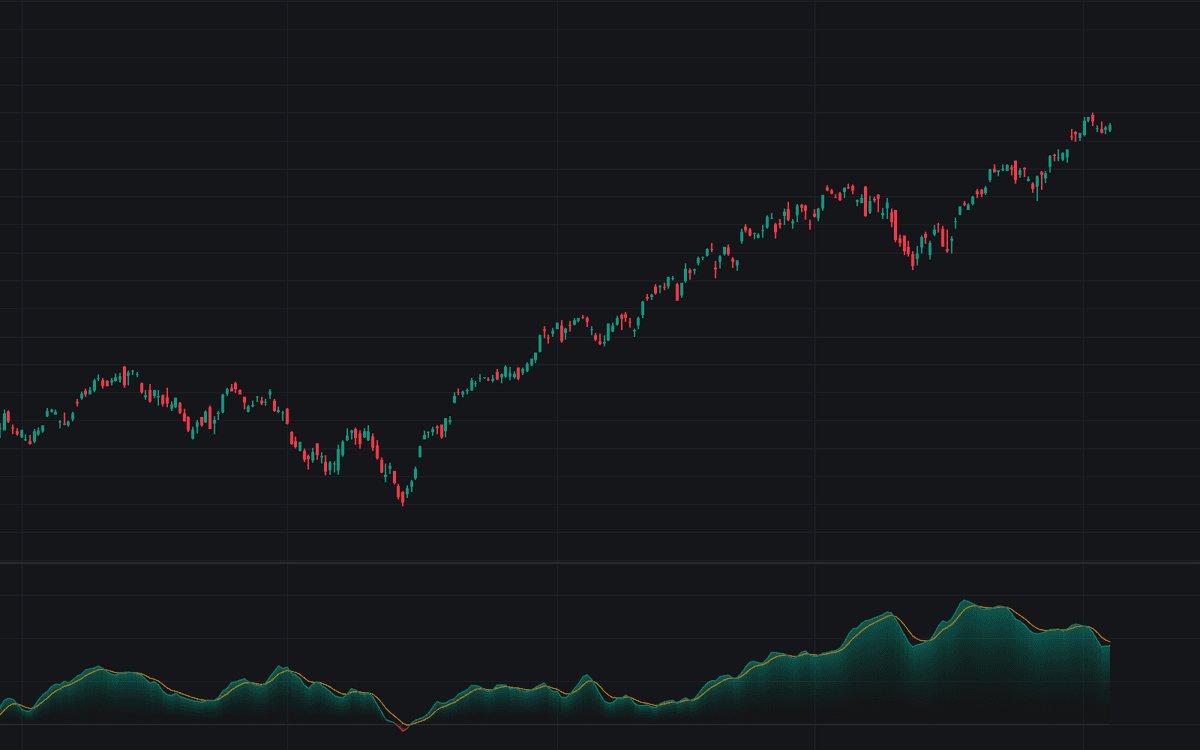

Volume Flow Indicator implements the published Volume Flow Indicator construction exactly: volume takes its sign from each typical-price change, but only once the move exceeds an adaptive noise floor; contributions are capped at 2.5 times average volume; and the filtered sum over 130 bars is scaled by average volume into an oscillator around zero. The line prints bullish above zero and bearish below with a gradient fill toward the zero line, carries the published 3-bar smoothing, and adds an optional 5-period signal line.
How to Trade the Volume Flow Indicator?
- Cross above zero: net volume flow turning to accumulation, the regime read the design was built for.
- Cross below zero: net flow turning to distribution.
- Signal-line crosses: earlier, more frequent turns in flow for traders who want a faster read than the zero line alone.
The 130-bar default targets position-horizon work (roughly half a trading year on dailies), so treat the line as a slow regime gauge among volume and order-flow tools. All four crossings carry alerts.
Volume Flow Indicator Settings
- Length (default 130): the summation window, also used for the scaling average volume; shorter responds faster but surrenders the design's steadiness.
- Cutoff Coefficient (default 0.2): scales the volatility-based minimum change in typical price. Smaller moves count as noise and contribute no volume.
- Volume Cap Multiplier (default 2.5): bounds each bar so one climactic print cannot distort the line for months.
- Volatility Length (default 30): window of the deviation behind the adaptive cutoff.
- Smooth VFI (default enabled, 3 bars): the published light smoothing.
- Signal Line (default enabled, 5 bars): the crossover addition.
- Style toggles cover the directional colors and the zero-line gradient fill.
Frequently Asked Questions

The Library is free. Quant makes it yours.
Pull any concept or indicator into Quant: rebuild it, retune it, or turn it into a backtested strategy of your own.