Windowed FIR Smoothing
 By LuxAlgoMar 24, 2026
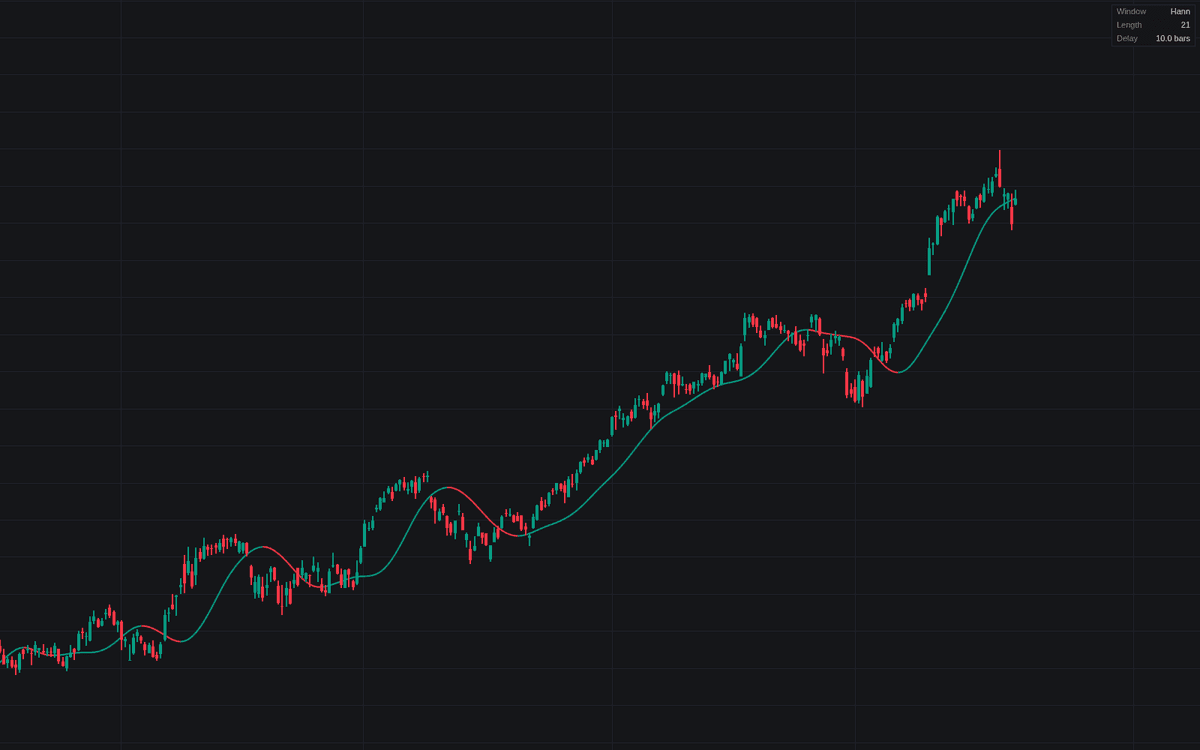

Windowed FIR Smoothing is the definitive clean build of windowed FIR smoothing: a moving average whose weights come from a chosen window profile, normalized to sum to one. Hann tapers to zero at both edges, Hamming leaves the edges a small residual weight, Triangular ramps to the middle, and Rectangular weights every bar equally, exactly the simple moving average. Symmetric FIR weights delay everything equally, so the cost is a known constant of (N - 1) / 2 bars, and the dashboard states it outright.
How to Trade the Windowed FIR Smoothing?
- Slope as trend: the line rising or falling is the regime read of the smoother, with slope-turn alerts at each flip.
- Price crossings: the source crossing the FIR Average reads exactly like a moving-average cross; optional markers, alerts either way.
- Fast/slow pair: with the second average shown, the fill tracks which line is on top, a two-average momentum gauge with cross alerts.
The Delay-Aligned Reference re-plots the primary average shifted back by its delay, so the shifted line lands on the price movement it preserved, a benchmark for judging faster, overshoot-prone filters.
Windowed FIR Smoothing Settings
- Source (default close): series being smoothed.
- Window (default Hann): the weight profile; Hamming, Triangular and Rectangular (SMA) are alternatives.
- Length (default 21): bars N in the window. Pick it with the (N - 1) / 2 bar delay in mind.
- Show Second Average (default off) and Second Length (default 50): the slower half of the fast/slow pair.
- Show Dashboard (default on), Position (default Top Right), Size (default Small): the window, length and delay readout.
- Style toggles: Slope Trend Coloring and Fill Between Averages (on by default); Delay-Aligned Reference and Price Crossing Markers (off by default).
Frequently Asked Questions

The Library is free. Quant makes it yours.
Pull any concept or indicator into Quant: rebuild it, retune it, or turn it into a backtested strategy of your own.