Can Retail Algo Traders Compete with Wall Street?

Retail algo traders can compete in selected strategies, but accessible software does not remove Wall Street’s advantages in capital, data, execution and research. The practical goal is to find a repeatable process that works after costs at your own scale—not to assume that a home trading system can win an institutional speed race.
A smaller account may have more freedom to wait, trade a limited opportunity or avoid deploying capital. Those are potential advantages, not evidence of profitability. A strategy still needs realistic testing, suitable liquidity, reliable operations and a loss level the trader can sustain.
- Choose the right competition: distinguish slower signal research from latency-sensitive market making.
- Use size carefully: smaller orders may be easier to execute, but thin markets can still be expensive and risky.
- Measure a real edge: compare results after costs with a defined baseline and genuinely later data.
- Build an operating process: monitor data, orders, positions and failures rather than treating automation as unattended income.
Retail Traders and Institutions Are Not One-Size-Fits-All Groups
“Wall Street” includes market makers, proprietary trading firms, hedge funds, banks and asset managers. Their mandates, holding periods and technology differ. Some specialize in very fast execution; others invest over months or years. It is misleading to describe every institution as slow, benchmark-bound or dependent on outdated systems.
Retail traders also vary. A developer running a daily portfolio model faces different demands from someone trading short-lived intraday signals. Compare the particular strategy and operating requirements, rather than treating retail versus institutional status as the deciding variable.
| Dimension | Potential retail position | Institutional position and caveat |
|---|---|---|
| Capital and capacity | Smaller trades can fit opportunities with limited capacity | Large capital pools need sufficient capacity; specialized small firms also pursue niches |
| Decision freedom | Can wait, stay in cash or change a personal mandate | Constraints vary by fund, client mandate and business model |
| Research and data | Public datasets and accessible tools lower entry barriers | Dedicated teams, licensed datasets and infrastructure can support deeper research |
| Execution | Ordinary broker interfaces may suit slower strategies | Some firms invest heavily in venue connectivity and low-latency execution |
| Operations and risk | One person can act quickly but is also a single point of failure | Specialist teams and layered controls provide resources, with coordination costs |
How Retail Algo Traders Build Their Systems
A retail workflow generally combines a hypothesis, data, a test engine, order handling and monitoring. Some platforms cover several of these functions; others provide research or charting only. Keep the roles explicit so an attractive backtest is not confused with a working execution system.
Code-based and no-code development
QuantConnect documents Python and C# for algorithm development. A code-based approach can make custom rules and tests easier to express, but the trader must still understand data conventions, engine behavior and deployment requirements. A platform’s community size does not establish the quality of a particular strategy.
Tradetron describes a cloud-based strategy builder, testing and automation workflows without requiring users to write code. Check the supported region, exchanges, broker connections and plan for the intended use. Visual rules still need to be inspected: no-code development does not remove model errors, missing conditions or execution risk.
Charts can help investigate an idea before implementation. MetaTrader 5 uses MQL5 and Expert Advisors for its automated-trading workflow; the connected broker determines instruments and account conditions. Research software, data access and brokerage services are separate choices even when they appear in one interface.
Paper trading and live operations
Use a simulated environment to exercise signals, order handling and recovery before considering live deployment. Alpaca’s paper-trading documentation explains that the simulator does not restrict order quantity to the available size at the best quote. Paper results therefore cannot establish what a real order would fill in the same quantity.
A functioning system also needs stale-data checks, logs, order identifiers, position reconciliation and a defined response to disconnects. A timeout after order submission can leave the outcome unknown. Reconcile broker state before deciding whether to resubmit, rather than blindly creating another order.
Automation can reduce repeated discretionary intervention, but people still choose the rules, optimize parameters and decide when to override or stop a system. It can repeat a mistake faster as well as enforce a valid rule consistently.
Where Institutions Have Substantial Advantages
Execution infrastructure and market access
For strategies whose opportunity disappears almost immediately, venue connectivity, data processing and order handling can be central to the business. A broker’s internal processing statistic is not the same as the delay from your signal through the network to an actual fill. Do not infer competitive end-to-end speed from a vendor’s isolated latency figure.
Access and economics also matter: account permissions, financing, borrow availability, venue fees and data entitlements can affect what a strategy can do. These vary by market and relationship. A small account should not assume it receives the same terms or can implement every trade described in institutional research.
Research, alternative data and specialization
Institutions may fund specialist researchers, engineering teams and datasets covering news, company activity, consumer behavior or other observations. Some alternative datasets are commercially available to smaller users too. They are not necessarily exclusive, and access alone does not prove useful prediction.
Before using such data, establish when it became available, what revisions occur and whether the license permits the intended use. Historical observations collected or cleaned later can introduce information that was unavailable at the supposed decision time. A sophisticated model cannot repair that evaluation error.
Capacity, mandates and controls
Larger orders can create a capacity problem: deploying more capital may increase execution costs or take longer. But large firms do not all overlook small opportunities, and retail orders are not automatically free of market impact. The relevant question is how much size the actual strategy can trade without destroying its economics.
Research on algorithmic trading across 42 equity markets during 2001–2011 reported both improvements in liquidity and efficiency and higher short-term volatility in its sample. This historical evidence is about market outcomes, not a test showing that retail algorithms outperform institutions. Competition can have several effects at once.
Institutional controls are also more than bureaucracy. FINRA’s 2015 guidance to member firms discusses algorithm development, testing, deployment and supervision. Retail traders can learn from the operating disciplines without treating this firm-focused notice as a complete statement of their own obligations.
Where a Smaller Trader May Have Room to Compete
Limited capacity can still be useful capacity
An opportunity that cannot absorb a large allocation may still be researchable at a smaller size. However, “small market” is not a synonym for “easy profit.” Wider spreads, gaps, thin depth, borrow constraints and difficulty exiting can outweigh the benefit of being small.
For illustration, if a selected execution window traded 100,000 shares, a 100-share order represents 0.1% of that observed volume, while a 20,000-share order represents 20%. Neither figure guarantees a fill or an acceptable price: volume is not the same as immediately available depth, and the timing of other orders matters.
The freedom to wait and simplify
A trader using personal capital may be able to avoid trading when a setup is absent or the system is unreliable. There is no requirement to manufacture daily activity. A simpler strategy at a manageable frequency can also be easier to test and operate than a complex model whose failures are difficult to diagnose.
Changing rules quickly is useful only when it improves a controlled process. Constantly adapting to the latest losing trade can turn flexibility into overfitting. Version changes, retain earlier results and define the evidence needed before replacing a live or simulated model.
Specific knowledge and careful execution
Deep familiarity with a market’s sessions, data conventions and recurring operational issues can help formulate better questions. Turn that knowledge into a falsifiable hypothesis, such as a precisely defined condition and a specified holding period. Do not assume familiarity itself creates an edge.
A slower decision horizon can reduce the importance of winning a microsecond race, but it does not eliminate competition. Other traders can investigate the same patterns. The strategy needs to survive costs, changing conditions and comparison with simpler alternatives.
How to Test Whether the Strategy Actually Competes
Define success before running a parameter search. A positive historical return alone does not show an advantage: it may reflect market exposure, leverage, a favorable period or selection from many unsuccessful experiments. Use a relevant baseline with comparable dates, exposure and costs.
| Test | What to examine | Reason to pause |
|---|---|---|
| Data validity | Availability timestamps, gaps, adjustments and historical universe | Results rely on future information or instruments selected with hindsight |
| Out-of-sample behavior | Later evaluation periods untouched during development | Performance disappears when rules are frozen |
| Execution realism | Spreads, fees, slippage, delays and incomplete fills | The apparent edge is smaller than plausible trading costs |
| Robustness | Nearby parameters, different periods and adverse scenarios | Only one narrow setting or exceptional period works |
| Operational readiness | Disconnects, stale data, order reconciliation and stop procedures | The system cannot establish its actual position or order state |
Keep development and evaluation periods in chronological order. Fit preprocessing and select features using training data only, then apply the learned transformations to later data. Scikit-learn’s leakage guidance explains why using evaluation data during preparation produces misleading results; a pipeline still needs a time-appropriate split for trading research.
Hypothetical cost check: a model shows an average gross result of 0.12% of trade notional per completed trade. If combined entry-and-exit costs are 0.08%, the net estimate is 0.04%. If costs rise to 0.15%, it becomes −0.03%. These assumed averages illustrate cost sensitivity, not a forecast, annual return or account-level return.
Track drawdown, concentration, turnover and the distribution of outcomes alongside average returns. A strategy may make money in a sample while exposing the account to unacceptable losses. Review whether a few exceptional trades dominate the result and whether the sample contains the conditions the system is expected to face.
After historical testing, use paper operation to compare expected signals with observed behavior. If moving to live trading is appropriate, begin at a size consistent with the risk plan and review differences between modeled and actual fills. Predefine conditions for pausing; a successful backtest is not permission to ignore deteriorating execution.
Use LuxAlgo to Organize the Research Process
Start on Vela with the instrument, venue, timeframe and documented data coverage needed for the hypothesis. Vela is our next-generation charting platform, free to start. Compare price behavior across the chosen conditions before adding complexity. A chart feed should not be assumed identical to the broker’s executable quotes.
Ask Quant, our coding agent to implement explicit entry, exit and timing rules. Inspect the generated code and run it yourself. Check that required inputs exist, completed-bar decisions are handled correctly and the model does not silently substitute unavailable information.
Example prompt: “Implement this hypothesis using the available chart data. Explain entry and exit timing, identify missing inputs and expose transaction-cost assumptions. Keep the code inspectable so I can review it, run the strategy and compare it with a simple baseline over separate development and evaluation periods.”
Use native strategy testing with standard candles and realistic costs. Keep related charts and versions in a workspace so you can compare the assumptions as well as the reported results.
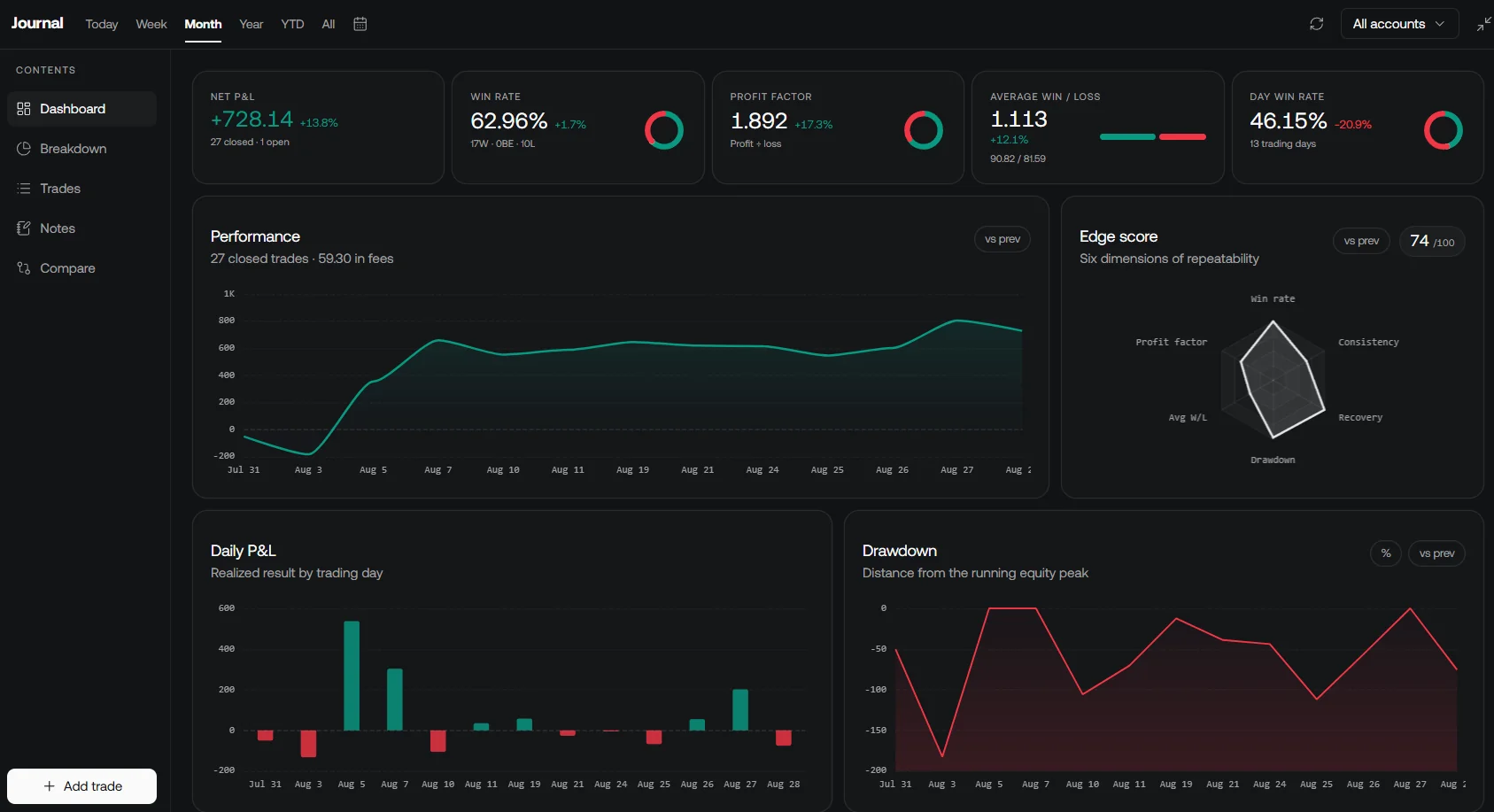
Review compatible recorded trades in the native LuxAlgo journal alongside broker records. Compare expected entries, actual fills, costs and rule deviations. This creates a feedback process for investigating whether a problem comes from the hypothesis, implementation or execution.
Research in Vela is not broker order execution. Consult current plans for access and billing terms.
Additional Perspective: Retail Versus Institutional Trading
The original StocksToTrade video, published July 1, 2023, discusses retail and institutional trading from the creator’s perspective, including information access and broker choices. It promotes StocksToTrade resources and focuses on broader stock-trading issues rather than a controlled comparison of algorithmic performance. Use it as background discussion, with current documentation and the testing framework above for decisions.
Build a Process You Can Sustain
- Choose one market and a hypothesis with a clear explanation.
- Confirm suitable data and a workflow you can understand and maintain.
- Test against a baseline with realistic costs and later evaluation data.
- Exercise failure handling in simulation and document the limits.
- Review outcomes and stop conditions before increasing complexity or exposure.
Retail traders do not need to replicate every institutional capability. They do need credible evidence that their chosen process is useful at their scale. Smaller size and accessible tools can help with implementation; profitability remains an uncertain result to evaluate, not a feature supplied by the platform.
Frequently Asked Questions
Can a retail algorithm outperform an institutional strategy?
It is possible in a particular comparison, but it cannot be assumed from account size or software access. Compare the same period, risks, exposure and costs, and evaluate results beyond the development sample.
Are less liquid markets automatically better for retail traders?
No. Smaller orders may fit limited capacity, but wider spreads, thin depth, gaps and difficult exits can erase an apparent advantage. Test the actual size and execution conditions.
Does automation eliminate trading emotions?
No. It can apply programmed rules consistently, but people still choose parameters, select strategies and override systems. Automation can also repeat flawed rules without hesitation.
Do retail traders need institutional execution speed?
The requirement depends on the strategy. Latency-sensitive approaches need specialized infrastructure, while slower hypotheses may be evaluated without trying to win a microsecond race. All strategies still need reliable data and realistic execution assumptions.
How can LuxAlgo support retail algorithmic research?
Use native charts to examine a hypothesis, ask Quant to implement explicit rules, inspect the code and run it yourself. Test with realistic assumptions and review compatible recorded trades in the native journal. Keep research, alerts and broker execution as distinct roles.
Read next