Choose the Best US Stock Broker — Five Key Questions

Choose a U.S. stock broker by answering five questions: does it support your account and investments, what will it really cost, can you use its tools confidently, can you get help, and have you verified the firm and its protections? A popular app or a zero-commission headline cannot answer all five.
Keep market research and brokerage services distinct. Vela, our charting platform, and Quant help you analyze markets and develop trading rules. Your broker holds the brokerage account, applies trading permissions, and handles supported orders. You can choose each for the job it needs to do.
The five-question shortlist
| Question | Evidence to collect | A useful practical check |
|---|---|---|
| 1. Does the account fit? | Account types, residence eligibility, products, and permissions | Confirm your intended account and securities are supported |
| 2. What is the total cost? | Current fee schedule, cash terms, and optional-service prices | Calculate costs for your expected activity |
| 3. Can you use the platform? | Demo, simulator, current documentation, and data terms | Practice finding, entering, modifying, and closing an order |
| 4. Can you get the right help? | Support hours, channels, escalation routes, and education | Ask a specific question and assess the answer |
| 5. Is the firm verified? | Official registration records, account-protection terms, and security controls | Match the legal entity and contact details independently |
Use the same questions for every candidate. A beginner may value straightforward recurring purchases, while an active trader may need more detailed order controls. Both need transparent costs, reliable records, and clear account protections.
1. Does this broker fit your account and investment needs?
Write down what you expect to do before comparing features: invest a set amount each month, hold individual stocks, trade short-term setups, or use options. Include how often you expect to trade, how much time you can spend reviewing the account, and when you may need to withdraw funds.
Then confirm the basics directly with each broker:
- Eligibility: your residence, the legal entity serving you, and the documents required to open an account.
- Account registration: individual, joint, retirement, custodial, or another supported type.
- Investments: the specific stocks, ETFs, funds, or options you intend to use.
- Features: recurring purchases, fractional shares, dividend reinvestment, or extended-hours access where needed.
- Restrictions: product approvals, transfer limitations, and rules that apply to your account.
A U.S. stock-trading app may serve residents of different countries through different entities. Do not assume that another customer’s fees, products, or protections apply to you.
Choose cash or margin deliberately
As Investor.gov explains, a cash account requires full payment for purchased securities. A margin account can allow borrowing against account assets, bringing interest costs and the possibility of larger losses or forced sales. Confirm the selected account type instead of accepting an unfamiliar default.
Options permissions and intraday trading requirements are separate checks. Ask about the current rules for the exact strategy and account rather than relying on a universal account-size figure or an old online checklist.
2. What will the account cost for the way you actually invest?
Compare current schedules rather than assumed “typical” annual charges. Some self-directed accounts have no maintenance fee, while particular services or account types may carry charges. For example, Fidelity’s pricing page advertises zero online U.S. stock and ETF commissions and no account fees for its retail brokerage accounts, subject to the stated terms. That does not make every product or optional service free.
| Cost category | What to ask |
|---|---|
| Transactions | Which online trades are commission-free? What changes for options, foreign securities, OTC trades, or assisted orders? |
| Account services | Are there maintenance, inactivity, statement, wire, closure, or transfer fees for this account? |
| Data and software | Which quotes, research packages, and platform features require a subscription? |
| Borrowing and cash | What margin rate applies, and where does uninvested cash sit? |
| Investments and advice | What fund expenses or separate advisory charges apply? |
The SEC’s account-opening guide explains why account fees, transaction charges, cash-management choices, and transfer conditions all deserve attention. Check whether cash remains at the broker, moves to a bank sweep, or enters a money market fund; the yield and protection arrangements can differ.
Separate brokerage from investment advice
A percentage-of-assets advisory fee is not a universal stock-broker commission. Read the firm’s relationship summary, or Form CRS, to understand its services, charges, conflicts, and reportable disciplinary history. If a firm offers both brokerage and advisory services, establish which agreement you are considering.
Build a simple annual-cost estimate
Suppose one optional research package costs $20 per month. That adds $240 per year, equal to 2.4% of a hypothetical $10,000 account before any market movement. The calculation does not make the service good or bad; it makes its cost visible.
Also consider execution. A $0.02 less favorable price on 100 shares changes the trade’s cost by $2, even if the commission is zero. Compare the trade price, spread, and order handling alongside advertised fees.
Do not place unnecessary trades just to avoid a charge or earn a volume discount. Compare another account or service arrangement if the fee structure encourages activity you do not otherwise want.
3. Can you research and operate the platform confidently?
Test a complete workflow on the device you intend to use. Find a security, inspect its quote, prepare an order, review its quantity and limit, locate open orders, and learn how to cancel or modify one. Check where statements, confirmations, tax documents, and transfers appear.
A clean interface is useful, but it does not prove better execution. Likewise, a fast average for a particular stock-order sample does not establish the speed of every stock, options, or extended-hours order. Compare definitions and products when reviewing execution statistics.
Use LuxAlgo for a repeatable research workspace
In Vela, select the market, timeframe, and studies needed for your setup. A multi-chart layout can help compare one stock across intervals or several markets together. Check the active chart before changing symbols or applying a script.
Quant is our coding agent. Describe a clear entry and exit rule, inspect the generated Code, and Run the strategy. For instance, ask for a moving-average crossover strategy with adjustable lengths and explicit long-only entries and exits. Confirm that the code matches the intended rule before interpreting results.
Use the strategy settings and results to account for order size, commission, slippage, drawdown, and individual trades. Historical results are evidence about the tested rules and assumptions, not a promise of future profit or proof of a broker’s fill quality.
The LuxAlgo indicator library offers studies for exploring price, trend, volatility, and volume. TradingView toolkits remain available for their supported workflows; do not assume custom studies automatically transfer into every broker’s charting software.
Practice and keep usable records
If simulation matters, confirm the exact products and functions supported. Schwab’s thinkorswim paperMoney, for example, provides simulated trading practice. A simulator is useful for learning controls, but its fills cannot establish live performance.
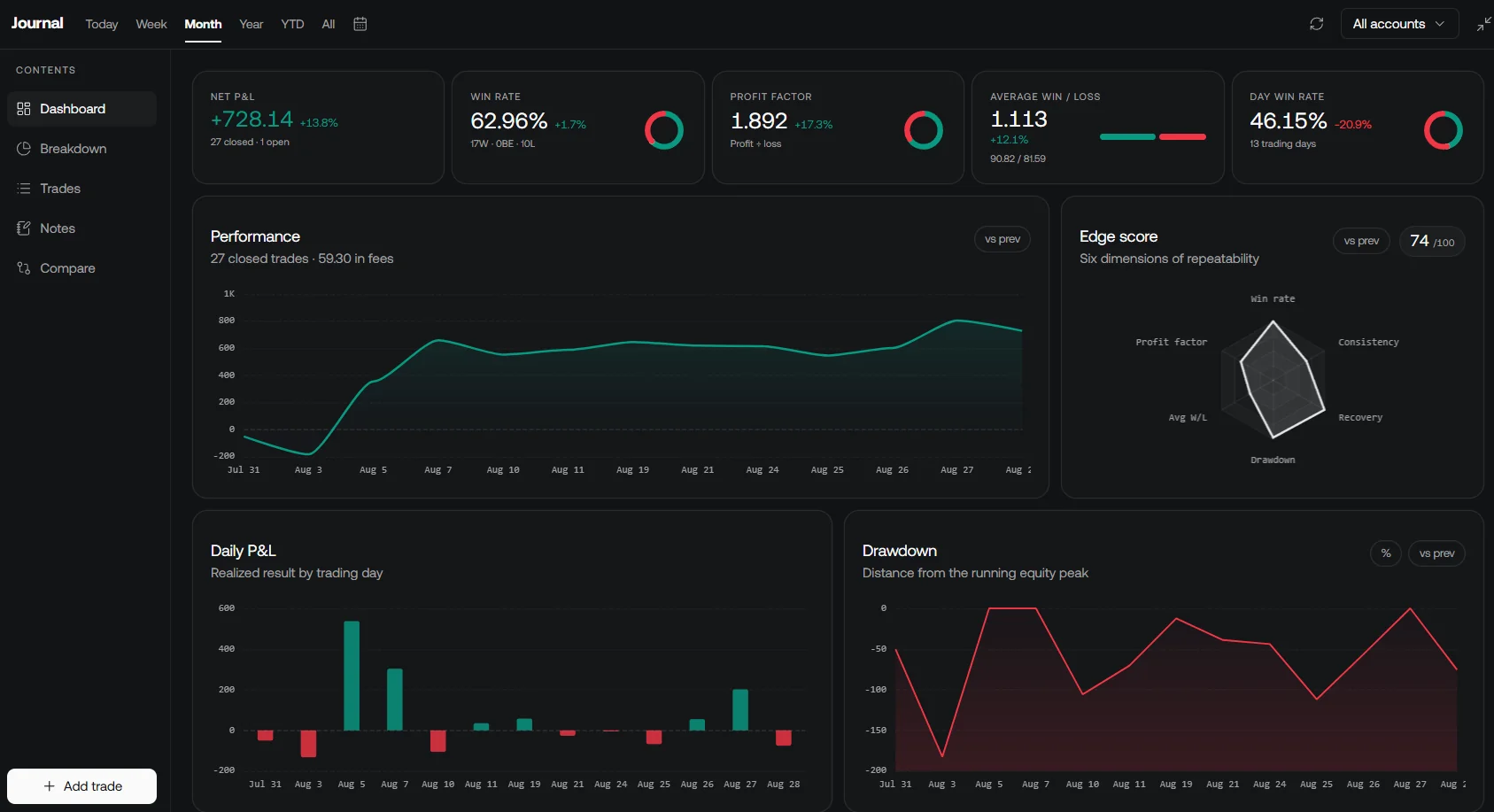
Check whether your broker provides an export you can use for review. LuxAlgo’s Journal supports manual entry, supported file imports, and supported broker connections. Compatibility depends on the source and format; verify yours before making automated syncing a requirement.
4. Can you get useful support and education?
Published service rankings describe a particular test and date. They do not guarantee your next response time. Instead, check support hours, available channels, the process for urgent account issues, and whether assistance is available during the sessions you plan to trade.
Ask one concrete question before choosing: “Where can I see the full charge for this order?” or “How do I report an unauthorized withdrawal?” Assess whether the answer is clear, accurate, and relevant to your account. A quick reply that does not solve the problem is not strong support.
Look for education that explains order types, costs, risk, and the platform’s actual controls. A library of videos may be useful, but a broker’s marketing material should not replace an understanding of the investment. Confirm that any course or webinar reflects the current interface and product rules.
You do not need a dedicated account manager to invest responsibly, and 24-hour support is not universal. Prioritize the service level you will use rather than treating every premium feature as essential.
5. Have you verified the firm and understood account protection?
Check the legal entity independently
Use FINRA BrokerCheck to research the firm and, where relevant, the individual professional. Review current registration and disclosure information. Investment-adviser information is a related but distinct search; Investor.gov helps you locate the appropriate records and relationship summary.
Match the legal name, registration details, and contact information to the entity that would hold your account. A real registration number can be copied by an imposter. FINRA’s broker-imposter guidance recommends independently comparing information rather than trusting a supplied report, message, or lookalike website.
Understand what SIPC does and does not cover
SIPC protection concerns missing customer cash and securities at a financially troubled SIPC-member brokerage, subject to eligibility and limits. The protection limit is $500,000, including a $250,000 cash limit. It does not reimburse a decline in investment value or bad investment advice.
Do not treat SIPC as a guarantee that an account cannot lose money, or assume it applies identically to every product offered by a financial group. Confirm the entity, custody arrangement, and treatment of uninvested cash in the account disclosures.
Check everyday security controls
Look for multi-factor authentication, login and transfer alerts, device-management controls, and a clear process for reporting suspicious activity. Use a unique password and independently navigate to the firm’s official site. An HTTPS connection encrypts the connection; it does not prove the site belongs to a legitimate broker.
Review confirmations and statements promptly. Registration, custody rules, and digital controls serve different purposes, and none eliminates market risk.
Video: questions to ask before selecting a broker
This Smart Money with Kai video offers general broker-selection considerations. Its examples may cover markets outside the U.S.; confirm U.S. account eligibility, legal entities, fees, and protections using the official sources above rather than treating a featured broker as a recommendation.
Make the decision from a short, documented comparison
Shortlist two or three firms, answer the five questions for the same account and activity, and record any unresolved details. Eliminate a candidate that cannot support an essential requirement before comparing optional features.
Use Vela and Quant to build your research process, and choose a verified broker whose account terms and execution workflow fit it. Keep the current fee schedule and account agreement with your records so you can review the choice as your needs change.
FAQs
What matters most when choosing a U.S. stock broker?
Start with account eligibility and the investments you need, then compare total costs, platform usability, support, and verified registration. Evaluate the exact legal entity and account terms rather than choosing solely by an app rating or commission headline.
Does a zero-commission broker have no costs?
No. Product-specific charges, optional data or software, account services, margin interest, fund expenses, and execution-price differences can still matter. Calculate costs for your intended activity and confirm which services are included.
Does SIPC protect me from stock-market losses?
No. SIPC addresses eligible missing cash and securities at a financially troubled member brokerage, subject to its limits and conditions. It does not protect against a fall in the value of your investments or losses caused by bad investment advice.
Read next