John Paulson Gold Bet What Traders Can Learn

John Paulson’s gold investments offer a useful case study in separating a macroeconomic thesis from the security used to express it. Believing that gold will benefit from inflation or currency concerns is one decision. Buying a mining company, financing a development project or trading a futures contract introduces different costs, risks and time horizons.
The practical lesson is to research both layers. A rising gold price does not guarantee that a particular miner will deliver strong shareholder returns, and a long-term investment thesis does not supply a short-term entry signal. This guide examines the historical context, documented project investments and a repeatable research and risk process using current LuxAlgo tools.
How Paulson Built His Gold Position
Keep the Historical Periods Separate
The post-2008 monetary-policy backdrop belongs to a different period from Paulson’s later North American development investments. The Bureau of Labor Statistics’ historical review describes gold’s rise during the financial crisis and subsequent monetary easing, including a reported high of $1,917.90 an ounce in late August 2011. That is market history, not evidence of a specific profit earned by Paulson.
Losses followed: Bloomberg reported a 26% Gold Fund decline through February 2013.
Later concerns about inflation, government finances and reserve diversification provide additional context, rather than an explanation retroactively applied to the 2009–2011 period. For example, the World Gold Council’s full-year 2023 report estimated net purchases by central banks and other institutions at about 1,037 tonnes. This is a dated aggregate demand figure, not a daily timing signal or a record of Paulson’s trades.
Documented Mining and Project Investments
Ownership disclosures need dates and the correct entity. A fund’s public-company shares, a direct project interest and John Paulson’s personal assets are not interchangeable. The following examples illustrate the distinctions; they are not a live portfolio or a recommendation to copy these positions.
| Investment | Dated evidence | What the trader must distinguish |
|---|---|---|
| Donlin Gold, Alaska | NOVAGOLD’s 2025 year-end report records a June 3, 2025 closing: Paulson-affiliated Donlin Gold Holdings acquired 40% for $800 million; NOVAGOLD increased its interest to 60%. | Barrick sold its 50% interest in that transaction. It was not Paulson’s remaining joint-venture partner. |
| Perpetua Resources, Idaho | The company’s June 16, 2025 release records a $100 million private placement of 7,575,757 shares to Paulson & Co. | Financing the Stibnite project is distinct from buying bullion; development, funding and shareholder dilution matter. |
| International Tower Hill Mines, Alaska | The company’s June 30, 2026 capital-structure page lists Paulson & Co. with 104,486,703 shares, or 39.9%, based on its cited ownership filing. | A dated ownership snapshot can change through purchases, sales and new share issuance. Verify the latest filing before using a percentage. |
Sources: NOVAGOLD’s transaction report, Perpetua’s financing release and International Tower Hill’s capital structure.
There is also a later proposed change: in its July 22, 2026 announcement, NOVAGOLD described agreements to acquire Paulson’s remaining Donlin interest through an all-share transaction. The announcement made completion subject to approvals and other conditions, with closing expected in the fourth quarter of 2026. An announced transaction should not be reported as already completed.
Another company named in discussions of Alaska investments, Trilogy Metals, describes copper and other metal projects. Treating every Alaska mining investment as pure gold exposure would misclassify the underlying business.
Evaluate the Mine, Not Just the Gold Thesis
A favorable jurisdiction can reduce some legal and political uncertainties, but it does not eliminate permitting disputes, environmental obligations, community concerns, construction delays or financing risk. Development-stage projects may require years of spending before producing revenue.
- Geology and economics: distinguish resources from economically supported reserves; examine recovery assumptions, grade, mine life and the study’s gold-price assumptions.
- Capital and funding: compare construction costs and contingencies with available cash and committed financing. An application for funding is not cash received.
- Ownership and dilution: model the company’s attributable interest, debt and potential new shares. Project growth can coexist with weaker value per share.
- Execution: track permits, infrastructure, contractors and milestones against the original schedule, using updated filings and technical reports.
Consider a simplified producer earning $600 per ounce before other expenses at a gold price of $2,000 and assumed operating costs of $1,400. If gold rises 10% to $2,200 with costs unchanged, that margin rises to $800, or 33.3%. If costs instead rise to $1,650, the margin falls to $550 despite higher gold. These hypothetical margins omit taxes, financing, capital spending and other costs; they are not earnings forecasts or stock-return estimates.
Trading Rules to Take From the Case Study
Turn Macroeconomic Ideas Into Testable Conditions
Paulson’s public interviews explain a view of inflation and gold. They do not establish that he used the technical rules below. These are research methods a trader can apply independently.
| Research input | Possible relevance | Important limitation |
|---|---|---|
| Real interest rates | Higher inflation-adjusted yields can increase the opportunity cost of holding non-yielding bullion. | Gold responds to multiple drivers; a rate change is not a guaranteed directional signal. |
| U.S. dollar | Dollar moves affect the purchasing cost of dollar-priced gold for other currency holders. | Inverse relationships vary by period and can break during stress. |
| Central-bank demand | Reserve purchases can contribute to longer-term demand. | Reports arrive with delays and may be revised; do not use unreleased data in a backtest. |
| Company milestones | Financing, permits and construction news can change a miner’s outlook. | A project announcement can move a stock independently of bullion. |
| Price and volatility | Trend, momentum and volatility help define a repeatable entry and risk plan. | Indicators describe market data; agreement among indicators does not prove the thesis. |
Choose the Exposure Before Setting the Risk
Bullion involves purchase spreads, custody and storage. A gold-backed exchange-traded product has its own fees, structure and tracking characteristics. Mining shares add operating, financing and equity-market risks. Futures introduce a contract multiplier, margin, expiry and potentially delivery obligations. Options add strike, premium, expiry and sensitivity to volatility. None is a universal substitute for another.
Several miners can still form a concentrated gold-sector position. Assess shared commodity exposure alongside company-specific risks, and measure it against the whole portfolio. A short gold-futures hedge may reduce some metal-price exposure but will not precisely offset a developer’s stock-price change. The hedge itself requires margin and can lose money as gold rises.
Position Sizing With Gold-Contract Units
Use a loss budget, stop distance and the actual contract multiplier. The margin deposit is not the maximum loss. CME’s Micro Gold overview specifies 10 troy ounces per MGC contract and a $0.10-per-ounce tick, worth $1 per contract.
For an illustrative $10,000 account, a 1% planned loss budget is $100. A $10-per-ounce stop distance on one MGC contract implies $10 × 10 = $100 before costs. With a $5 allowance for commission and slippage, the planned amount becomes $105. Rounding down $100 ÷ $105 gives zero whole contracts within that budget. The trader can skip the trade or evaluate another suitable instrument; moving the stop closer solely to force the position to fit changes the strategy.
A $20-per-ounce adverse execution on that same contract would lose $200 before fees. Stop orders do not guarantee execution at the selected price, as the SEC’s order-type bulletin explains. Check the actual product’s order rules, current margin, expiry and broker delivery deadlines separately.
For a mining share bought at $20 with a planned exit at $18, a $100 budget permits at most 50 shares before costs. If bad news gaps the execution to $15, the loss is $250. Position sizing controls intended exposure; it cannot remove event risk.
Plan Entries, Exits and Thesis Reviews
Separate a multi-year development thesis from an intraday or swing trade. For a testable trend hypothesis, define the exact completed-bar condition, next-bar execution rule, stop, exit and review date in advance. Scaling into a position changes exposure over time but does not eliminate unfavorable fills or announcements.
Record what would invalidate the investment case: a financing shortfall, a revised cost estimate or a delayed milestone, for example. A trading stop and a fundamental review serve different purposes. Do not turn a failed short-term trade into an indefinite investment to avoid recognizing the loss.
Video: Paulson’s Inflation and Gold Thesis
This interview clip from the verified David Rubenstein channel was published on August 31, 2021. It captures Paulson’s views at that time, rather than a current forecast or proof that inflation always produces an immediate gold rally.
Research Gold Markets With LuxAlgo
Organize Instruments and Evidence
Use the LuxAlgo Watchlist to organize available gold-related symbols and inspect supported market, financial and news information. Keep the issuer filing, ownership date and project milestones in your research notes. A Watchlist is not a complete mining feasibility database.
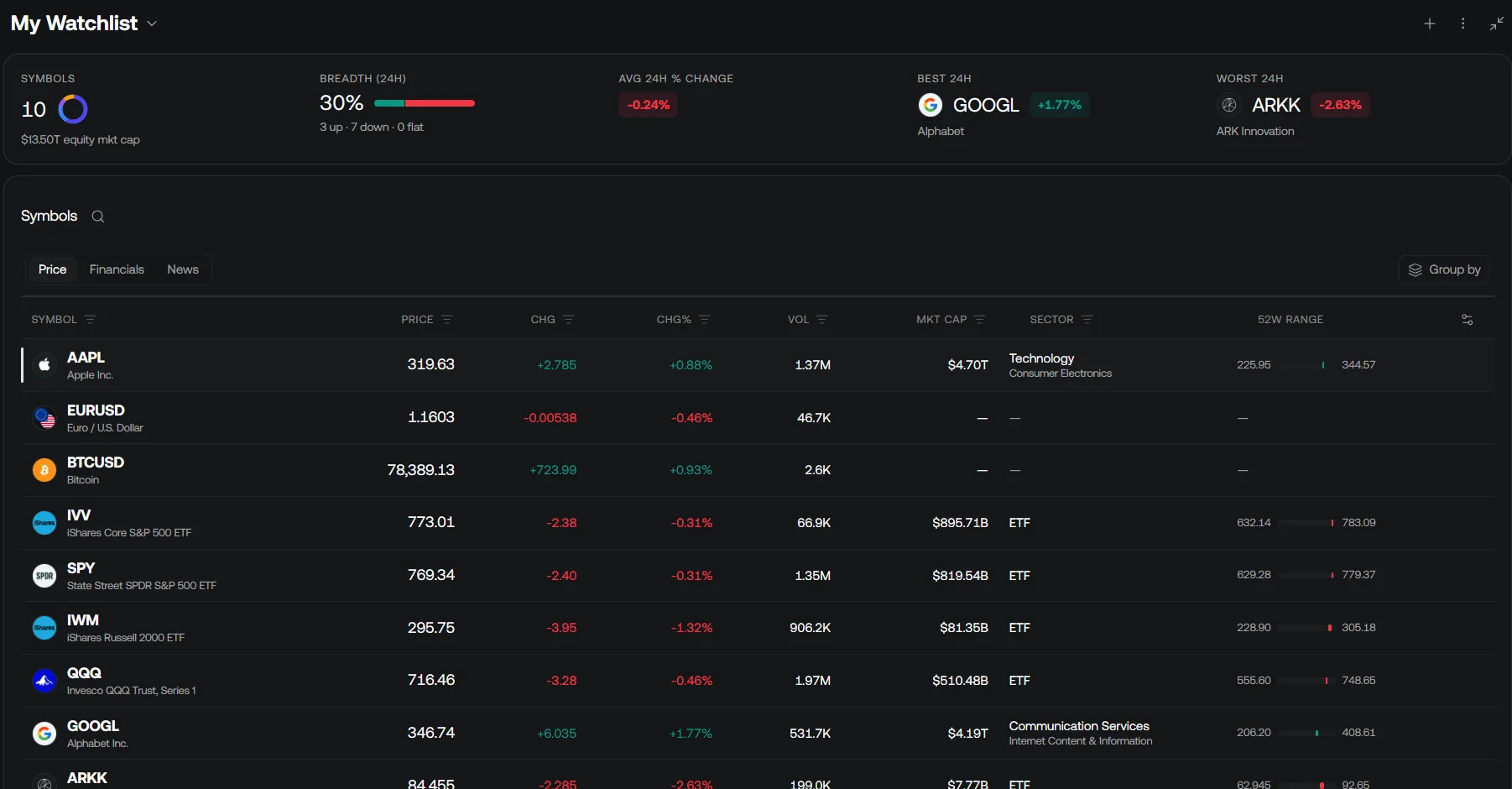
On LuxAlgo charts, examine the selected instrument’s trend and volatility across timeframes. Confirm the symbol, venue, session and data coverage. A spot-gold chart, a continuous futures series and a mining share are different datasets. Futures roll adjustments can affect historical signals, and a thinly traded miner can have very different execution costs from gold futures.
Use Quant to Build and Review a Defined Test
Quant, our coding agent, can help turn specified rules into strategy code. Review the code, inputs and assumptions before running it. For example, investigate a daily trend rule with completed-bar signals, next-bar entries and a fixed volatility-based exit. This is an illustrative hypothesis, not an attributed Paulson system.
Set realistic order sizes, commission and slippage, then inspect Backtest Summary, Performance, Trades Analysis and Trades Log. Compare against a relevant benchmark over the same dates, assess drawdowns and losing periods, and test untouched historical data after setting the rules. Repeatedly choosing the best parameters on the same history can produce a fragile result.
A price-only test cannot verify a mine’s permits or financing. A macroeconomic test needs the data that were actually available at each decision time, not later revisions. Generated code and historical results do not establish future profitability or automatically reproduce an investor’s full portfolio.
Apply the Research, Not the Celebrity Trade
The useful takeaway from Paulson’s gold investments is the need to connect a thesis to a specific asset, valuation and funding path. Keep historical ownership and interview claims dated, calculate losses in the correct units, and decide what evidence would change the plan. Current charting and coding tools can make that process easier to test and document; the investor still has to assess the business and the risk.
FAQs
Does investing in a stable mining jurisdiction remove the risk?
No. It can reduce some political or legal uncertainties, but a project still faces geology, permitting, construction, financing and operating risks. A higher gold price does not guarantee higher value per share.
How do macroeconomic trends affect gold-trade timing?
Real rates, currency moves and demand can inform a thesis, but their relationships with gold change. Define entry and exit rules separately, and use only information available at the time when testing historical decisions.
How can Quant help research a gold strategy?
Quant can help write strategy code from defined rules. Review the logic and data, set costs, examine historical trades and test untouched periods. It does not independently verify mine economics or guarantee profitable trading.
Read next