DIY Algorithmic Trading: Building Systems on a Budget

You can begin algorithmic trading research on an existing computer with a small, clearly defined project. The useful budget is the total cost of data, software, computing, execution and maintenance—not just the advertised subscription price. Start with reproducible research before paying for continuous hosting or connecting live orders.
Define the System Before Buying Tools
Write the instrument, timeframe, entry and exit rules, position-sizing policy and signal timing. Specify what happens when data is missing, an order is rejected or the process restarts. A flowchart or a plain document can expose missing decisions before they become code.
Keep four components separate: data ingestion, strategy calculations, order handling and monitoring. A signal describes a desired action; an order request may be rejected, delayed or partially filled. Account records and broker acknowledgements determine actual exposure.
| Component | Record | Failure to handle |
|---|---|---|
| Data | Source, timestamps and cleaning rules | Missing or stale observations |
| Strategy | Version, inputs and desired exposure | Repeated signals or unavailable information |
| Orders | Identifiers, acknowledgements and fills | Rejections, partial fills and retries |
| Monitoring | Positions, logs and recovery state | A restart with live orders still open |
Do not adopt a universal risk percentage simply because it appears in a tutorial. Planned loss depends on quantity, entry and assumed exit, while gaps and costs can make the realized loss larger. Include pending orders when reviewing aggregate exposure.
Start Research in LuxAlgo
Use Vela, our next-generation charting platform, to examine a setup and its source data. Ask Quant, our coding agent, for a precise implementation, inspect the generated code and run it yourself. Review individual entries and exits against the written rules before treating a backtest summary as useful evidence.
Turn the setup into a strategy and backtest it with Quant against years of history. Strategy alerts notify you about conditions; neither an alert nor a research result proves that a broker order filled.
For a budget, compare the actual billing commitment, included credits and required data access on the current pricing page. An annual plan's monthly equivalent is not the amount charged on a month-to-month subscription. Start with the features needed for one experiment and upgrade for an identified requirement, rather than assuming more tools improve returns.
Choose Data for the Question
Free access does not imply complete coverage. Alpaca’s individual Basic plan provides real-time equity data from IEX, rather than every US exchange. Its documentation separates individual Trading API plans from Broker API plans. Check the relevant feed, historical restrictions and request limits for the account you will use.
Alpha Vantage’s support page currently describes free access to the majority of datasets at 25 requests per day, with separate arrangements for verified open-source or educational projects. Real-time and 15-minute delayed US stock data are premium offerings. Do not assume that every endpoint or bulk request belongs to the free allowance.
For cryptocurrency, inspect the exchange-specific API documentation, available markets, history and regional account eligibility. An exchange feed describes that venue; it is not automatically a consolidated market record. Keep timestamps, units and missing observations explicit when comparing datasets.
Economic observations can be revised. A macro backtest must use information available at its decision time rather than silently applying today's revised values to historical decisions. Preserve publication timing and investigate vintage data when the strategy depends on economic releases.
Store raw observations separately from cleaned inputs. Document symbol identity, sessions, timezone, corporate-action treatment, volume units and duplicate handling. A free indicator library supplies analytical tools, not a replacement market-data feed.
Select a Research Framework
Freqtrade is an open-source Python crypto trading bot with backtesting, dry-run operation and monitoring through Telegram or its web interface. Its documentation recommends understanding the strategy and starting in dry-run mode. Supported exchange features and configuration vary; open-source software does not make exchange fees, data or hosting free.
Backtrader and QuantConnect are other frameworks to evaluate for the intended strategy and data. Compare current documentation, supported integrations and the distinction between local software and hosted services before committing time. A free account or open-source engine does not imply unlimited cloud research, live deployment or all datasets.
Choose one framework for the first baseline. Record its version and dependency versions, preserve the input data and keep configuration alongside the strategy. Several overlapping frameworks add maintenance work before they add useful evidence.
Build a Small, Testable Rule
The example below uses only Python's standard library and synthetic prices. It returns desired exposure after each completed close: zero during warm-up, then one when the three-period average exceeds the five-period average. It does not place trades or calculate investment returns.
from math import isfinite


def sma_targets(closes, fast=3, slow=5):
    """Desired exposure after each completed close; no orders or fills."""
    if (type(fast) is not int or type(slow) is not int
            or not 1 <= fast < slow):
        raise ValueError('Require integer periods: 1 <= fast < slow')
    prices = [float(x) for x in closes]
    if any(not isfinite(x) or x <= 0 for x in prices):
        raise ValueError('Closes must be finite and positive')
    targets = []
    for i in range(len(prices)):
        if i + 1 < slow:
            targets.append(0)
            continue
        short = sum(prices[i-fast+1:i+1]) / fast
        long = sum(prices[i-slow+1:i+1]) / slow
        targets.append(int(short > long))
    return targets
Compare successive targets to identify a change in desired exposure. A target of one on several consecutive bars does not mean buy a fresh position on every bar. If the rule uses a completed close, a separate execution model must specify when a later order can fill. Preserve chronological inputs; the helper cannot infer dates from an unlabeled list.
The helper was checked for warm-up, equal averages, target changes, invalid inputs and independence from appended future observations. These tests establish the calculation's behavior on the stated cases, not that the strategy is profitable.
Make the Trailing Exit Explicit
A trailing-stop example must do more than calculate a threshold. This second helper updates the highest observed close for an existing long position and returns an exit signal when the current close is at or below the threshold. Initialize the peak from the actual entry fill and then retain it across observations.
from math import isfinite


def trailing_close_signal(highest_close, close, trail=0.10):
    """Long-position close-based exit signal; caller submits/manages orders."""
    highest_close, close, trail = map(float, (highest_close, close, trail))
    if (not all(isfinite(x) for x in (highest_close, close, trail))
            or highest_close <= 0 or close <= 0 or not 0 < trail < 1):
        raise ValueError('Require positive prices and 0 < trail < 1')
    new_high = max(highest_close, close)
    threshold = new_high * (1 - trail)
    return new_high, threshold, close <= threshold
This is a close-based signal, not an intrabar or broker-hosted stop. If it signals an exit, an order-management component still needs to submit the appropriate order, track acceptance and fills, and reconcile exposure. Keep an exit-pending state until the position is confirmed closed; do not repeatedly submit duplicate orders or reset the peak on every bar.
With an initial peak of 100 and a 10% trail, closes of 105 and 110 raise the threshold to 94.5 and 99. A later close of 98 produces an exit signal. The actual exit could occur at a worse price. Reset the state only for a new position under the strategy's entry policy.
prices = [10, 11, 12, 13, 14, 13, 12, 11]
print(sma_targets(prices))
# [0, 0, 0, 0, 1, 1, 1, 0]

peak = 100.0
for close in [105, 110, 98]:
    peak, threshold, exit_signal = trailing_close_signal(peak, close)
    print(round(peak, 2), round(threshold, 2), exit_signal)
    if exit_signal:
        break  # demonstration ends; no broker position is closed
# 105.0 94.5 False
# 110.0 99.0 False
# 110.0 99.0 True
Evaluate Costs and Failure Modes
Include commissions, spread, slippage, funding and borrowing where relevant. Compare net outcomes, equity drawdown, exposure, turnover and sample size. A win rate above 50%, a chosen Sharpe threshold or a drawdown below an arbitrary percentage does not certify readiness.
Separate development from later evaluation data. Fit preprocessing on training observations and record when evaluation results influence another change. Paper trading can expose integration defects, but simulated fills do not reproduce every live-market constraint.
Test operational cases as well: stale data, an order filled in several pieces, a rejected cancellation, duplicate retries and a restart while orders remain open. Stopping a local program is different from cancelling orders or closing positions. Log the strategy version, event time, order identifier and state transitions needed to investigate.
Budget for Hosting and Maintenance
An existing computer can be sufficient for scheduled research. Continuous operation introduces power, connectivity, updates, backups and monitoring requirements even when there is no separate server invoice. Choose hosting around the strategy's actual schedule and recovery needs.
AWS’s current Free Tier page describes a Free plan with up to $200 in credits for up to six months. That differs from treating a legacy 750-hour instance allowance as a universal, permanent entitlement. Check the account's applicable plan and terms, plus storage, networking and paid-service usage. Other cloud offers also have eligibility, region, time and resource limits.
Estimate normal monthly usage and the cost after credits expire. Configure billing notifications and define what happens if the host stops. A cheap server without order reconciliation or monitoring is not a reliable execution system merely because it stays online most of the time.
| Cost | Initial approach | When to reconsider |
|---|---|---|
| Software | One reproducible local research environment | A specific missing capability |
| Data | A feed matched to the research question | Coverage, history or timing is insufficient |
| Hosting | Scheduled local research where suitable | Continuous availability is actually required |
| Execution | Explicit simulated costs and order states | Integration testing exposes unmodeled behavior |
| Maintenance | Logs, backups and recorded versions | Recovery or monitoring cannot meet the requirement |
Review Results Before Expanding
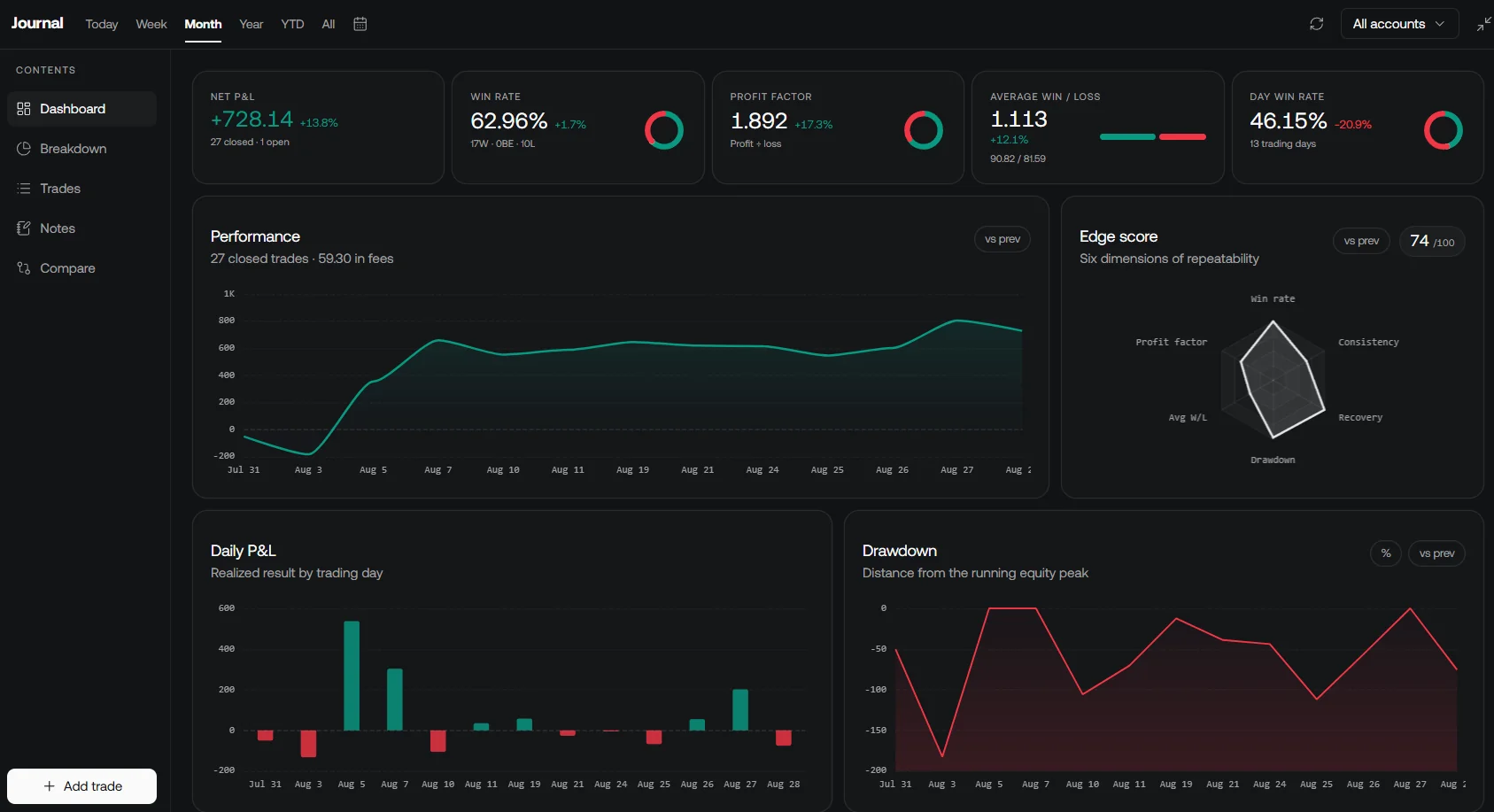
Review compatible recorded trades in LuxAlgo’s native journal and keep simulated records distinct from actual fills. Use a workspace to organize baseline charts and related experiments. The native journal and a separately self-hosted journal have different setup and data-import requirements; verify compatibility rather than assuming universal broker synchronization.
Risk estimates such as value at risk or ruin probability depend on the model, sample and assumptions. They are not maximum-loss guarantees. Review shared exposures across strategies and preserve a written response to a loss limit, connectivity failure or unexplained position.
Expand only after identifying a concrete need and reviewing its costs and controls. Keep a change record with the observed problem, proposed modification, evidence and rollback condition. Community examples can suggest questions, but another trader's results do not validate your implementation.
Original Python Tutorial: Historical Context
The original straight-code tutorial was published May 21, 2019. It introduces an Alpaca-based Python workflow, but its package, API and pricing details are historical. Use current provider documentation when following it; the demonstration is not evidence that an unattended trading system is ready for live use.
Frequently Asked Questions
Can I begin algorithmic trading research without paid hosting?
Yes. Scheduled local research on an existing computer can be a starting point. Continuous execution has separate availability, monitoring and recovery requirements, and total costs include data and maintenance.
Does a free data feed cover the whole market?
Not necessarily. Coverage, delay, history and request limits vary. For example, Alpaca’s individual Basic real-time equity feed covers IEX rather than every US exchange.
Do these Python examples place orders?
No. They calculate desired exposure and a close-based trailing exit signal. An order-management component must submit requests, handle rejections and partial fills, and reconcile actual positions.
Does a trailing stop guarantee a maximum loss?
No. A local signal may only run when new data arrives, and a broker order can execute at a worse price after a gap or rapid move. The threshold is not a guaranteed fill price.
When should I pay for more tools?
Identify a concrete requirement first, such as missing data coverage or a needed workflow feature. Compare the actual billing commitment and ongoing operating cost rather than assuming a higher-priced setup improves returns.
Read next