Long-Term Investing 101: Build Sustainable Wealth
Long-term investing means putting money to work for goals years or decades away. Regular contributions, diversified holdings, controlled costs, and reinvestment can help build sustainable wealth. Growth is uneven: a long holding period does not guarantee a profit or make an unsuitable investment safe.
Retirement money needed in 20 years has a different job from a home deposit needed in two. Start with the goal and the amount you can afford to invest, then choose the mix of assets. Historical stock-market averages are context, not a dependable annual return assumption.
- Plan: define a target amount, timeline, and contribution schedule while maintaining emergency savings.
- Build: diversify across appropriate assets, compare fund costs, and understand what you own.
- Maintain: reinvest when appropriate, use eligible tax benefits, and rebalance according to written rules.
- Research: use Vela, our next-generation charting platform, and Quant to investigate specific market questions, alongside account statements and financial planning.
The Long-Term Investing Guide to Compounding Wealth
This Sure Dividend video, published March 16, 2018, introduces a framework for long-term stock investing. Its examples and dividend lists are historical; use current company information and the updated account limits below when applying the ideas. Dividend-focused stock selection is one approach, not a requirement for a diversified plan.
Getting Started with Long-Term Investing
Define Your Money Goals
Write down the goal, deadline, amount already saved, and monthly contribution you can sustain. Separate near-term spending from long-term investments so a market decline does not force you to sell to pay a bill. Review income, essential expenses, emergency reserves, and expensive debt before choosing a savings rate.
Saving 10–15% of pay can be a starting scenario to evaluate, but it is not sufficient for every retirement target. Someone starting later may need higher contributions, a later retirement date, or a smaller spending goal. Account for employer matching contributions and their vesting conditions when reviewing workplace benefits.
For example, repaying $10,000 over 24 months requires about $416.67 monthly before interest; actual debt payments may be higher. A fixed two-year obligation should not depend on stocks delivering a particular return. Review progress quarterly or annually and after major life changes.
Know Your Risk Level
Distinguish risk tolerance—how you feel about losses—from risk capacity—how much financial damage you can absorb. FINRA’s investing-risk guide explains why risk includes more than day-to-day price changes. Inflation can reduce purchasing power, while concentrated holdings can suffer permanent losses.
| Risk factor | Question to answer | Practical response |
|---|---|---|
| Time horizon | When will withdrawals begin? | Keep near-term needs in suitable liquid holdings; do not assume a five-year stock investment must recover. |
| Loss capacity | Would a decline disrupt essential spending? | Maintain reserves and size risky assets around your broader finances. |
| Emotional tolerance | Could you follow the plan during a large drawdown? | Use a realistic loss scenario and a risk questionnaire as discussion tools. |
Understand Compound Growth
Compounding means gains can earn subsequent gains when they remain invested. For a fixed rate, future value equals starting capital × (1 + annual rate)years. Stock returns fluctuate and can be negative, so this formula illustrates an assumption rather than promising an outcome.
Example: $10,000 growing at a hypothetical 5% annually becomes about $26,533 after 20 years, versus $16,289 after 10 years, before fees, taxes, and inflation. Starting earlier gives the same initial capital more time to compound; it does not eliminate investment risk.
Use compounded growth rather than simply averaging yearly percentages. A 20% gain followed by a 20% loss leaves $100 at $96, a 4% loss. Also separate nominal growth from purchasing power: a 7% gain with 3% inflation is about 3.88% real growth, calculated as 1.07 ÷ 1.03 − 1.
Main Investment Methods
Manage Risk with Diversification
Diversification spreads exposure across issuers, industries, regions, and asset types. Owning 20 or 30 stocks does not by itself establish a diversified portfolio: their businesses and price movements may overlap. Funds can simplify diversification, but several funds holding the same largest companies may add little variety.
The SEC’s asset-allocation guide connects investment mix to time horizon and risk tolerance. Diversification can reduce concentration risk but cannot prevent every loss; relationships between assets can change during stressed markets.
| Holding | Potential role | Important limitation |
|---|---|---|
| Stocks or stock funds | Long-term business growth and possible dividends | Prices and earnings can fall; concentrated sectors add risk. |
| Bonds or bond funds | Income and diversification | Credit, interest-rate, and inflation risks vary; bond funds can lose value. |
| Listed REITs or REIT funds | Exposure to income-producing property businesses | Sensitive to financing costs, property conditions, and equity-market declines. |
| International stocks and bonds | Geographic and currency diversification | Not a separate asset class by themselves; currency and country risks matter. |
| Cash and short-term instruments | Liquidity for spending and emergencies | Purchasing power may erode when yields lag inflation. |
Stick to a Regular Investment Schedule
Dollar-cost averaging invests a fixed amount at regular intervals, buying more units when prices are lower and fewer when prices are higher. It supports a routine but does not assure profits or protect an existing balance from a decline. FINRA distinguishes investing new income from gradually deploying money already available: holding a lump sum in cash while staging purchases can carry an opportunity cost.
The illustration below assumes a constant 5% effective annual return, no starting balance, and deposits at the end of each month. The monthly rate is 1.051/12 − 1. Values are rounded to the nearest dollar and exclude fees, taxes, and inflation. They are mathematical scenarios, not forecasts.
| Monthly contribution | After 10 years | After 20 years | After 40 years |
|---|---|---|---|
| $100 | $15,436 | $40,580 | $148,252 |
| $200 | $30,873 | $81,161 | $296,505 |
| $300 | $46,309 | $121,741 | $444,757 |
At $100 monthly, your own deposits total $12,000, $24,000, and $48,000 over those periods. Actual balances depend on the sequence of market returns as well as the amount and timing invested. Automate only an affordable contribution and revisit it when income changes.
Reinvest Dividends and Profits
A dividend reinvestment plan (DRIP) uses distributions to purchase additional shares. Reinvesting can support compounding, but a 5% dividend yield is not a guaranteed 5% investment return: share prices change, payouts can be cut, and distributions are not free additional wealth.
Decide whether you need the income for spending or want to reinvest it. Compare reinvestment costs and fractional-share arrangements, and retain purchase records. In a U.S. taxable account, reinvested dividends generally remain taxable income even when you receive shares instead of cash; see the IRS explanation of reinvested dividends.
Investment Options to Compare
Low-Cost Index Funds
Broad index funds can provide exposure to many securities through one holding. Compare the index, holdings, fees, tracking, liquidity, and overlap with your existing portfolio. “Index fund” describes a method, not a promise of broad diversification: a narrow sector fund can still be concentrated.
For a concrete fee example, Vanguard lists VOO’s expense ratio at 0.03% in its June 30, 2026 fact sheet. That is approximately $3 annually per $10,000 at a constant investment value, excluding other costs. VOO tracks the S&P 500, providing large U.S. company exposure rather than a complete global, multi-asset portfolio. This is an illustration, not a fund recommendation.
Income-Generating Stocks
Evaluate dividend coverage, cash generation, debt, business durability, and valuation. A high yield may reflect a falling share price or concern about a future cut. Dividend history is useful evidence, but it cannot guarantee future payments.
The S&P 500 Dividend Aristocrats framework includes S&P 500 companies with at least 25 consecutive years of dividend increases, alongside other index eligibility criteria. That record is a starting point for research, not proof that every constituent fits your allocation or offers an attractive price.
REIT Investments
Real estate investment trusts offer exposure to property businesses such as residential, healthcare, industrial, and data-center assets. U.S. REIT qualification generally requires distributing at least 90% of taxable income, excluding net capital gains—not 90% of cash flow or a fixed shareholder yield. See the SEC’s publicly traded REIT guide.
Distributions and property values can fall. Review debt maturities, tenant concentration, occupancy, and interest-rate sensitivity. Publicly traded REITs can be volatile; non-traded REITs have different liquidity and fee considerations. Existing broad stock funds may already hold REITs, so check overlap before adding a dedicated position.
Tax Planning and Portfolio Maintenance
Use Tax-Advantaged Accounts Thoughtfully
These are U.S. federal rules; eligibility and treatment depend on your circumstances. For 2026, the IRS contribution-limit announcement sets the following amounts:
- IRAs: $7,500 combined across traditional and Roth IRAs, plus $1,100 catch-up for eligible people aged 50 or older ($8,600 total).
- 401(k) employee deferrals: generally $24,500; an eligible age-50-plus $8,000 catch-up brings this to $32,500.
- Ages 60–63: the higher $11,250 catch-up, where applicable, brings the 401(k) employee total to $35,750 instead.
Compensation, income, plan rules, and other limits apply. Employer contributions have separate rules. Traditional IRA deductions and Roth IRA contributions can face income restrictions; confirm eligibility before contributing. Check your plan’s current catch-up and Roth requirements as well.
Pre-tax workplace contributions and deductible traditional IRA contributions can reduce current taxable income, with tax generally deferred until withdrawal. Roth contributions use after-tax money and qualified withdrawals are tax-free. A taxable account offers flexibility but may generate tax on dividends, interest, and realized gains. Choose account placement around the whole portfolio, access needs, and applicable tax rules—not a universal “best account” for each asset.
Tax-loss harvesting realizes investment losses in taxable accounts. Under IRS capital-gain and loss rules, net capital losses can generally offset up to $3,000 of other income annually ($1,500 if married filing separately), with remaining losses carried forward. Losses first interact with capital gains under the applicable netting rules. Wash-sale rules and other restrictions can defer or disallow a deduction; automatic reinvestment and related-account purchases need attention.
Rebalance to Manage Drift
Rebalancing restores a chosen allocation. It is a risk-management process, not a guaranteed return improvement. Pick a review schedule or clearly defined drift threshold, then consider trading costs and taxes. A change from 60% stocks to 65% is 5 percentage points, not a 5% relative increase.
Example: a $100,000 portfolio starts with $60,000 stocks and $40,000 bonds. If stocks gain 25% and bonds remain unchanged, the portfolio becomes $115,000, with $75,000 in stocks (65.22%). Restoring 60/40 would move $6,000 from stocks to bonds, ignoring costs and taxes. New contributions directed toward bonds may reduce the need to sell.
Review allocation across accounts, including overlapping funds. Change the target when your goals or capacity change; frequent reactions to headlines can undermine a deliberate plan. There is no universally superior 5% or 10% rebalancing band.
Respond to Market Changes Without Abandoning the Plan
Trying to leave the market before every decline and return before every recovery requires two difficult decisions. FINRA’s market-timing discussion explains the costs and uncertainty. A downturn can justify reviewing liquidity and concentration, but it does not automatically make every asset a bargain.
Stay disciplined without confusing patience with ignoring evidence. Review deteriorating company finances, changed fund mandates, excessive fees, or an allocation that no longer fits. As withdrawals approach, consider how an early decline combined with spending could deplete capital; a long-run average return alone does not describe that risk.
Investment Tools and Software
Organize Research in Vela
Vela brings charting and AI-assisted market research together. For long-term investing, use Watchlists to organize the symbols you want to review: open Panels, select Watchlist, and use Add symbol. Selecting a row loads that symbol into the active chart. Advanced view provides a larger table with financial information and news where available.
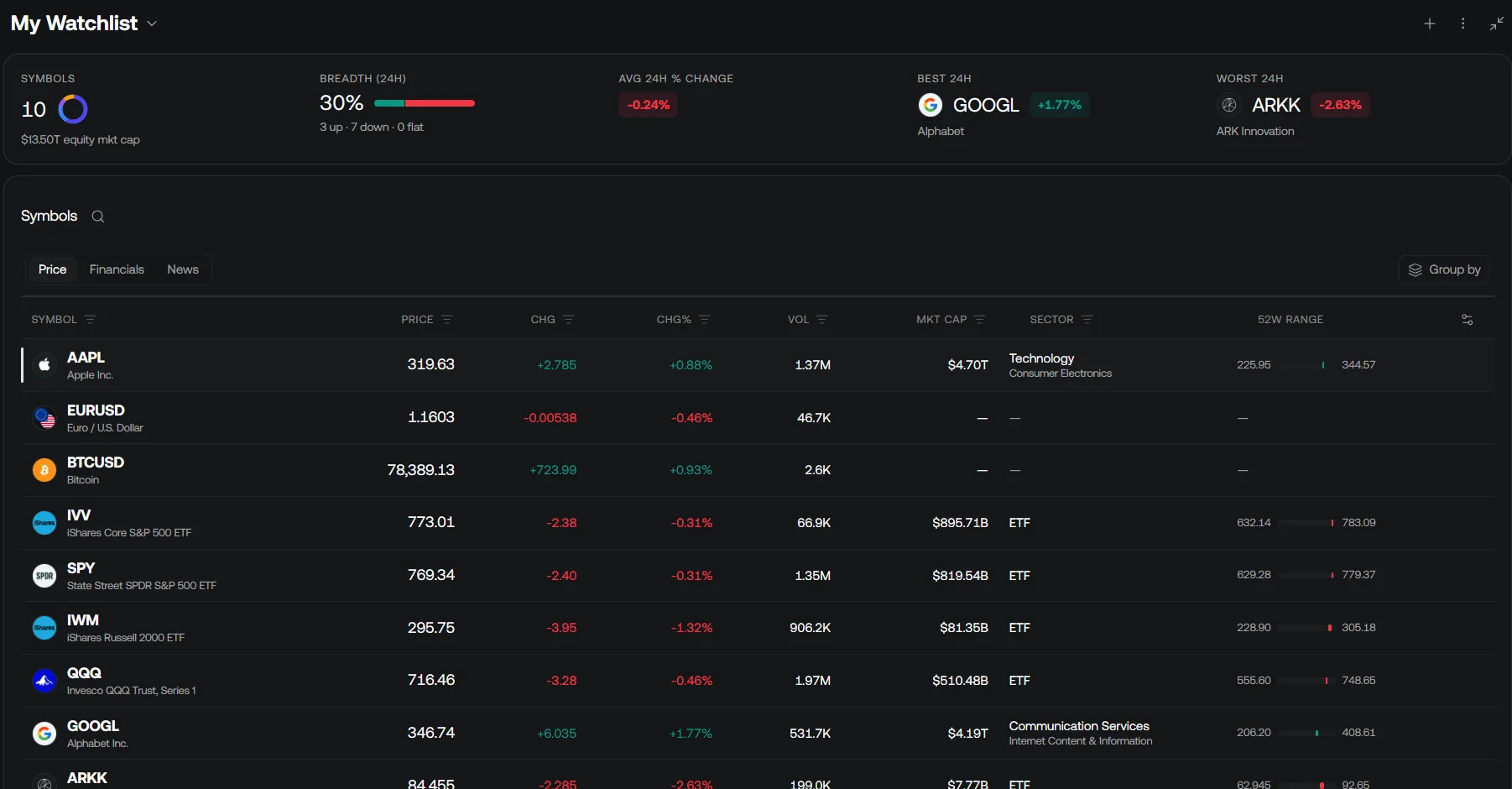
Start with a question: has a business’s financial position changed, has your holding become too concentrated, or does the market trend warrant closer review? Use weekly or monthly chart views for context, then consult company filings and fund documents. A chart does not establish dividend sustainability or replace a financial plan.
Test a Specific Rule with Quant
Quant, our coding agent, can help turn explicit trading rules into a strategy script. For example, investigate how a monthly trend exit would have changed exposure in one supported equity ETF. Specify the signal, when an order may execute, re-entry conditions, position size, and costs. Review the generated code, sign in, and run it on the intended chart.
Use the strategy viewer to inspect net profit, drawdown, trade count, and the Trades Log. Set realistic commission and slippage; compare a rule against a consistent buy-and-hold baseline over the same data and dates. Test a separate period before drawing conclusions.
For a long-term question, also check dividend adjustments, contribution timing, uninvested cash, fund fees, and taxes. Do not assume a chart backtest models them correctly or combines several accounts into a retirement portfolio. A generated script and attractive historical results still require validation; they cannot establish a safe withdrawal rate or guarantee future returns.
Keep Records and Choose Tools for the Job
Record why you bought, what would change your view, and when you plan to review. The LuxAlgo Journal supports reviewing recorded trades and performance. Reconcile records with brokerage statements and maintain separate contribution, income, and tax information when needed.
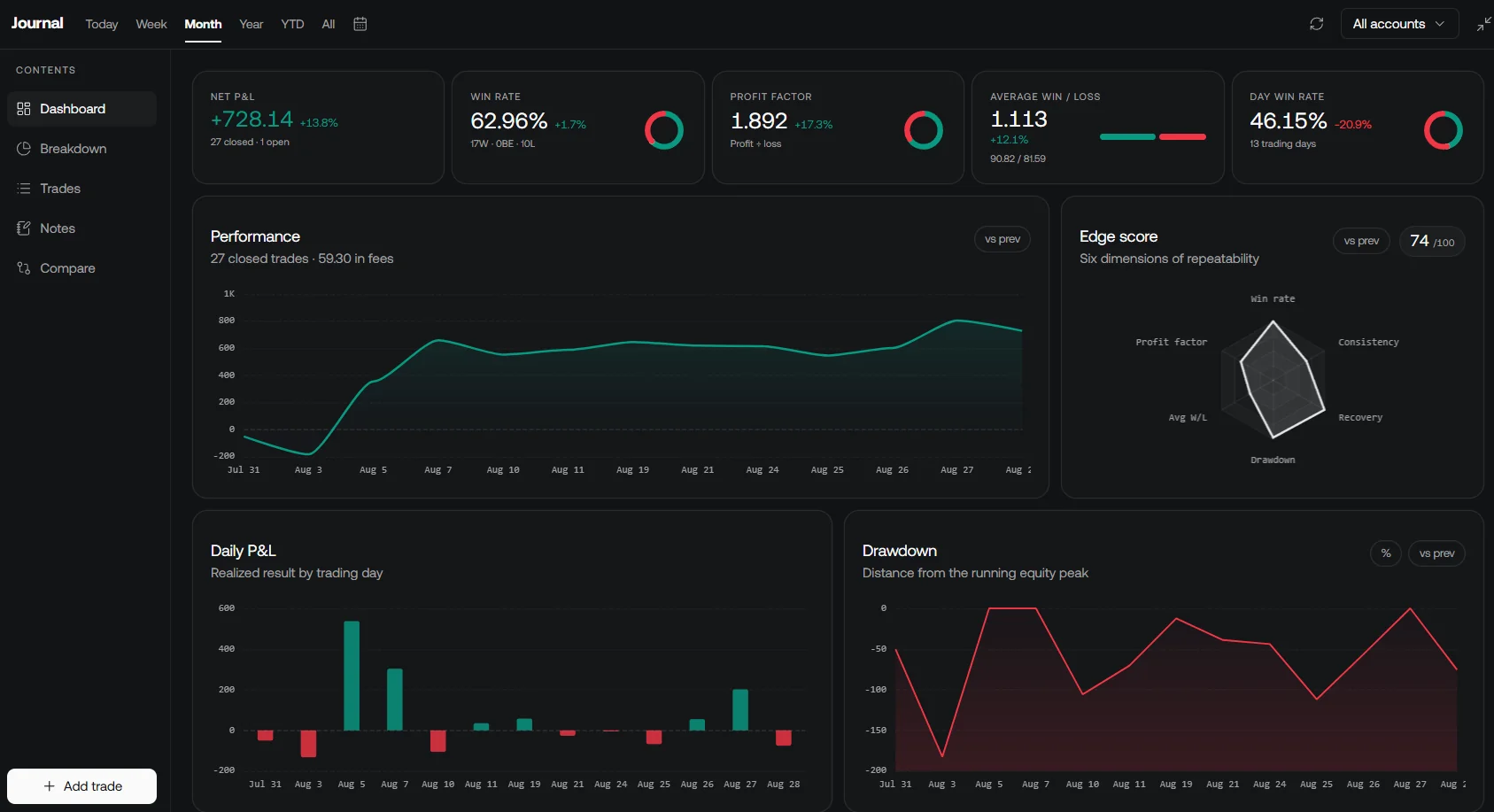
When comparing software, check supported securities and brokers, data sources, reporting completeness, mobile usability, and costs. Learn from other investors, but verify their claims and distinguish a documented method from testimonials or a recent winning trade.
Your Next Steps
- Write one goal with a deadline, starting balance, and affordable monthly contribution.
- Choose a diversified allocation and review fund overlap, costs, and risks.
- Use eligible account benefits and decide whether distributions should be reinvested or spent.
- Set a review and rebalancing policy, and keep cash available for planned near-term needs.
- Use charts, Quant, and records to answer specific research questions while checking assumptions against primary sources.
Sustainable wealth building depends on decisions you can repeat: saving, controlling costs, managing concentration, and adapting when your circumstances change. A five- or ten-year label alone does not make an investment appropriate. Build a process that fits the goal and remains workable through periods of loss.
Read next