Sunk Cost Fallacy in Trading Explained
The sunk cost fallacy in trading is the tendency to keep committing capital, time, or effort because of what you have already spent, rather than because the next decision is justified. It can sound like “I have researched this stock for weeks” or “I cannot leave until I make my money back.” Neither statement explains why the position is attractive at its current price and risk.
The practical response is to separate past expenditure from the choices still available: hold, reduce, exit, or add under a defined plan. LuxAlgo’s native charts, Quant, our coding agent, and the Journal can help you document and review those choices. They provide research and recordkeeping tools; they do not remove bias or guarantee better returns.
What Counts as a Sunk Cost?
A sunk cost is an expenditure that the current decision cannot undo. Research hours already spent and nonrefundable fees already paid are straightforward examples. Continuing an unsuitable strategy does not recover those hours or refund those fees.
A tradable asset, however, still has a current value. If you bought 100 shares at $50 and they now trade at $40, the position is worth $4,000 before selling costs. The $1,000 decline has already reduced your economic wealth, even though it is an unrealized loss. The remaining $4,000 is capital you can still make decisions about; it is not all “gone” or irrelevant.
Ask: “Given today’s evidence and my existing portfolio, what is the best use of the capital still at risk?” Your purchase price matters for records, performance measurement, and potentially taxes. It does not, by itself, make a return to that price more likely. Future transaction costs, financing, liquidity, and applicable tax consequences also remain relevant when comparing choices.
Why Past Commitment Can Distort Decisions
In The Psychology of Sunk Cost, Hal Arkes and Catherine Blumer studied how prior investments of money, effort, and time can increase willingness to continue an endeavor. Their experiments included theater tickets and hypothetical projects. The research supports the existence of the effect; it does not establish a fixed annual return penalty for traders.
A related trading pattern is the disposition effect: investors’ tendency to realize gains more readily than losses. Terrance Odean’s 1998 study examined records from 10,000 discount-brokerage accounts over 1987–1993 and found evidence of that tendency. It is a historical sample, not a measurement of every trader today. The disposition effect describes a pattern of selling; sunk-cost reasoning is one way past commitment can influence a decision. They are not interchangeable diagnoses.
| Thought to examine | Possible problem | A more useful question |
|---|---|---|
| “I spent too much time on this to stop.” | Past effort becomes the reason for continued exposure. | What evidence supports the next decision? |
| “I will sell only at my entry price.” | A personal reference price replaces an exit rule. | Does the current outlook justify holding this size? |
| “Everyone in the group still believes in it.” | Social reassurance substitutes for independent analysis. | What would disprove the shared thesis? |
| “One more adjustment will rescue this strategy.” | Previous development work motivates repeated retuning. | What is the remaining research budget and stopping criterion? |
Fear of realizing a loss, selective attention to favorable evidence, and a wish to defend a public prediction can reinforce the pattern. A thought such as “the fundamentals have not changed” is not automatically irrational: it could reflect a valid review. The question is whether you checked contrary evidence and applied the same criteria you would use without the need to defend the original decision.
Watch: A General Explanation of the Sunk Cost Fallacy
Three Ways the Fallacy Appears in Trading
1. Moving the Exit to Avoid Admitting a Loss
A trader may move a stop farther away after price approaches it, without new information that justifies the additional risk. The warning sign is a changing explanation: a short-term setup becomes a long-term investment only after the original exit condition occurs.
Predefined rules make that change visible. Record the price or condition that ends the trade, the intended order type, the position size, and any allowed adjustments before entry. A tested trailing-stop rule can legitimately change the stop. An improvised wider stop on the same position increases planned loss and needs to be recognized as a new risk decision.
Protective orders have execution limits. The SEC’s bulletin on stop orders explains that a triggered stop becomes a market order and may execute away from the stop price. A stop-limit can remain unfilled. Neither creates a guaranteed maximum loss.
2. Averaging Down to Make Breakeven Feel Closer
Adding at a lower price reduces the average purchase price, but it also increases exposure. Consider the same hypothetical 100 shares bought at $50, now trading at $40. Compare keeping those shares with buying another 100 at $40. The numbers below ignore fees, taxes, financing, and slippage.
| Measure | Keep the original 100 shares | Add 100 shares at $40 |
|---|---|---|
| Total purchase cost | $5,000 | $9,000 |
| Average purchase price | $50 | $45 |
| Position value at $40 | $4,000 | $8,000 |
| Unrealized loss immediately after the decision | $1,000 | $1,000 |
| Additional loss if price falls from $40 to $35 | $500 | $1,000 |
| Total loss relative to purchase cost at $35 | $1,500 | $2,000 |
The lower average price has not erased the existing $1,000 loss. It has doubled the number of shares exposed to the next price move. To compare the alternatives fairly, also account for the $4,000 of cash that remains available if you do not add.
A planned scale-in can be part of a strategy when its conditions, total size, and exit policy were evaluated in advance. Adding solely because the position is down and you want to recover faster is different. Review the combined exposure, including correlated positions and margin requirements, before any additional commitment.
3. Keeping a Strategy Because It Took Months to Build
Research can create attachment too. An expensive data subscription or months of coding do not prove that another month of live trading is justified. Evaluate the future cost of continuing and the evidence for the strategy separately from the development bill already paid.
A few losses do not establish that a method has failed. Compare results against review criteria chosen in advance: data quality, implementation errors, expected variation, execution costs, and performance outside the development sample. Repeatedly optimizing the same history until the result looks attractive can preserve the attachment while weakening the evidence.
A Practical Review Process With LuxAlgo
Write the Decision Before Seeing the Outcome
Record the entry rationale, what would contradict it, the planned exit, the risk budget, and any time limit. Specify whether an exit depends on an intrabar price event, a completed candle, or a scheduled review. A ten-day holding limit or a particular risk percentage is a strategy choice to evaluate, not a universal remedy for bias.
For an existing position, use the question “Would I choose this exposure today?” as a diagnostic prompt. It is not an automatic sell instruction: holding and buying can have different transaction costs and tax consequences. Compare the actual choices and explain any decision to retain the position without relying on time already spent or the need to recover an old loss.
Use Quant to Test Explicit Alternatives
Ask Quant to build or revise a strategy with specific entry, exit, and risk conditions. For example, compare a fixed initial stop with a predefined trailing-stop rule while keeping entries and other assumptions consistent. Review the generated code before running it; successful execution is not proof that the logic matches your intent.
Set realistic capital, order size, commission, slippage, and margin assumptions. Inspect the backtest’s trade log and drawdowns, and check individual exits on the chart. Reserve unseen periods before tuning and keep a record of all variations tried. Quant provides simulated strategy research; a backtest does not enforce the rules in your brokerage account or diagnose your emotional state.
Use the Journal to Compare Intent With Execution
The LuxAlgo Journal lives on your account and opens beside the native charts from Journal in the workspace header. You can create a manual account, import a statement, or use a supported broker connection. It groups fills into trades and records information such as average entry and exit, fees, net profit or loss, and duration.
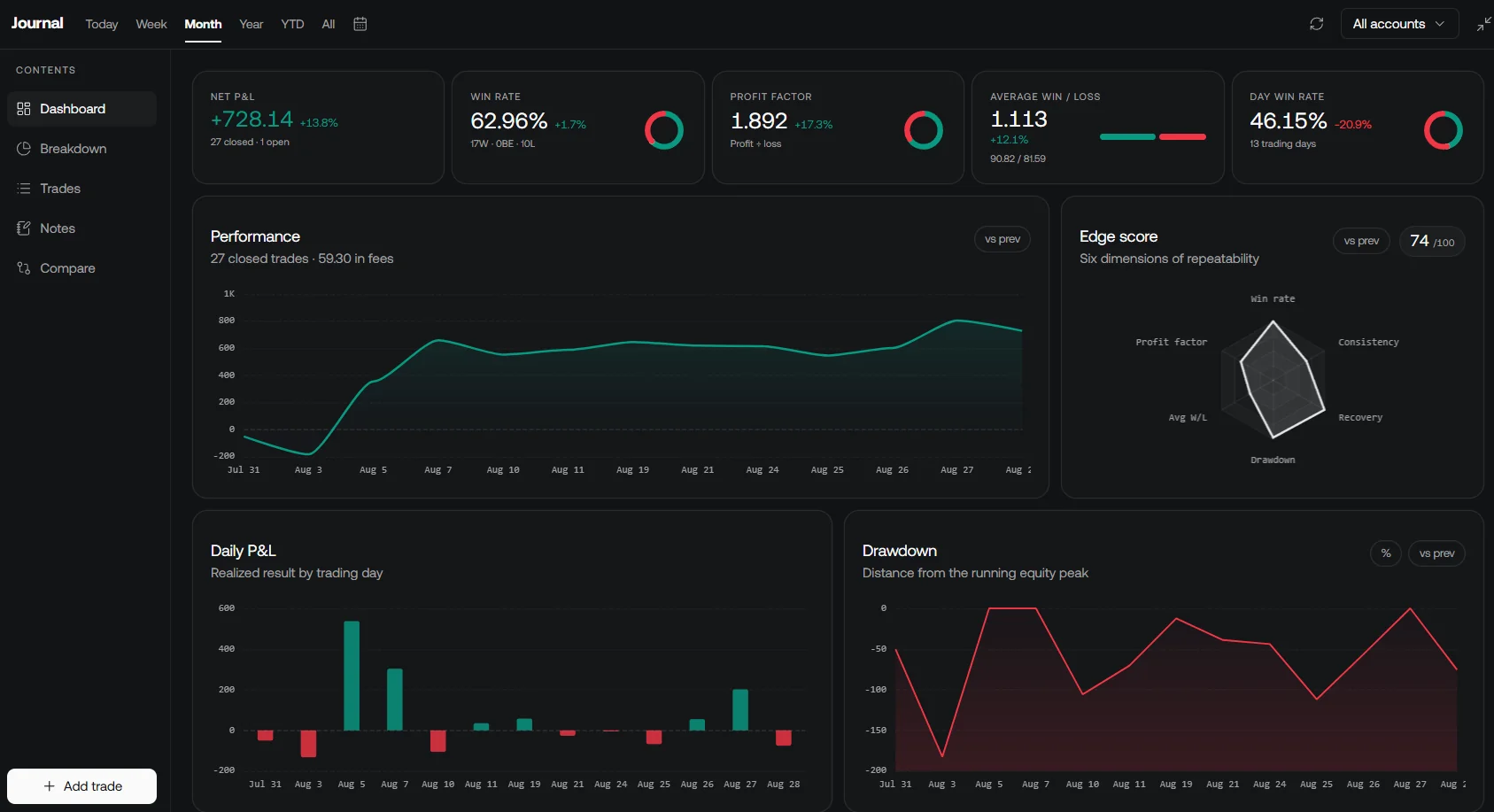
Add notes and consistent tags for behaviors you want to review, such as “planned exit followed” or “unplanned addition.” Record an explanation when the decision occurs, rather than reconstructing a convenient reason after the outcome. Preserve the original stop and later changes in your notes so the initial plan remains distinguishable from the final trade record.
Useful review fields include the planned exit condition, actual exit and time, position-size changes, costs, relevant market context, and the reason for any deviation. Measure both outcome and process: a profitable rule violation is still a violation, and a losing trade can follow a sound plan.
Build a Review Habit Without Overreacting
- After a trade: compare the actual decision with the recorded plan and flag unexplained changes.
- At a regular review: group comparable setups and examine how often rules were followed, how exposure changed, and whether execution costs differed from expectations.
- Before more research spending: define the next question, the time or money available to answer it, and the evidence needed to continue.
Do not infer bias from win rate or holding time alone. Different strategies naturally have different durations and loss patterns. A longer losing trade is a reason to inspect the plan and contemporaneous notes, not proof of sunk-cost behavior.
The aim is to make the next commitment defensible on current evidence. Money and time already spent belong in your records. The decision still ahead should be assessed using the risks, costs, and opportunities that remain.
Read next