The Truth About Trade Management: Beyond Psychology and Into Strategy

Trade management connects a strategy’s entry idea to the decisions that determine its actual outcome: position size, exits, exposure, execution and review. Psychology affects how you follow that process, but it cannot replace clear rules or evidence that the approach is viable after costs.
A losing trade does not automatically identify the problem. It may be an expected loss under a sound rule, a rule violation, a sizing error, an execution problem or evidence that the strategy needs review. Separate those possibilities before deciding that either your mindset or your method is at fault.
The Role of Risk Management
Position Sizing Starts with Exposure and Invalidation
Choose size in relation to account constraints, the instrument and the planned exit, not simply confidence in the setup. A percentage such as 1% or 2% is a convention some traders discuss, not a universal safe amount. Correlated positions, leverage, gaps and changing volatility can make combined losses much larger than a single-trade estimate.
For a simplified share example, suppose the account is $10,000, the planning loss budget is $50, entry is $100 and the planned exit is $98. The $2 price difference gives 25 shares before costs: $50 ÷ $2. That position has $2,500 of notional value and $50 of planned price risk. This illustrates the distinction between allocation and risk; it is not a recommended budget.
If the exit instead executes at $96, those 25 shares lose $100 before costs. Round size down where minimum increments require it and include commissions and plausible execution costs in the assessment. Futures multipliers, currency conversion, options behavior and margin requirements need their own treatment; a share formula should not be copied unchanged into every instrument.
Stops Define a Plan, Not a Guaranteed Fill
A planned invalidation level helps make the decision explicit before a position becomes stressful. Confirm whether the exit is an actual accepted order, a platform alert or a manual action you must take. They do not provide identical protection.
Investor.gov’s order guide explains that a stock stop order becomes a market order when triggered. The eventual price can differ from the stop price. A limit order controls the acceptable price but may remain unfilled. Check the instrument, order type, session and broker’s handling rather than assuming every “stop loss” behaves identically.
Avoid moving an invalidation point merely to postpone accepting a loss. If the strategy permits trailing stops, partial exits or changes in protection, define the conditions and test the whole rule. After an amendment, verify that the correct quantity and order are actually active.
Manage Drawdowns with Written Review Rules
A drawdown can occur even when a strategy behaves as expected. One losing streak does not prove the strategy has stopped working, but neither should a backtest justify unlimited losses. Define account-level limits, review conditions and the response to unexpected behavior in advance.
During a review, distinguish larger-than-expected losses from rule deviations, feed changes, execution problems and a change in the opportunities being traded. Reducing size or pausing can be part of a predefined response, while a rejected protective order may require immediate operational attention. Record why the action was taken so it can be evaluated later.
Evaluate Expectancy, Not the Target Ratio Alone
A target offering twice the planned risk does not ensure profitability. Realized results depend on how often trades win, the sizes of actual wins and losses, and costs. A target may never be reached, and partial exits can change the average outcome.
For illustration, if 30% of trades win 2R and 70% lose 1R, the average is 0.30 × 2R − 0.70 × 1R = −0.10R before costs. Here R is the initial planned risk unit. A seemingly attractive 2:1 target therefore can coexist with a losing process. Review realized distributions as well as intended targets.
Trade Approach and Strategy Adaptability
Markets and operating conditions can change, but an old strategy is not automatically obsolete. Frequent adjustments can also fit recent noise. Separate a scheduled research review from decisions made while a trade is open, and require a reason for each proposed change.
| What you observe | What to investigate | Useful next step |
|---|---|---|
| Rules followed, ordinary losing sequence | Whether outcomes remain within the researched range | Continue or pause according to the existing review policy |
| Unexpected fill or rejected order | Order status, quantity, session and account connection | Resolve the operational problem before assuming a strategy flaw |
| Repeated rule deviations | Clarity, complexity, availability and execution of the plan | Simplify or revise the process and document the reason |
| Persistent change in net results | Costs, data, trade mix, exposure and later-period evidence | Test a defined revision against the saved baseline |
Backtesting evaluates historical behavior under a model. It is useful for checking assumptions, but it does not reproduce every live fill or establish future profitability. Forward testing means observing behavior as new data arrives; it can begin in simulation rather than requiring real money. Any later live test has its own execution and capital risks.
Keep the original version and change one defined element at a time where practical. Compare the baseline and revision on appropriate periods, including data that did not determine the new settings. Account for the number of alternatives tried: repeatedly searching for the best recent result can produce a convincing but fragile choice.
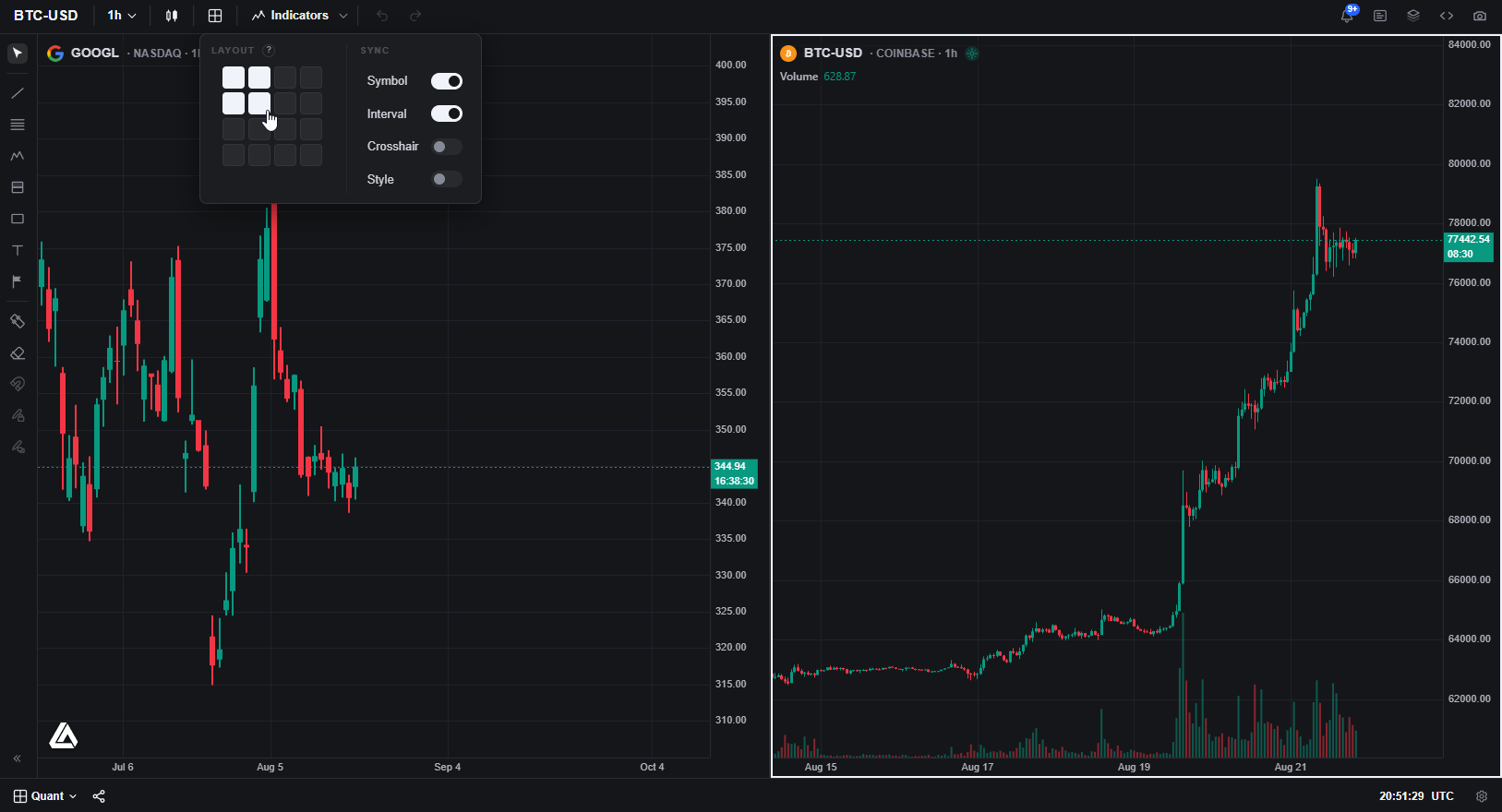
On LuxAlgo’s native charts, ask Quant, our coding agent to implement or explain a management rule, inspect the generated code and run it manually. For example, compare a fixed exit with a precisely specified trailing rule while keeping entries, sizing and costs explicit.
Check the native strategy settings for commission, slippage, capital and order size. Use standard candles for price-based tests, preserve the provider and session, and inspect individual trades alongside aggregate results. This is research; it does not configure a broker connection or prove live execution.
Psychology: Important, but Not a Complete Diagnosis
Fear, frustration and overconfidence can influence decisions. So can vague rules, unsuitable size, a strategy that conflicts with your schedule or incorrect data. There is no basis here for ranking psychology as the cause of most—or few—failed trades. Use the record of what happened rather than a broad explanation.
A calm trader can follow an unprofitable plan consistently. A researched plan can also be undermined by skipped exits or unintended exposure. Diagnose strategy quality and rule adherence separately, then look at how they interact. If following the plan becomes difficult at a particular size, that is useful information about the process.
Record both the intended action and the actual one, with the reason for any difference. Replace vague notes such as “bad psychology” with observations: entered before the condition closed, doubled size after a loss, or missed an exit while unavailable. Specific observations support a specific response.
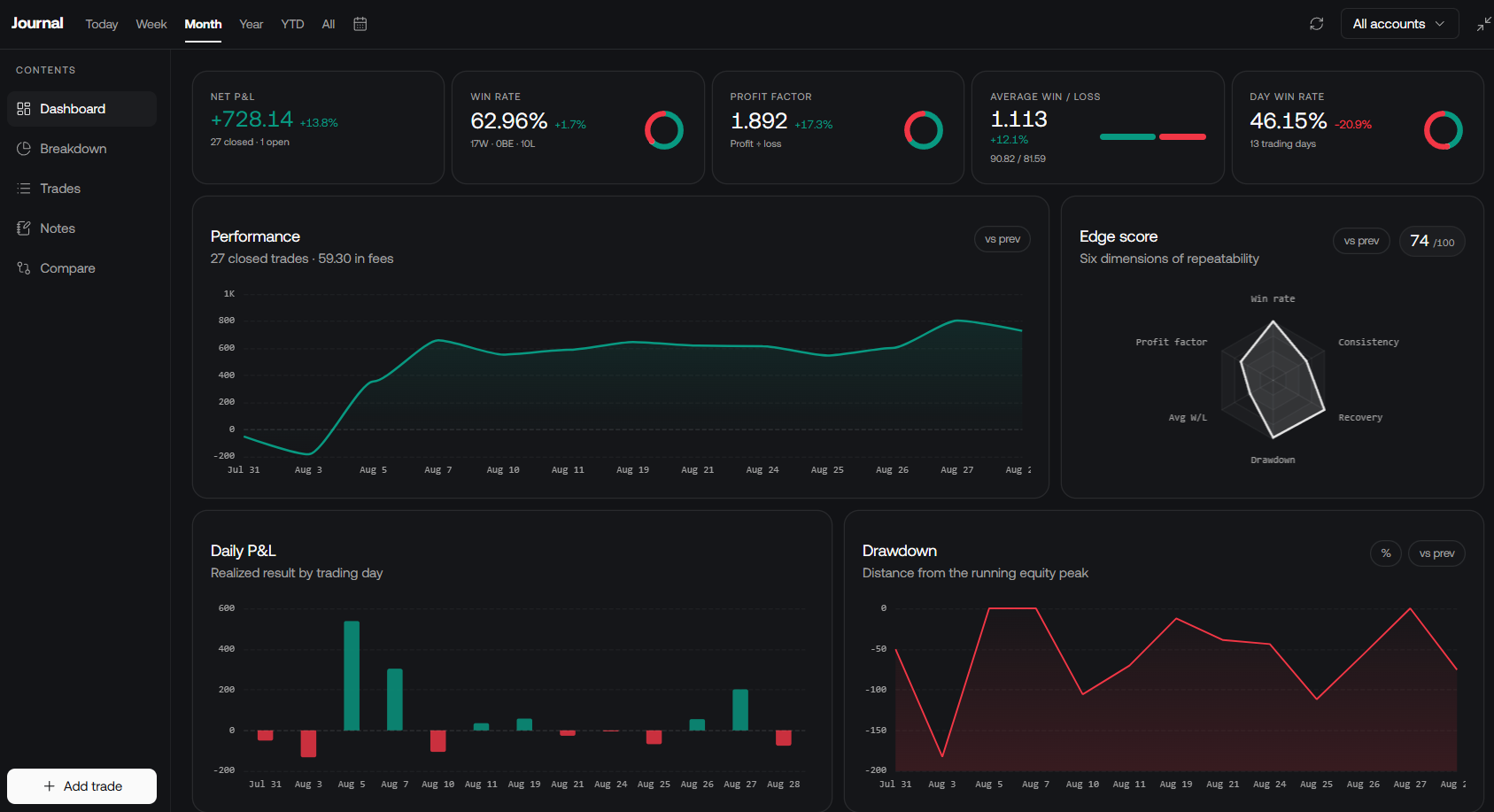
Use the native journal for compatible recorded trades, while retaining the account records needed to confirm current positions and orders. Keep simulated trades separate from actual ones. A performance chart alone cannot establish why a decision was made.
Discretionary vs. Systematic Trading
Discretionary trading uses judgment within a decision process; it need not mean improvising without limits. Systematic trading defines conditions in advance; it need not mean every action is automated. Both approaches require sizing, exit rules, monitoring and a way to investigate failures.
| Approach | Potential strength | Management challenge |
|---|---|---|
| Discretionary | Can incorporate context that is difficult to encode | Document the reasoning and apply consistent exposure limits |
| Systematic | Makes defined decisions reproducible and testable | Check assumptions, implementation and operational failures |
| Combined process | Uses rules for boundaries and judgment where specified | Define which decisions allow discretion and log overrides |
Neither approach has an automatic edge. Discretion can become inconsistent; a rule-based process can apply an unsuitable rule very consistently. Systematic traders still make choices about design, activation, overrides and revisions, so emotions are not removed from the process.
If you use a combined approach, identify the permitted decisions clearly. For example, a discretionary review might veto a setup under a predefined event policy while position sizing remains fixed by rule. Track those vetoes separately so you can assess their effect instead of attributing the whole outcome to the base strategy.
A Repeatable Management Routine
- Before entry: record the setup, size, invalidation, exit policy and total related exposure.
- After submitting orders: verify acceptance, fills, remaining quantity and protective instructions at the account.
- During the trade: follow the defined amendment rules and record any permitted override.
- After exit: reconcile costs and fills, then distinguish the strategy outcome from execution or adherence issues.
- At review: compare the evidence with your baseline and document any change before using it.
Keep related research organized so you can return to the original assumptions. This workspace demonstration shows how to group experiments in LuxAlgo; it does not monitor or manage a live brokerage position.
Effective trade management makes decisions and limits explicit. It cannot eliminate losses, but it gives you a more reliable basis for learning than changing a strategy after every loss or blaming every outcome on mindset.
Frequently Asked Questions
Does a 2:1 reward-to-risk target guarantee profitability?
No. The frequency and size of realized wins and losses, plus costs, determine the average outcome. Targets are not the same as realized results.
Is risking 1% or 2% per trade always safe?
No. Appropriate exposure depends on the account, instrument, combined positions and execution risks. A conventional percentage is not a universal safety limit.
Will a stop order always exit at the stop price?
No. A triggered stock stop order becomes a market order, so the fill can differ from the stop price. Check the exact order type and account handling.
Does forward testing require real money?
No. You can observe a strategy on new data in simulation. A later live test introduces actual execution and capital risks.
Does systematic trading remove emotion?
No. Rules can make decisions more consistent, but people still choose the design, size, activation, overrides and revisions. Record those decisions as part of the process.
Read next