Trading Psychology for Algorithmic Traders

Algorithmic trading changes where human judgment enters the process; it does not remove it. People choose the data, rules, risk limits and evaluation methods. They also decide whether to keep a system running, change it or stop it. Trading psychology matters at each of those points.
The aim is to make decisions consistent with a documented process and the available evidence. That means resisting an impulsive override during an ordinary loss while responding promptly to a genuine execution or risk-control failure. Confidence should come from understanding the system and its limits, not from expecting every trade to work.
- Define the rules before pressure arrives: include risk limits, intervention conditions and a restart procedure.
- Separate losses from failures: an expected losing trade and a broken order connection require different responses.
- Keep changes reviewable: record the reason, evidence, code version and test results.
- Review behavior alongside performance: a profitable override can still be a poor process decision.
Where Emotions Enter an Automated Workflow
Fear can prompt you to disable a system after a normal losing sequence. Fear of missing out can push you to add an untested market or shorten a confirmation rule. A strong backtest or a run of wins can encourage larger exposure before you understand how the strategy behaves under different conditions.
Automation can repeat rules quickly, but it can also repeat a mistake quickly. Execution is subject to feed delays, connectivity, broker behavior and market liquidity. Statistical output is not inherently precise simply because a computer produced it, and an algorithm can reproduce biases introduced through data or design.
Use a brief decision note before a discretionary change: What happened? Is a written threshold breached? What evidence supports the proposed action? Is it an incident response or a strategy revision? Recording those answers makes it easier to distinguish a planned response from a reaction to the latest result.
| Trigger | Possible impulsive response | A defined response to consider |
|---|---|---|
| Losses within the tested risk range | Disable the system or change the rules immediately | Review data and execution, then follow the existing monitoring schedule unless a stated limit is breached. |
| Unexpected order or position | Ignore it to avoid interfering with the algorithm | Use the incident procedure, reconcile broker positions and apply the appropriate containment action. |
| A winning streak | Increase size because the system feels reliable | Keep the sizing rule; evaluate any increase through the documented review process. |
| A missed market move | Add conditions or markets without testing | Record the hypothesis and test it separately before deployment. |
| A striking historical backtest | Select the best result after many trials | Review costs, selection bias and performance on data not used to develop the rules. |
Build Evidence-Based Confidence
Confidence is more useful when you can explain how the system works, where it can fail and what evidence would change your view. A test can establish that code followed a specification on the cases examined. It cannot establish that future returns will match the historical sample.
Verify the logic and data
Write entry, exit, size and timing rules clearly enough that someone else could review them. Check the first valid signal, missing data, session boundaries, gaps and order behavior. Confirm that information used in a historical decision was available at that time. A compiling script and an attractive equity curve are different kinds of evidence.
Separate development from evaluation
Use an earlier period for development, a validation period for selecting settings and a final evaluation period you have not repeatedly used to refine the rules. For time-dependent trading data, random fragments can mix information across periods. A chronological split or a properly designed walk-forward process is often more appropriate.
A walk-forward process retrains or recalibrates using information available before each evaluation window. Keep the schedule and selection method explicit. Trying many alternatives and reporting only the strongest final result can still overfit the process, even when individual tests appear to be out of sample.
Check operation before increasing exposure
Forward observation or paper trading can reveal timing, feed and execution differences. If live use is appropriate, a limited pilot can expose additional operational issues, but small size does not make an unvalidated strategy profitable or harmless. Scaling should depend on defined evidence and account constraints, not a few encouraging trades.
FINRA’s 2015 guidance for member firms using algorithmic strategies discusses testing, retrievable code versions, change controls, monitoring and mechanisms to disable a system. Those institutional practices provide useful context for disciplined operation; they are not a universal retail compliance checklist or proof that a strategy has an edge.
Distinguish a Losing Sequence from a System Failure
Start with two questions: Did the system behave as specified, and did it remain within the defined risk limits? A correctly executed loss does not automatically call for a tighter stop or a new parameter. An incorrect fill, duplicate order or stale feed needs investigation even if it happened to make money.
Compare live behavior with the assumptions in the test. Review price feed, spread, commissions, slippage, order timing and position size. Then examine whether the market conditions and sample size support a strategic conclusion. Avoid rewriting the entry logic before checking whether the apparent performance change comes from an operational difference.
Drawdown example: an account falling from $100,000 to $90,000 has lost 10% from that starting level. Returning from $90,000 to $100,000 requires about 11.11%, not 10%. Raising risk to recover the dollar loss faster changes exposure; it does not repair the original problem or improve the strategy’s expected return.
A losing sequence is also not proof of failure by itself. Under the simplified assumption of independent trades with a 50% loss probability, five losses in a specific block of five have probability 0.55 = 3.125%. The probability of encountering such a sequence somewhere in many trades is different, and real trades may be dependent. Use the example to understand uncertainty, not to set a universal shutdown threshold.
If a predefined drawdown or exposure limit is breached, follow the procedure even if the next trade might recover the loss. A historical maximum drawdown is an observation from one sample, not a ceiling on future losses. Risk limits should reflect the account’s capacity and the consequences of a breach.
Write Intervention Rules Before You Need Them
A blanket rule to “never intervene” can leave a malfunctioning system active. A blanket rule to override whenever you feel uncomfortable destroys the strategy you intended to evaluate. Define separate responses for operational faults, risk-limit breaches and ordinary performance review.
| Condition | Possible action to define in advance | Evidence to record |
|---|---|---|
| Stale data, duplicate orders or position mismatch | Pause affected order generation, reconcile positions and follow the incident-specific containment procedure | Timestamps, feed status, open orders, broker positions and logs |
| A specified exposure or loss limit is breached | Apply the documented risk response and assess outstanding orders and positions | The measured breach, controls triggered and actual remaining exposure |
| Underperformance without an immediate failure | Review at the planned checkpoint; investigate costs, sample size and changing conditions | Comparable test assumptions, trade records and alternative explanations |
| A proposed strategy improvement | Create a separate version and test it before replacing the working configuration | Hypothesis, changes, results, limitations and rollback version |
Pausing new entries, canceling pending orders and closing positions are different actions. One does not necessarily perform the others. Choose the response for the failure and verify it against the broker’s actual state. Closing everything can itself incur slippage or fail; leaving positions open can also be inappropriate. A useful procedure makes those decisions explicit.
After an incident, preserve logs and establish the cause before restarting. Confirm that orders and positions are reconciled, the fault is addressed, relevant checks pass and the restart conditions are satisfied. Document who is responsible for the decision when more than one person operates the system.
Recognize Bias in Strategy Development
Confirmation bias
Look for evidence that contradicts the hypothesis. Test a plausible alternative explanation, another period and a simple reference strategy. Ask a reviewer to identify what would make the result unreliable rather than only asking whether the chart looks convincing.
Overconfidence and automation bias
Do not treat a recent winning run, a sophisticated model or an AI-generated explanation as proof of reliability. Review data coverage and failed cases as carefully as successful ones. Check whether increased size, leverage or market coverage is justified by the actual evidence.
Loss aversion and recency bias
Moving a stop to avoid recognizing a loss changes the planned risk. Disabling a system solely because the latest trades were unpleasant changes the selection process. Compare recent results with the broader evidence and the written intervention criteria, while remaining willing to act when a genuine limit or fault is present.
Outcome bias
Judge the decision using what was known when it was made. An override that avoids a loss once does not prove that discretionary overrides improve the system. Record all overrides, including missed gains and added costs, and account for why particular trades were selected for intervention.
Use LuxAlgo to Make the Research Process Reviewable
Start with LuxAlgo’s native charts and data coverage to establish the symbol, timeframe and feed context. Keep the intended rule and observation date with your notes so later reviews use the same assumptions.
Ask Quant, our coding agent to turn explicit rules into strategy code. Inspect the generated code and run it yourself. Request a focused change, verify the behavior and retain the prior working version. A model’s confidence does not replace your review.
Use native strategy testing with standard candles, realistic costs and separate development and evaluation periods. Record drawdowns, trade count and sensitivity to assumptions as well as net profit. Treat repeated parameter searches as additional development, not independent confirmation.
Use the native LuxAlgo journal to review compatible trade records. Add a separate decision log when needed for interventions, test versions and observations about your own behavior. Broker records remain important for reconciling actual orders and positions.
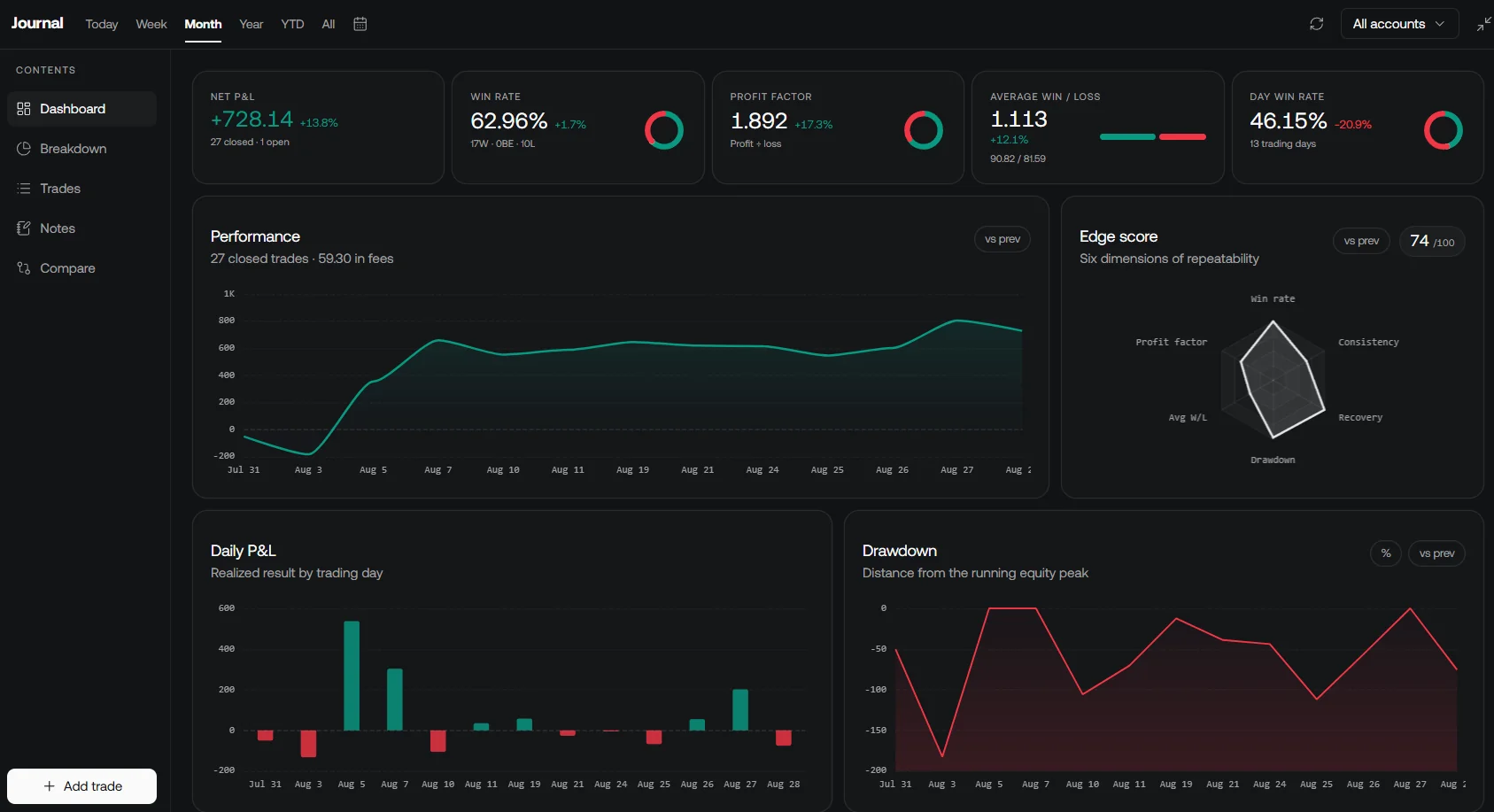
For example, if 18 of 20 reviewed decisions followed your documented procedure, adherence is 90%. That is a process measure, not a profit statistic. The two exceptions deserve investigation even if they made money, and the compliant decisions may still expose a weak strategy.
Create a Routine That Supports Clear Decisions
Choose a review rhythm that fits the strategy’s trading frequency and operational risk. A slower system may need different monitoring from one that submits many orders. A calendar can prompt a review, but it should not force parameter changes when the evidence does not support them.
- Before operation: confirm the intended version, data connection, account and exposure settings, alerts and incident procedure. Note whether you are distracted or too fatigued to supervise responsibly.
- During operation: monitor defined exceptions rather than reacting to every price movement. Keep safety alerts visible while reducing irrelevant notifications.
- After operation: reconcile records, review incidents and overrides, and record proposed changes for later evaluation.
- At scheduled reviews: assess performance, costs, capacity and controls. Test necessary software or credential changes according to provider requirements and risk, with a recovery plan.
Do not automatically retune every Sunday, rotate credentials every month or change core logic every quarter. The appropriate maintenance action depends on the system, provider requirements, identified vulnerabilities and observed issues. A rushed infrastructure change can create the same disruption as an impulsive strategy change.
Regular breaks, sufficient rest, exercise and an organized workspace can support a sustainable routine. Some traders use brief breathing or mindfulness exercises to pause before discretionary decisions. Treat these as personal practices, not a treatment claim or a measured guarantee of better returns. If you cannot supervise safely, use the planned coverage or shutdown procedure.
A community or peer review can help challenge assumptions, but another trader’s confidence is not validation of your system. Share a clear specification and evidence, and distinguish constructive feedback from pressure to take more risk.
Original Psychology Video
The original article embedded Time Affairs’ summary of The Psychology of Trading, published January 26, 2025. It is a third-party book summary, not a direct presentation by Brett N. Steenbarger or a study of algorithmic-trading returns. Use the practical workflow above to connect general psychology ideas to observable system decisions.
Frequently Asked Questions
Does algorithmic trading remove emotion from trading?
It can automate defined decisions, but people still choose data, rules, size and interventions. Bias can enter system design and monitoring, and automation can repeat mistakes quickly.
Should I stop an algorithm after several losing trades?
Use the predefined risk and intervention criteria. Check whether the system behaved correctly and stayed within limits. A losing sequence alone does not establish a malfunction, while an operational fault may require action regardless of profit.
Is manual intervention always harmful?
No. A documented response to a fault or risk breach can be necessary. Impulsive overrides and tested incident procedures are different. Record the reason, action and outcome, and verify the actual broker state.
Does a good backtest justify increasing size?
Not by itself. Review selection bias, costs, separate evaluation periods, live execution differences and account constraints. Scaling should follow defined evidence rather than a few favorable results.
Can a journal measure psychological discipline?
It can support a review of observable decisions and adherence to a written plan. That is different from diagnosing a psychological condition or proving that a habit improves returns.
Read next