Traditional Proprietary Trading: An Insider’s Guide

Traditional proprietary trading means a firm puts its own capital at risk in financial markets. Its traders research opportunities, execute orders, and manage positions within the firm’s limits. Trading gains belong to the business before expenses and compensation; individual traders receive the salary, bonus, or profit participation specified in their agreements.
This guide focuses on professional trading firms and desks. Paid online funding challenges are a different arrangement and may use simulated accounts. Understanding that distinction makes it easier to evaluate career opportunities, trading rules, and claims about earnings.
Key Takeaways
- Capital and responsibility: The firm bears market risk on its own positions, while traders remain accountable for their decisions and compliance with limits.
- Strategies: Market making, relative-value trades, statistical models, and directional strategies have different data, execution, and risk requirements.
- Careers: Hiring and pay depend on the employer, location, role, and skills. There is no universal salary ladder or 80/20 profit split.
- Technology: Research tools support an idea; production execution and risk controls determine how it can operate in live markets.
Prop Trading vs. Other Models
| Model | Capital and market exposure | How the participant is paid |
|---|---|---|
| Traditional proprietary firm | The business trades for its own account and bears the resulting gains or losses. | Employment or partnership terms may include salary, discretionary bonuses, or agreed profit participation. |
| Retail trading | An individual trades their account and bears its losses. | The account’s net trading result, after costs and applicable taxes. |
| Hedge fund | Fund investors supply capital and bear portfolio results; managers may invest alongside them. | The manager receives fees under the fund agreement; employee compensation is separate. |
| Retail evaluation or funded-account program | The arrangement may be simulated, live, or staged; the contract determines which. | Contractual payouts subject to the provider’s conditions, rather than an assumed employment salary. |
Trading for the firm’s account does not mean it never interacts with clients. A market maker can commit its own capital to provide liquidity to other institutions. Optiver describes this model in its institutional trading offering.
By contrast, FTMO states that its client accounts use fictitious funds in simulated trading. That is a specific example of why a “funded” label should not be read as proof of a live institutional trading job. Check account type, fees, payout conditions, restrictions, and legal relationship before comparing programs.
Exploring Proprietary Trading: Comprehensive Guide
This NetPicks explainer introduces prop trading’s benefits, challenges, and strategies. Use it as background, while checking current employer information and distinguishing professional desk roles from retail funding arrangements.
Core Operations
Money Management Rules
A desk needs more than a position-size formula. It must define permitted instruments, leverage, concentration, daily losses, overnight exposure, and the conditions that require escalation or a trading pause. The limits should match the strategy’s behavior and the liquidity available to unwind it.
Notional exposure, margin, and potential loss are different measures. Buying 1,000 shares at $50 creates $50,000 of exposure. An intended exit at $49 implies a $1,000 loss before costs, but an actual exit at $47 produces a $3,000 loss. Neither the capital allocated to a trader nor a broker’s margin requirement guarantees the smaller outcome.
| Control | Practical use | Important limitation |
|---|---|---|
| Position and concentration limits | Restrict size by instrument, sector, strategy, or shared risk factor. | Several different positions may lose together. |
| Exit and loss rules | Define trade exits, desk loss thresholds, and escalation procedures. | Gaps, halts, and thin markets can delay or worsen execution. |
| Scaling and profit taking | Add or reduce exposure according to a documented rule. | Adding to winners increases aggregate exposure; taking profits changes the strategy’s payoff. |
| Liquidity and funding reserves | Allow for collateral needs, settlement obligations, and unexpected market conditions. | Unused buying power is not necessarily cash available for every purpose. |
| Operational safeguards | Check orders before submission, reconcile executions, and provide a controlled way to stop activity. | Controls require testing and clear ownership to work during an incident. |
A blanket rule to keep every trade below 10% of capital is not a professional standard across asset classes. Futures, options, cash equities, and hedged portfolios require different exposure measures. As Investor.gov explains, a stop order does not guarantee its execution price, while a limit instruction does not guarantee execution.
Main Trading Methods
Market making involves quoting prices to buy and sell. Capturing a spread is a possible source of revenue, not a guaranteed profit. Inventory can move against the firm, and counterparties may trade just before prices change. Hedging, queue position, fees, and execution quality affect the result.
Arbitrage and relative-value strategies compare economically related instruments. Index arbitrage can involve an index future and the underlying basket, with financing and dividends included in fair-value estimates. Merger arbitrage depends on a deal closing on expected terms; a discount to the offer price compensates for risks rather than representing free money. Volatility arbitrage compares option pricing with a volatility view and usually requires managing changing exposures.
Statistical trading uses data to estimate relationships or predict conditional outcomes. A pairs model might anticipate convergence, but the relationship can change and the hedge can fail. Research must distinguish a repeatable effect from a pattern found by trying many alternatives.
Directional trading takes a view on price movement, perhaps using events, fundamentals, or technical signals. It may be discretionary or systematic. A directional desk’s requirements are not interchangeable with those of a high-frequency market maker.
Trading Software and Systems
Think in terms of connected functions rather than a shopping list of platforms. Market data supplies observations; research turns them into hypotheses; order systems route instructions; risk systems constrain exposure; records support reconciliation and review. A firm may build these components internally, buy them, or combine both approaches.
Data and analytics products serve a different purpose from a broker’s execution interface. One reference that has changed is Eikon: LSEG withdrew Eikon on June 30, 2025, and directs users to Workspace. Platform suitability still depends on the instruments, venue access, data rights, latency requirements, and integration needed by the desk.
For chart-based research, LuxAlgo brings charts and strategy development into the same workspace. That research environment should not be confused with an institutional order-management system, an exchange connection, or a firm-wide risk engine.
Starting as a Prop Trader
Key Skills You’ll Need
| Skill | What it looks like in practice | Evidence you can prepare |
|---|---|---|
| Quantitative reasoning | Working with probability, uncertainty, and expected outcomes. | A clear explanation of assumptions and how new information changes the decision. |
| Research and programming | Cleaning data, implementing a rule, and checking whether results are reproducible. | A small project with documented data, costs, and validation. |
| Risk judgment | Recognizing when size, liquidity, or model uncertainty makes a trade unsuitable. | Stress scenarios and an account of how an idea can fail. |
| Communication and discipline | Reporting errors promptly, explaining decisions, and learning from review. | A concise research memo and a record of changes made after mistakes. |
The balance varies by role. A quantitative researcher may need deeper statistics and coding; a discretionary trader may emphasize market interpretation and execution. Both benefit from explaining uncertainty honestly and responding constructively when an assumption breaks.
How to Get Hired
Read the actual role description before assuming a particular degree, school, or trading record is mandatory. Jane Street’s trading interview guidance, for example, emphasizes foundational reasoning and says prior finance knowledge is not required for its process. That employer’s approach is useful preparation context, not a rule for every firm.
Build one research project you can defend. Explain the hypothesis, how the data was collected, when decisions become available, what execution assumptions were used, and which results were reserved for validation. Be ready to describe an unsuccessful test and what it taught you. A smooth historical equity curve without those details is weak evidence of research quality.
Career Progression and Compensation
A junior role may begin with supervised research, execution assistance, and small responsibilities. Progress can mean larger limits, ownership of a strategy, mentoring colleagues, or managing a team. It depends on judgment, collaboration, operational reliability, and results; advancement is not automatic after a fixed number of profitable months.
As a specific September 2026 example, Jane Street’s New York Quantitative Trader posting lists a $300,000 base salary plus an annual discretionary bonus. This is one employer and location, not an industry average or a promise for entry-level applicants. Compare base salary, bonus discretion, benefits, deferral, and any repayment or capital-contribution terms in the actual offer.
Licensing also depends on the activity and jurisdiction. For covered U.S. securities-trader registration, FINRA specifies the SIE and Series 57, with firm sponsorship required for the representative-level exam. The old Series 56 is not a current exam to pursue. CFA and FRM study may support knowledge, but professional credentials do not substitute for required registrations.
Pros and Cons
Key Benefits
A traditional firm can provide trading capital, colleagues with specialized experience, research resources, and established infrastructure. Feedback from a team can expose mistakes that are harder to see when working alone. Compensation may reward contributions to the business, and a trader can gain experience with markets that would be difficult to access independently.
Those benefits depend on the employer. Review the training offered, who supervises risk, how performance is assessed, and whether the arrangement is employment, partnership, or another contract. A claim about an attractive profit split says little without knowing which expenses and losses are deducted first.
Main Risks
Market and liquidity losses can occur even when a model behaved well historically. Counterparties, clearing arrangements, and funding also matter. Technical failures can produce stale data, duplicate orders, or incorrect positions, while human errors can turn a manageable problem into a larger one if they are not escalated.
For an employee, the firm’s capital at risk is not usually the same as personally funding each trade, but income, bonuses, and job security can depend on performance. Some arrangements involve personal contributions or other obligations. Read those terms rather than assuming every prop role removes personal financial exposure.
Rules and Standards
The Volcker Rule generally restricts proprietary trading by banking entities, subject to applicable exceptions and conditions. It is not a blanket prohibition on all independent proprietary firms. Regulatory obligations vary with the legal entity, jurisdiction, instruments, and activities performed.
At the desk level, clear permissions, order controls, records, surveillance, and escalation procedures support compliance. Traders should know who can approve a new strategy, change a limit, or restart trading after an incident. Purchasing software or completing a course does not establish that these obligations have been met.
What’s Next in Prop Trading
AI and New Technology
AI can assist with code, research organization, and extracting information from text. Its output still needs to be checked for incorrect assumptions, data leakage, and sensitivity to changing conditions. Faster strategy creation also makes it easier to test many variations and accidentally select a result that worked by chance.
On LuxAlgo, use Quant, our coding agent, to turn a written specification into strategy code. Define signal timing, entries, exits, position sizing, and costs. Review the code and run the strategy; then inspect performance results and the Trades Log. Generating a strategy does not establish that it is robust or approved for live execution.
A useful sequence is to develop rules on one period, freeze them, and evaluate a separate period with realistic costs. For example, 100 trades averaging $8 before costs produce $800 gross. At $10 round-trip cost per trade, the same sample loses $200 net. Research that ignores execution can reverse the apparent conclusion.
Reviewing the Process with LuxAlgo
Use the LuxAlgo Journal to record trades through manual entry, import, or supported broker connections. Compare actual executions with the plan, track results after costs, and add notes about mistakes or changing market conditions. Use only data you are permitted to store or share under your employer’s policies.
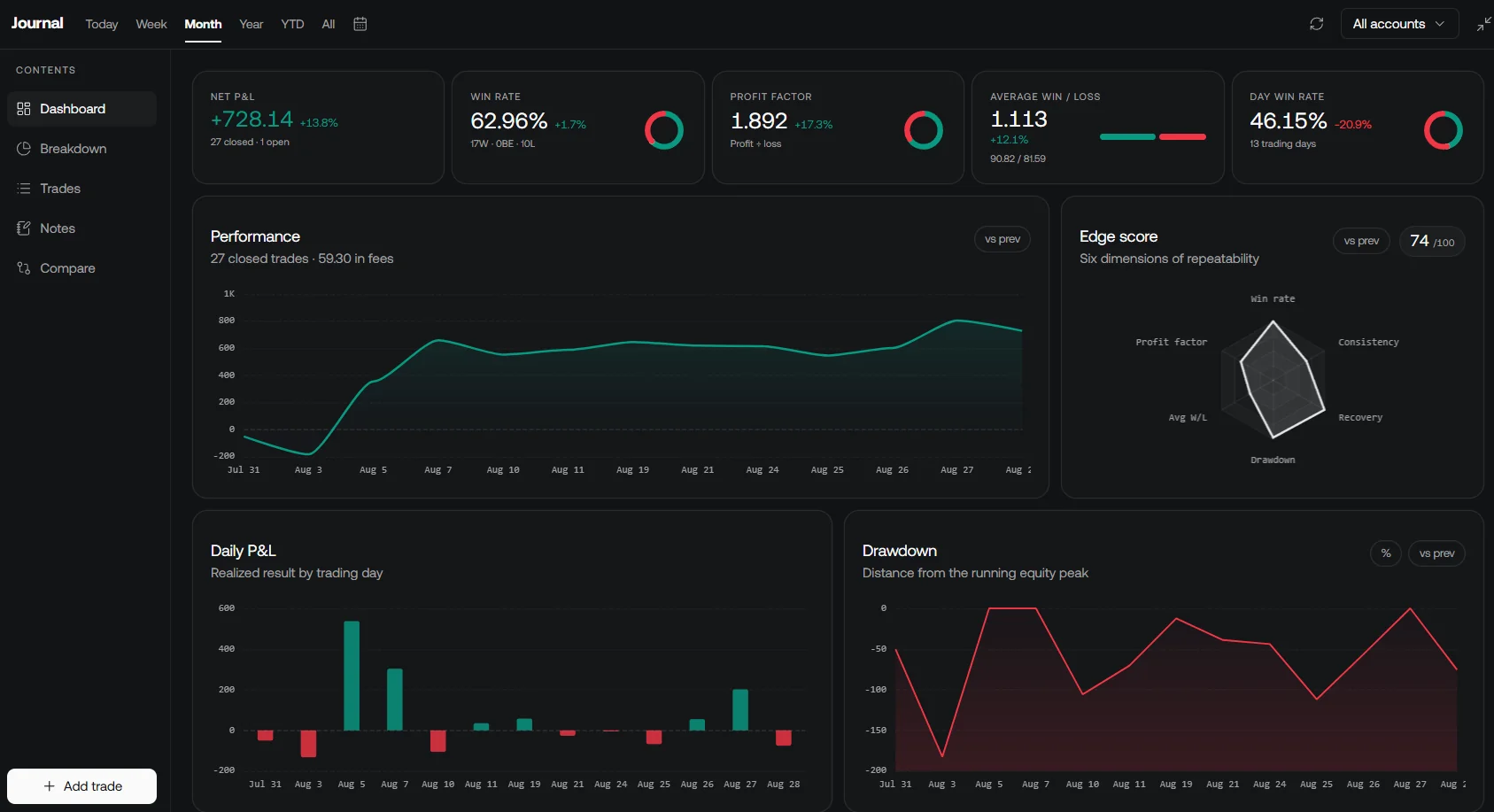
A review should connect outcomes with decisions. Was the loss caused by the strategy, an execution difference, a data problem, or a rule violation? Did several positions share an exposure that was missed? A small sample cannot establish a durable edge, but it can reveal problems that deserve investigation before more capital is committed.
Market Changes and Future Outlook
Professional trading and retail funding programs will continue to be shaped by technology, competition, and their respective rules. Wider access to research tools can help people learn, but it does not remove the need for market access, reliable operations, or a valid economic reason for a strategy to work.
Evaluate new technology through measurable questions: Does it improve data quality, reduce avoidable errors, or make research easier to reproduce? Can the team explain and monitor its outputs? Which new failure modes does it introduce? These questions are more useful than assuming AI adoption automatically improves returns.
Getting Started Steps
- Choose the path: Separate an institutional career application from a retail evaluation product, and identify the instruments and role you want to learn.
- Build the foundations: Practice probability, market mechanics, data analysis, and the communication skills relevant to that role.
- Produce defensible research: Document a strategy, validate it outside its development sample, and include costs and failure scenarios.
- Review your decisions: Use simulated practice and a journal to examine execution and discipline; do not treat simulated gains as live proof.
- Check the opportunity: Read current hiring criteria, compensation terms, supervision arrangements, and applicable registration requirements.
Traditional prop trading combines research with responsibility for a firm’s capital. A credible route into the field is built on clear reasoning, realistic testing, reliable execution, and evidence that you can learn from mistakes. Tools can support that process; they cannot replace it.
Read next