





Adaptive Centric Moving Average
 by LuxAlgo · Feb 17, 2026
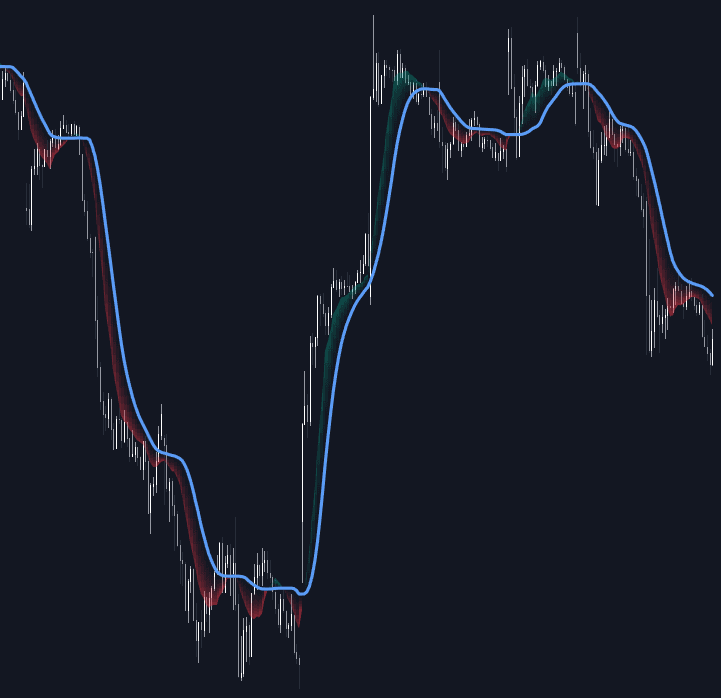
The Adaptive Centric Moving Average (AMA) is an advanced trading indicator designed to dynamically adjust its smoothing behavior based on price location within its recent range. Unlike traditional moving averages that apply a fixed smoothing factor, this adaptive trading tool reacts differently depending on whether price is consolidating near equilibrium or expanding toward range extremes. The result is a responsive trend-following indicator that filters noise in sideways markets while accelerating during strong directional moves.
How to Trade the Adaptive Centric Moving Average?
The Adaptive Centric Moving Average is built to solve one of the most common problems in technical analysis: balancing responsiveness with stability. Most moving averages either lag too much during trends or whipsaw excessively during consolidations. The AMA trading indicator adapts automatically to market structure.
When price trades near the midpoint of its recent high-low range, the AMA becomes flatter and less reactive. This helps eliminate false signals during ranging conditions. As price moves toward the upper or lower boundaries of that range, the AMA increases its responsiveness, allowing traders to capture emerging trends earlier.
This makes the AMA useful for:
- Identifying trend direction
- Filtering consolidation noise
- Confirming breakouts
- Acting as a dynamic trailing stop
- Measuring trend strength through distance from price
The gradient fill between price and the AMA line provides instant visual feedback. A strong expansion of the fill often signals increasing momentum, while compression indicates weakening pressure.
Trading Strategy Applications
Trend Identification
When price remains consistently above the AMA, the market is in a bullish regime. When price holds below the AMA, bearish pressure dominates. Because the smoothing adapts to volatility and range expansion, the indicator responds faster during genuine breakouts than during random fluctuations.
Traders can combine the AMA with:
- Breakout trading strategies
- Pullback entries in trending markets
- Market structure shifts
- Volatility expansion setups
Dynamic Trailing Stop
The Adaptive Centric Moving Average can function as a trailing stop-loss tool. In trending conditions, the AMA accelerates toward price, allowing traders to lock in profits without giving back excessive gains. During consolidations, the flatter behavior prevents premature stop-outs.
This makes it particularly useful for swing trading and intraday trend-following strategies.
DETAILS
The strength of this trading indicator lies in its adaptive smoothing logic, which is driven by a normalized relative position calculation similar to a Stochastic oscillator.
Adaptive Smoothing Logic
The script calculates a dynamic smoothing coefficient (alpha) based on how far price is from the 50% midpoint of its recent range.
- When price is exactly at the midpoint (50%), alpha approaches zero, and the moving average becomes nearly flat.
- As price moves toward the extremes (0% or 100% of the range), alpha increases.
- The further price moves away from equilibrium, the faster the AMA reacts.
This creates a self-adjusting smoothing mechanism that responds to structural imbalance rather than raw volatility alone.
The Centric Calculation
Unlike conventional moving averages that directly track price, the Adaptive Centric Moving Average centers its logic around the midpoint of the recent range.
Two advanced parameters refine its behavior:
- The Attenuation Factor scales the distance between price and the range midpoint, controlling baseline responsiveness.
- The Power Factor exponentiates the smoothing coefficient, introducing non-linear acceleration.
This centric design helps the indicator behave conservatively near equilibrium while becoming aggressive during expansion phases. The result is a highly adaptive trend indicator optimized for both consolidation and breakout environments.
SETTINGS
The Adaptive Centric Moving Average offers flexible customization to suit different trading styles, from scalping to position trading.
Price Settings
- Source: Select the price series used in calculations (default: Close).
- Length: Defines the lookback window for determining the highest high and lowest low. This window also affects pre-smoothing and sensitivity.
Shorter lengths increase responsiveness, while longer lengths create smoother trend structures.
Adaptive Settings
-
Attenuation Factor: Controls how strongly price deviations influence the smoothing process.
- Lower values increase sensitivity and responsiveness.
- Higher values produce steadier, slower adaptation.
-
Power Factor: Applies an exponent to the smoothing coefficient.
- Higher values make the AMA significantly flatter near the midpoint.
- Lower values produce more linear responsiveness.
These controls allow traders to fine-tune the indicator for trending markets, volatile assets, or mean-reverting conditions.
Colors
- AMA Color: Defines the primary moving average line color.
- Bullish Fill: Gradient color used when price is above the AMA.
- Bearish Fill: Gradient color used when price is below the AMA.
Clear visual customization improves chart readability and makes trend shifts easier to interpret.
Why Use the Adaptive Centric Moving Average?
This trading indicator provides a structural, range-aware alternative to traditional moving averages such as EMA or SMA. By adapting to price location within its range rather than simply time-based smoothing, the AMA offers:
- Reduced whipsaws in sideways markets
- Faster response during breakout phases
- Clear visual trend strength assessment
- Flexible risk management applications
For traders seeking a dynamic moving average trading strategy that intelligently adjusts to market conditions, the Adaptive Centric Moving Average offers a powerful and adaptable solution.
FAQ
What makes the Adaptive Centric Moving Average different from a regular EMA?
Unlike an EMA that uses a fixed smoothing factor, the AMA adjusts its smoothing speed dynamically based on price position within its recent range. This makes it flatter during consolidation and more reactive during strong directional moves.
Can the AMA be used for scalping?
Yes. By reducing the Length parameter and adjusting the Attenuation and Power Factors, the Adaptive Centric Moving Average can be optimized for lower timeframes and intraday trading strategies.
How can I access the Adaptive Centric Moving Average?
You can get access on the LuxAlgo Library for charting platforms like TradingView, MetaTrader (MT4/MT5), and NinjaTrader for free.

Unlock Unlimited Access to the LuxAlgo Library
Upgrade your plan to get all indicators, strategies, charts, and full access to Quant, our AI agent.
Trading & investing are risky and many will lose money in connection with trading and investing activities. All content on this site is not intended to, and should not be, construed as financial advice. Decisions to buy, sell, hold or trade in securities, commodities and other investments involve risk and are best made based on the advice of qualified financial professionals. Past performance does not guarantee future results.
Hypothetical or Simulated performance results have certain limitations. Unlike an actual performance record, simulated results do not represent actual trading. Also, since the trades have not been executed, the results may have under-or-over compensated for the impact, if any, of certain market factors, including, but not limited to, lack of liquidity. Simulated trading programs in general are designed with the benefit of hindsight, and are based on historical information. No representation is being made that any account will or is likely to achieve profit or losses similar to those shown.
Testimonials appearing on this website may not be representative of other clients or customers and is not a guarantee of future performance or success.
As a provider of technical analysis tools and strategies, we do not have access to the personal trading accounts or brokerage statements of our customers. As a result, we have no reason to believe our customers perform better or worse than traders as a whole based on any content, tool, or platform feature we provide.
Charts used on this site are by TradingView in which the majority of our technical indicators are built on. TradingView® is a registered trademark of TradingView, Inc. www.TradingView.com TradingView® has no affiliation with the owner, developer, or provider of the Services described herein.
Market data is provided by CBOE, CME Group, BarChart, Massive, CoinAPI. Select U.S. equities data is provided through Massive. CBOE BZX real-time U.S. equities data is licensed from CBOE and provided through BarChart. Real-time futures data is licensed from CME Group and provided through BarChart. Select cryptocurrency data, including major coins, is provided through CoinAPI. All data is provided “as is” and should be verified independently for trading purposes.
This does not represent our full Disclaimer. Please read our full disclaimer.
© 2026 LuxAlgo Global, LLC.