Options Contracts 101: Key Concepts and Strategies for Beginners
An options contract gives its buyer a right and its seller an obligation under specified terms. Understanding the strike, expiration, premium, and settlement comes before choosing a strategy. A correct forecast for a stock can still produce an options loss if the move is too small, too late, or offset by a change in implied volatility.
Start by researching the underlying market in Vela, the charting platform we build at LuxAlgo. Quant can help turn that market thesis into rules you can inspect and test. Then use options-specific quotes and your broker’s tools to evaluate the actual contract and order. Underlying-chart analysis and options pricing answer different questions.
What an Options Contract Contains
A call gives its holder the right to buy the underlying at the strike; a put gives the right to sell. For physically settled equity options, an assigned call writer must deliver the shares and an assigned put writer must purchase them. Cash-settled products work differently. The Options Industry Council’s options basics explains these contract distinctions.
| Term | What to check |
|---|---|
| Underlying and option type | The security or index, and whether the contract is a call or put |
| Strike price | The contract’s exercise price |
| Expiration | When the contract expires, plus trading and exercise deadlines |
| Premium and multiplier | The quoted price and how it converts to the contract’s cash amount |
| Exercise and settlement | American or European style; physical or cash settlement; actual deliverable |
Standard U.S. equity contracts generally cover 100 shares. A $2.50 premium therefore costs $250 for one contract before fees. Adjusted contracts and other products can have different terms. American-style options permit exercise before expiration; European-style exercise is restricted to expiration under the product’s terms. Selling a position to close is a separate action from exercising it.
There are four order actions: Buy to Open creates a long option; Sell to Close reduces it; Sell to Open creates a short option; Buy to Close reduces it. Review our guide to option order actions before entering a ticket. The position changes only for the quantity filled.
Options Pricing and Structure
Intrinsic and Extrinsic Value
For a call, intrinsic value is the greater of the stock price minus the strike or zero. For a put, it is the greater of the strike minus the stock price or zero. The premium above intrinsic value is called extrinsic value, often described as time value.
For a hypothetical stock at $187.40, a $180 call has $7.40 of intrinsic value. If its premium is $10.00, the remaining $2.60 is extrinsic value. With a 100-share multiplier, the contract’s premium is $1,000, split into $740 intrinsic and $260 extrinsic value. Intrinsic value is not the buyer’s profit: the purchase price and costs still matter.
Why the Premium Changes
Stock price, strike, remaining time, implied volatility, interest rates, and expected dividends affect theoretical pricing. Actual quotes also reflect the market for that series. Implied volatility is inferred from option prices; it describes priced-in uncertainty, not a guaranteed future move or direction.
Time decay is not a fixed schedule in which one-third disappears in the first half of a contract’s life. It varies with the contract and pricing assumptions. The OIC explanation of theta describes its nonlinear behavior. A long option can lose value as expiration approaches even when the underlying is unchanged.
The Greeks: Read the Units
The Greeks estimate local sensitivity with other inputs held constant. They change as conditions change and are not forecasts. The OIC’s Greeks overview provides the pricing context.
| Greek | Meaning | Example or caution |
|---|---|---|
| Delta | Premium change for a $1 underlying move | A 0.50 call delta suggests about $0.50 per quoted share, or $50 for a standard contract |
| Gamma | Change in delta for a $1 underlying move | Delta itself changes, so a large move cannot be valued by a fixed delta alone |
| Theta | Premium sensitivity to one less day remaining | Usually negative for a long option; the amount is not constant |
| Vega | Premium sensitivity to a one-percentage-point IV change | Vega of 0.09 implies about $9 per standard contract, not a fixed $1 |
Using the common per-share convention, long-call delta ranges from 0 to 1 and long-put delta from −1 to 0. Some platforms scale the display by 100. Check the units before combining positions. Short positions reverse the corresponding long-position sensitivities; multi-leg totals depend on every leg.
Simple Options Trading Methods
Buying Calls and Puts
A purchased call typically expresses a bullish view, while a purchased put typically expresses a bearish view. The standalone option can lose the full premium plus costs. Exercise can create a stock position with further funding needs and exposure.
Suppose a $50-strike call costs $3.00. Its expiration break-even is $53 before costs. At a $52 stock price on expiration, it has $2.00 intrinsic value, so the buyer loses $100 on a standard contract despite the stock being above the strike. Before expiration, remaining extrinsic value changes the exit price.
A $50-strike put bought for $3.00 has a $47 expiration break-even before costs. If the stock finishes at $45, the option’s $5.00 intrinsic value yields a $200 gross profit on a standard contract. These are hypothetical expiration payoffs, not predicted returns.
Buying both a call and a put at the same strike and expiration creates a long straddle. It pays two premiums and generally needs a sufficiently large move to overcome that cost at expiration. “More volatile” does not automatically mean profitable when the entry premium already reflects high volatility.
Writing Covered Calls
A covered call combines owned shares with a short call covering the same deliverable. It collects premium and caps upside while retaining substantial stock downside. See the OIC covered-call guide for the combined payoff.
Consider 100 hypothetical shares bought at $50 and a $55 call sold for $4.00. If the shares are delivered at $55, the gross gain is $500 on the shares plus $400 premium, or $900 before costs. That equals 18% of the initial $5,000 stock purchase—not an annualized return or an expectation for future trades.
If the stock falls to zero, the combined loss is $4,600 before costs. If it rises well above $55, the covered call gives up that additional upside. Be willing to deliver the shares and understand early assignment, including around dividends. “Covered” is not downside insurance.
Selling Cash-Secured Puts
A cash-secured put sets aside money for a potential share purchase at the strike. Premium reduces the economic acquisition cost, but assignment can still require buying well above the then-current market price. The OIC cash-secured-put guide explains the obligation.
For example, selling a $50 put for $2.00 produces $200 gross premium on a standard contract and a possible $5,000 share-purchase obligation. The economic break-even is $48 per share before costs. If the stock reaches zero, the loss is $4,800. Available purchase cash does not remove that downside.
Managing Risk in Options
Size the Complete Position
Separate premium paid or received, collateral required, and possible loss. They are different numbers. There is no account percentage that automatically makes an options strategy conservative.
- For a standalone purchased option, budget for losing the entire premium and costs.
- For a short option, account for assignment, margin changes, and adverse price moves.
- For a spread, inspect both the intended payoff and exposure if legs are closed or assigned separately.
- Include correlated positions and any shares acquired or left behind.
A stop on a $1,000 option purchase does not guarantee that the loss is limited to $500. Quotes can gap, a stop can slip, and a limit can remain unfilled. Define an exit plan, but distinguish the desired exit from the maximum contractual or portfolio exposure.
Check Execution and Assignment
Review the exact series’ bid, ask, displayed size, and quote freshness. High stock volume or option open interest alone does not establish that your order will fill at a favorable price. The OIC general FAQ distinguishes option activity from liquidity.
American-style short options can be assigned before expiration. Follow broker deadlines and inspect positions after exercise or assignment; do not assume an unfilled closing order removed the exposure. The OIC assignment FAQ covers these mechanics.
Account for Volatility and Events
An earnings announcement can change both the stock and implied volatility. A buyer may get the direction right yet lose after IV falls; a seller can collect premium and suffer a much larger adverse move. High IV alone is not a reason for a beginner to sell a short straddle, whose uncovered call side can have unlimited loss.
The Cboe VIX Index represents expected 30-day volatility derived from S&P 500 index options. It is not the implied volatility of each stock, an all-asset volatility measure, or a directional signal.
Options Trading Software
Start with Vela and Quant
Use the native chart workspace to compare timeframes, mark the underlying’s levels, and examine trend and volume. Indicators such as moving averages and RSI can organize the thesis; they do not tell you whether a particular option is fairly priced.
Quant is LuxAlgo’s coding agent. Describe the underlying-price rules, review the generated code, and run tests with explicit assumptions. For example: “Define a breakout above the previous 20-bar high, specify the entry timing, and show the exit rules.” Inspect what the strategy actually implements before using its results.
An underlying-price backtest is not a full options simulation. Contract selection, historical option quotes, spreads, volatility, expiration, exercise, and assignment need their own treatment. Do not assume Quant models those automatically or sends broker orders.
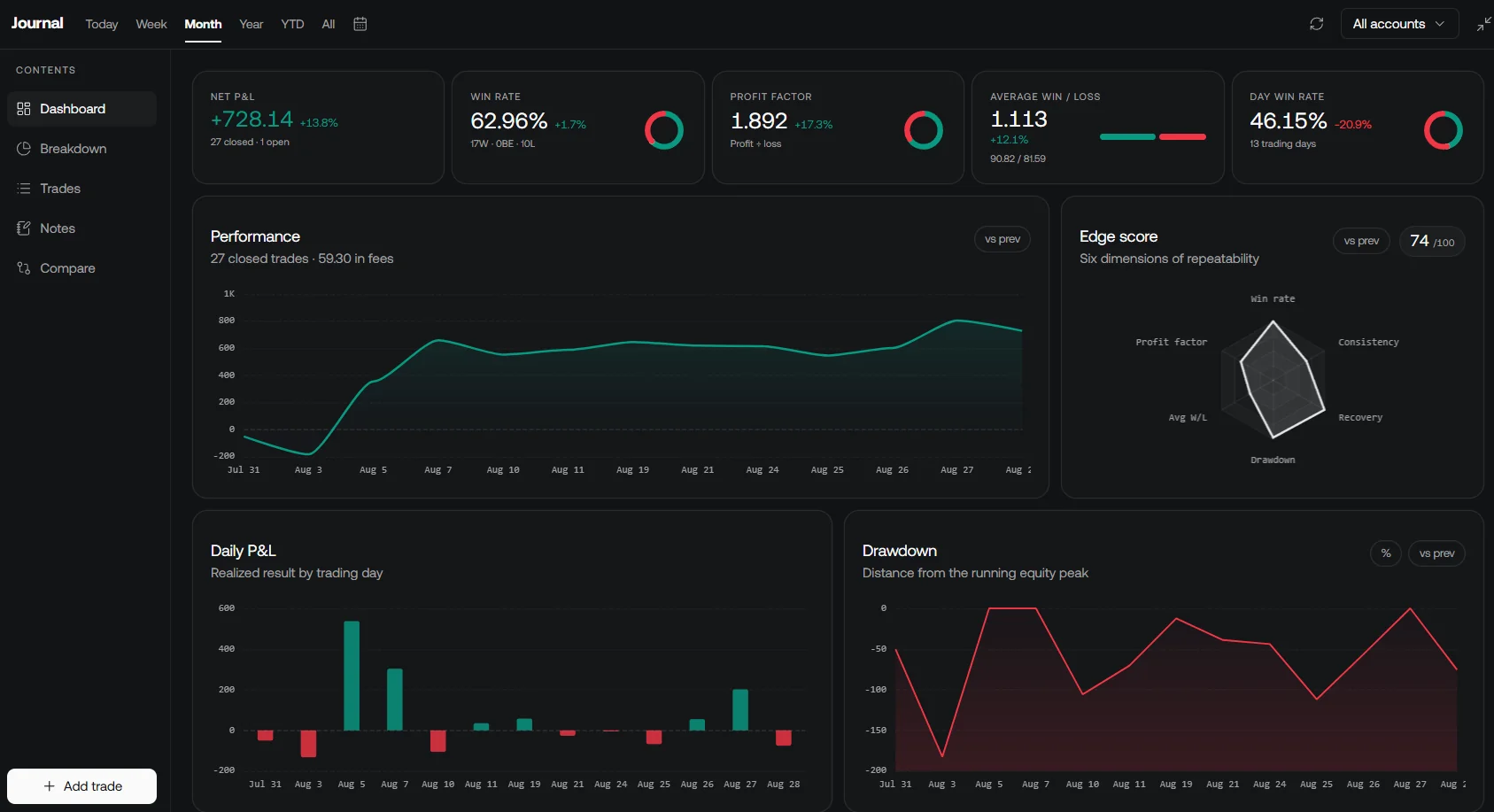
After a trade, use the LuxAlgo Journal to record the thesis and review results. Confirm that the supported import or broker connection captures the needed option and multi-leg details, and supplement missing premiums, assignments, fees, or notes.
TradingView Options Analysis: Video Walkthrough
The official TradingView video below introduces its options-analysis tools and strategy builder. It is a product walkthrough, rather than a ten-minute introduction to every options concept. Its interface reflects the version shown; verify current product access and market coverage before relying on a feature.
Choose Broker Tools by the Contract Requirements
Compare options permissions, supported products, current data, chain and Greeks displays, payoff analysis, order controls, and exercise procedures. Check commissions, exchange and regulatory charges, assignment or exercise fees, and data costs. A “commission-free” label is not a complete cost comparison.
Use broker records to confirm actual fills, positions, and obligations. Community examples can generate questions to investigate, but another trader’s result does not validate a strategy or establish suitability for your account.
Summary and Next Steps
Key Takeaways
- Know the contract’s multiplier, strike, expiration, exercise style, and settlement.
- Separate premium, intrinsic value, and profit; use the correct per-contract units.
- Read Greeks as changing sensitivities, not promises.
- Evaluate the entire strategy, including stock exposure and assignment.
- Use native charts and Quant for an explicit underlying thesis, then validate option pricing and execution separately.
Build a Repeatable Review Process
Practice calculating a contract’s premium and hypothetical payoff before placing an order. Write down the entry thesis, the event or price that would change it, the possible loss, and the intended exit. Reconcile actual fills and costs afterward. The goal is a decision process you can explain and review, not a strategy name that sounds safe.
Read next