





Adaptive Harmonic Forecast
Feb 11, 2026
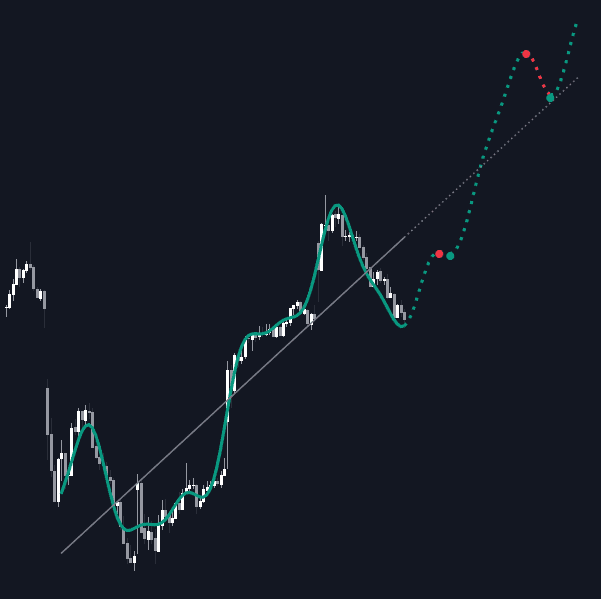
The Adaptive Harmonic Forecast is a quantitative trading indicator designed to model market behavior using dominant price cycles and a linear trend component. By decomposing price action into multiple harmonic frequencies and projecting them forward, this trading tool provides a dynamic forecast of potential trend continuation and reversal zones. Built for traders who want more than traditional moving averages or lagging oscillators, the Adaptive Harmonic Forecast blends spectral analysis with regression modeling to anticipate where the market’s rhythm may shift next.
Unlike static indicators, this forecasting model adapts to recent price data, continuously recalculating the dominant cycles that drive market structure. The result is a forward-looking trading strategy tool that helps identify momentum shifts, cyclical turning points, and underlying trend direction across all markets and timeframes.
How to Trade the Adaptive Harmonic Forecast Indicator?
At its core, this trading indicator assumes that markets move in repeating cycles layered on top of a broader trend. By extracting the strongest frequencies from recent price data, the model projects a multi-harmonic structure into future bars.
Traders can use the forecast in several ways:
- Momentum Confirmation: When live price action aligns with the projected harmonic direction, it strengthens conviction in trend continuation.
- Reversal Anticipation: Forecasted peaks and troughs can signal potential timing windows for pullbacks or turning points.
- Trend Bias Filtering: The integrated linear trend component helps confirm the broader market direction before executing trades.
Because the projection dynamically recalculates on every new bar, it is best used as a confirmation and timing tool rather than as an exact price target generator. The goal is to anticipate directional rhythm, not predict exact tick levels.
Historical Fit & Forward Projection
The indicator displays two key components:
- A solid line across the historical lookback window, showing how closely the harmonic model fits actual price action.
- A dotted forecast line extending into the future, representing the projected movement of the composite cycles.
The projection is color-coded:
- Green → Projected upward harmonic movement
- Red → Projected downward harmonic movement
This forecast should be interpreted as a timing mechanism within a broader trading strategy. When the projected harmonic direction aligns with structure breaks, liquidity zones, or volume confirmation, it can significantly improve entry precision.
Trend Line & Reversal Markers
In addition to cyclical modeling, the indicator calculates a linear regression trend line across the lookback window. This provides:
- Clear visualization of overall slope (bullish or bearish bias)
- Separation of cyclical movement from structural trend
The script can also plot reversal markers (dots) at forecasted peaks and troughs. These points represent where the composite harmonic model predicts local maxima or minima, offering potential early warnings of:
- Short-term pullbacks in trending markets
- Larger reversals when aligned with structural resistance or support
For traders building systematic trading strategies, these markers can be incorporated as timing filters within algorithmic rules.
Detected Cycles Dashboard
The built-in Detected Cycles table provides transparency into the spectral engine driving the forecast.
This dashboard shows the dominant periods (measured in bars), allowing traders to determine whether current market conditions are:
- High-frequency / noisy: Short detected periods relative to the lookback window.
- Stable / structural: Longer detected periods indicating smoother, macro-level cyclicality.
Understanding whether price is dominated by short-term oscillations or longer structural waves can dramatically improve strategy selection — for example, choosing mean reversion setups in high-frequency states versus trend-following systems in longer-cycle environments.
Indicator Methodology & Technical Details
The Adaptive Harmonic Forecast operates through a two-stage quantitative modeling process:
Periodogram Logic (Cycle Detection)
The script first removes the linear trend from the lookback data to isolate pure cyclical behavior. It then performs spectral analysis across a range of candidate periods, calculating the spectral power (correlation between price and a specific frequency).
Key steps include:
- Detrending via linear regression
- Scanning multiple candidate periods
- Identifying spectral peaks
- Selecting only statistically meaningful cycles
This ensures the indicator focuses on dominant structural frequencies rather than random market noise.
Multi-Harmonic OLS Regression
Once dominant cycles are detected, the script constructs a composite model consisting of:
- Multiple sine waves
- Multiple cosine waves
- A first-order polynomial (trend component)
Using Ordinary Least Squares (OLS) regression, the indicator solves a matrix-based normal equation to determine optimal amplitudes and phase shifts. This minimizes the squared error between the model and historical price.
The fitted model is then evaluated for future time coordinates, generating a forward projection based on current harmonic structure.
This institutional-grade approach makes the Adaptive Harmonic Forecast suitable for both discretionary traders and quantitative trading strategies.
Indicator Settings & Customization
Model Settings
- Fit Lookback (N): Number of historical bars used to detect cycles and fit the harmonic model. Larger values capture broader structure; smaller values increase responsiveness.
- Extrapolation Bars: Number of future bars projected by the forecast.
- Number of Sinusoids (1–10): Controls model complexity. More sinusoids capture additional structure but may increase sensitivity.
Automatic Cycle Detection
- Min Period: Defines the shortest allowable cycle length (in bars). Increasing this value filters out very short-term noise cycles.
Visual Settings
- Show Reversal Dots: Enables or disables forecasted peak/trough markers.
- Dot Size: Adjusts marker visibility.
- Show Detected Periods: Displays or hides the cycle table dashboard.
Trend Line Controls
- Show Trend Line: Toggles the linear regression bias line.
- Trend Line Color: Customizes historical and projected trend display.
Practical Trading Applications
This trading indicator can be integrated into various trading strategies:
- Trend-following systems that enter in the direction of both the linear trend and projected harmonic slope.
- Mean reversion strategies that target forecasted troughs in bullish environments or peaks in bearish markets.
- Multi-timeframe approaches where higher timeframe harmonic projections guide lower timeframe execution.
Because the forecast adapts in real time, it reflects current market structure rather than static historical assumptions.
FAQ
What type of trading indicator is the Adaptive Harmonic Forecast?
It is a multi-harmonic forecasting trading indicator that combines spectral cycle detection with linear regression to project future price direction and identify potential reversal timing zones.
Is this indicator suitable for algorithmic trading strategies?
Yes. The mathematical structure (cycle detection + OLS regression) makes it well-suited for systematic trading models and rule-based strategies.
Does the forecast repaint?
The model recalculates on each new bar using the latest data. Historical forecasts remain fixed once the bar closes, but forward projections update dynamically as new information becomes available.
How can I access the Adaptive Harmonic Forecast?
You can get access on the LuxAlgo Library for charting platforms like TradingView, MetaTrader (MT4/MT5), and NinjaTrader for free.
Trading & investing are risky and many will lose money in connection with trading and investing activities. All content on this site is not intended to, and should not be, construed as financial advice. Decisions to buy, sell, hold or trade in securities, commodities and other investments involve risk and are best made based on the advice of qualified financial professionals. Past performance does not guarantee future results.
Hypothetical or Simulated performance results have certain limitations. Unlike an actual performance record, simulated results do not represent actual trading. Also, since the trades have not been executed, the results may have under-or-over compensated for the impact, if any, of certain market factors, including, but not limited to, lack of liquidity. Simulated trading programs in general are designed with the benefit of hindsight, and are based on historical information. No representation is being made that any account will or is likely to achieve profit or losses similar to those shown.
Testimonials appearing on this website may not be representative of other clients or customers and is not a guarantee of future performance or success.
As a provider of technical analysis tools and strategies, we do not have access to the personal trading accounts or brokerage statements of our customers. As a result, we have no reason to believe our customers perform better or worse than traders as a whole based on any content, tool, or platform feature we provide.
Charts used on this site are by TradingView in which the majority of our technical indicators are built on. TradingView® is a registered trademark of TradingView, Inc. www.TradingView.com TradingView® has no affiliation with the owner, developer, or provider of the Services described herein.
Market data is provided by CBOE, CME Group, BarChart, Massive, CoinAPI. Select U.S. equities data is provided through Massive. CBOE BZX real-time U.S. equities data is licensed from CBOE and provided through BarChart. Real-time futures data is licensed from CME Group and provided through BarChart. Select cryptocurrency data, including major coins, is provided through CoinAPI. All data is provided “as is” and should be verified independently for trading purposes.
This does not represent our full Disclaimer. Please read our full disclaimer.
© 2026 LuxAlgo Global, LLC.