Anchored Clusters Volume Profile
Feb 17, 2026

The Anchored Clusters Volume Profile indicator is an advanced volume analysis and trading indicator that applies K-Means clustering to segment price action into distinct regimes within a user-defined time range. Instead of displaying a single aggregated volume histogram, this tool generates multiple independent volume profiles—one for each detected price cluster—offering a deeper, structure-based view of liquidity, fair value, and institutional activity.
By grouping price bars based on proximity and density rather than strict chronological order, the indicator reveals hidden liquidity zones that traditional volume profiles often blur together. This makes it a powerful trading strategy companion for identifying support and resistance, market regime shifts, and high-probability entry and exit levels.
How to Trade the Anchored Clusters Volume Profile Indicator?
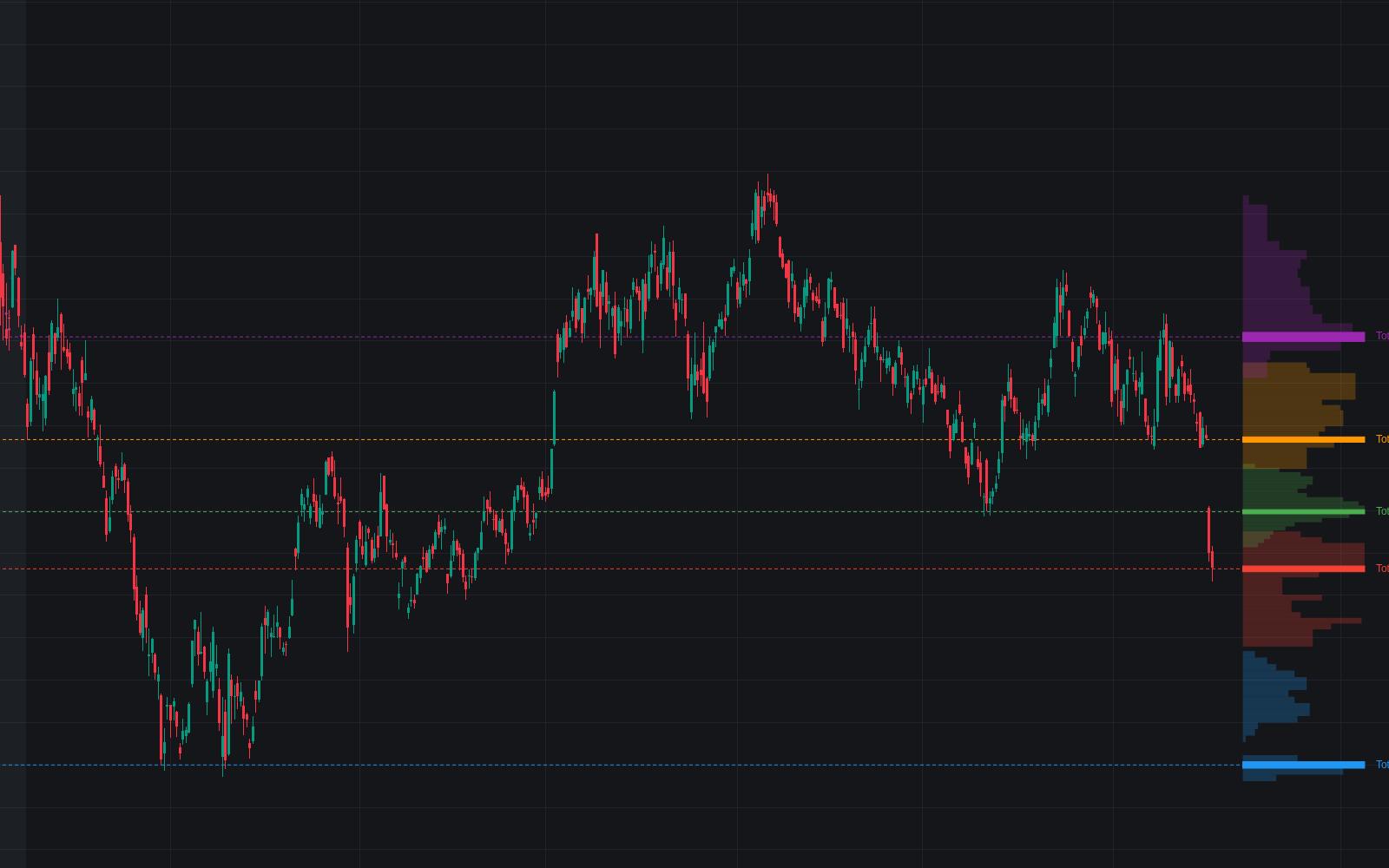
This trading indicator identifies clusters of price activity between a selected Start Time and End Time. Each cluster is color-coded and plotted with its own horizontal volume profile, allowing traders to see exactly where volume was concentrated within specific price regimes.
Rather than assuming all volume within a time range belongs to one structure, the K-Means algorithm separates price behavior into distinct groups. This allows you to analyze multiple “value areas” inside the same anchored range.
Identifying Institutional Support & Resistance Zones
One of the most powerful features of this volume profile trading strategy is the identification of cluster-specific Points of Control (POCs).
- Each cluster has its own POC, marked with dashed horizontal lines.
- These POC levels represent the price where the most volume occurred within that cluster.
- Because clustering is density-based, these POCs often reflect institutional fair value levels rather than arbitrary time-based averages.
When price revisits a high-volume cluster POC, it frequently reacts as:
- Strong support in bullish structures
- Strong resistance in bearish structures
This makes cluster POCs highly actionable levels for intraday trading, swing trading, and even position trading strategies.
Market Regime Detection Using Clusters
The Anchored Clusters Volume Profile indicator doubles as a market regime detection tool.
By analyzing how clusters are positioned vertically and how much they overlap, traders can identify whether the market is:
-
Accumulating or Distributing (Sideways Regime)
Multiple overlapping clusters with high volume concentration suggest balanced participation and range-bound conditions. -
Trending (Directional Regime)
Vertically separated clusters with low-volume gaps between them suggest price acceptance at new levels and directional expansion. -
Transitioning (Breakout Phase)
A new isolated cluster forming away from overlapping structures can indicate a breakout or the beginning of a new trend.
This structural perspective enhances traditional price action analysis and improves decision-making within broader trading strategies.
Precision Entries, Stops & Targets
Because each cluster forms its own price distribution, traders gain concrete structural levels for managing risk.
- Entries: Consider entering on retests of a high-volume cluster POC.
- Stop Loss Placement: Position stops outside the full price range covered by that cluster’s volume profile.
- Profit Targets: Target the POC of the next significant cluster above or below price.
This transforms the indicator into a complete volume-based trading framework rather than just a visualization tool.
Measuring Volume Conviction
The indicator provides total volume metrics for each cluster. By comparing the "Total" volume labels:
- A breakout into a high-volume cluster suggests strong conviction and higher probability of level retention.
- A breakout into a low-volume cluster may indicate weak participation and a higher likelihood of failure.
This volume conviction analysis helps traders filter false breakouts and align trades with stronger participation zones.
Indicator Mechanics: How the K-Means Volume Clustering Works
Unlike traditional anchored volume profiles that produce a single histogram, this trading indicator uses a structured clustering approach:
- Identifies all bars within the selected Start Time and End Time range.
- Initializes multiple centroids across the full price range.
- Assigns each bar to the nearest centroid using the HLC2 (median) price.
- Recalculates centroids using the volume-weighted average price of assigned bars.
- Repeats the process for the specified number of iterations until clusters stabilize.
The result is a set of independent volume distributions that reflect natural price groupings rather than arbitrary segmentation.
This approach allows traders to detect structural liquidity zones that may otherwise be obscured inside a single aggregated volume profile.
SETTINGS
Anchor Settings
- Start Time / End Time: Defines the analysis window. Using the Confirm feature, you can select the range directly on the chart after applying the indicator.
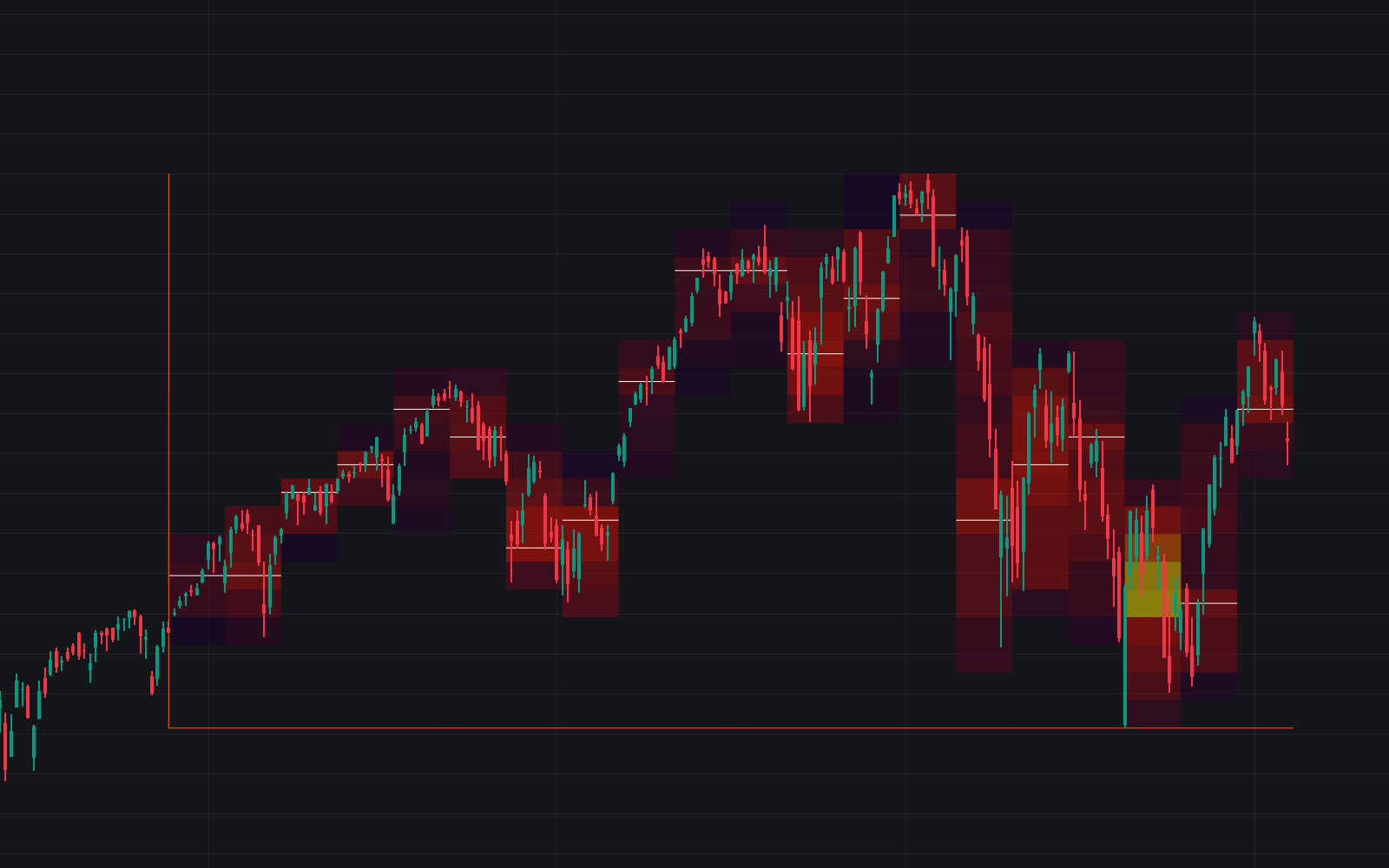
- Range Highlight: Customizes the background shading to visually isolate the analyzed range.
Clustering Settings
- Number of Clusters: Select how many price groups the K-Means algorithm should identify (2 to 10). Fewer clusters highlight broader regimes; more clusters reveal finer structural detail.
- K-Means Iterations: Determines how many refinement cycles the algorithm runs. Higher values typically produce more stable and precise cluster separation.
Volume Profile Settings
- Rows per Cluster VP: Controls the vertical resolution of each cluster’s volume profile.
- Max VP Width (Bars): Sets the maximum horizontal width of each histogram.
- VP Offset: Adjusts spacing between the latest price bar and the cluster profiles.
- Highlight Price Dots: Displays color-coded dots on bars to indicate cluster assignment.
- Dot Size: Adjusts the size of cluster dots from tiny to huge.
Why This Trading Indicator Is Different
Traditional volume profile tools show one consolidated distribution over a selected period. The Anchored Clusters Volume Profile breaks that assumption by recognizing that markets often operate within multiple internal value regimes inside the same time range.
By applying K-Means clustering to price structure:
- Liquidity zones become structurally separated
- Fair value levels become more precise
- Market phase transitions become easier to identify
This makes the tool especially valuable for traders who combine price action, volume analysis, and market structure concepts into systematic trading strategies.
FAQ
What is the Anchored Clusters Volume Profile indicator?
It is a volume-based trading indicator that uses K-Means clustering to divide price action into multiple regimes and generates separate volume profiles for each cluster within a selected time range.
How is this different from a traditional anchored volume profile?
A traditional anchored volume profile produces one aggregated histogram. This indicator creates multiple independent volume profiles based on price density, allowing for more precise identification of institutional zones and regime shifts.
How can I access the Anchored Clusters Volume Profile indicator?
You can get access on the LuxAlgo Library for charting platforms like TradingView, MetaTrader (MT4/MT5), and NinjaTrader for free.
Trading & investing are risky and many will lose money in connection with trading and investing activities. All content on this site is not intended to, and should not be, construed as financial advice. Decisions to buy, sell, hold or trade in securities, commodities and other investments involve risk and are best made based on the advice of qualified financial professionals. Past performance does not guarantee future results.
Hypothetical or Simulated performance results have certain limitations. Unlike an actual performance record, simulated results do not represent actual trading. Also, since the trades have not been executed, the results may have under-or-over compensated for the impact, if any, of certain market factors, including, but not limited to, lack of liquidity. Simulated trading programs in general are designed with the benefit of hindsight, and are based on historical information. No representation is being made that any account will or is likely to achieve profit or losses similar to those shown.
Testimonials appearing on this website may not be representative of other clients or customers and is not a guarantee of future performance or success.
As a provider of technical analysis tools and strategies, we do not have access to the personal trading accounts or brokerage statements of our customers. As a result, we have no reason to believe our customers perform better or worse than traders as a whole based on any content, tool, or platform feature we provide.
Charts used on this site are by TradingView in which the majority of our technical indicators are built on. TradingView® is a registered trademark of TradingView, Inc. www.TradingView.comTradingView® has no affiliation with the owner, developer, or provider of the Services described herein.
Market data is provided by CBOE, CME Group, BarChart, CoinAPI. CBOE BZX real-time US equities data is licensed from CBOE and provided through BarChart. Real-time futures data is licensed from CME Group and provided through BarChart. Select cryptocurrency data, including major coins, is provided through CoinAPI. All data is provided “as is” and should be verified independently for trading purposes.
This does not represent our full Disclaimer. Please read our full disclaimer.
© 2026 LuxAlgo Global, LLC.