Bollinger Squeeze
 By LuxAlgoJun 3, 2026
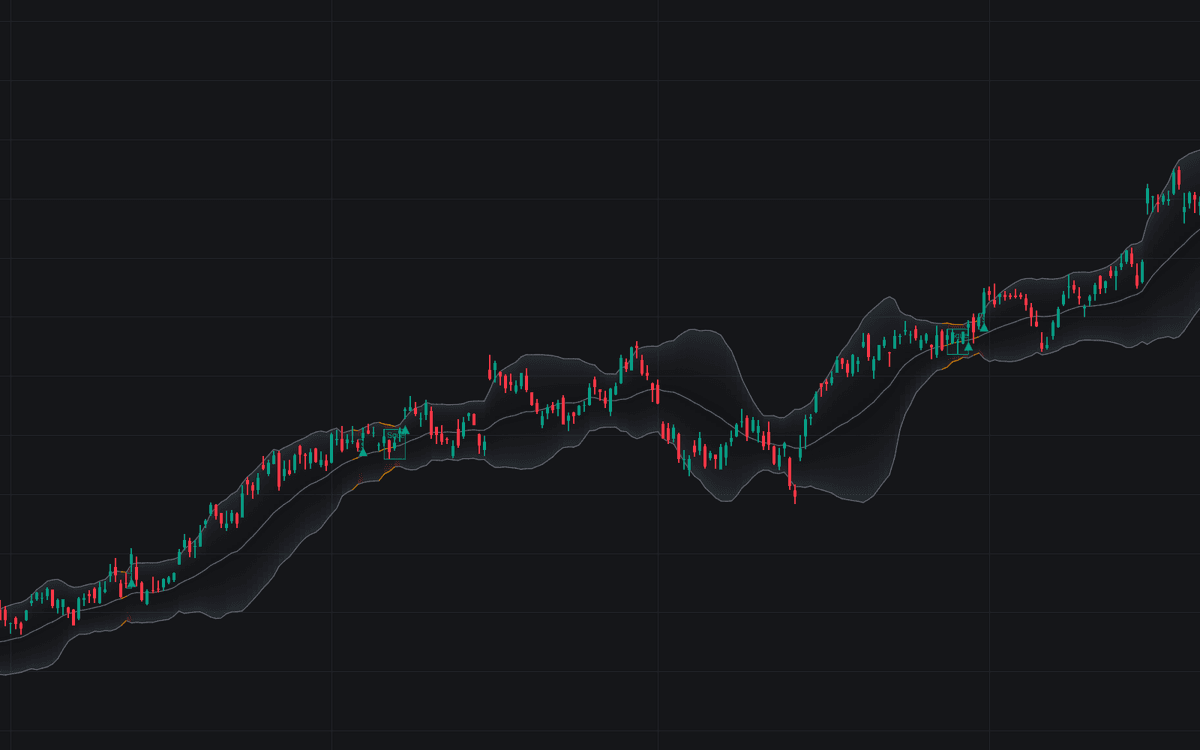

Bollinger Squeeze is the definitive clean build of the Bollinger Squeeze: the bands recolor while volatility is compressed, a dashed box tracks the price range forming during the compression, and a triangle marks the release, the bar where price settles outside that range as the bands turn outward. Three tests are built in: Bollinger's lowest-BandWidth definition, a percentile variant, and the bands-inside-Keltner test, swappable from one input.
How to Trade the Bollinger Squeeze?
- Squeeze on: compression is a condition, not a signal. No direction is implied. The box counter shows its length.
- Bullish / Bearish Release: a close outside the squeeze range while the bands expand resolves the episode and recolors the box; both sides carry alerts.
- Faded boxes: price left the range without expanding bands. No qualifying release, so the box dims instead.
- Confirm the break: initial breaks are notorious for head-fakes; demand volume and follow-through before leaning on the release direction.
Pair it with the rest of the volatility toolkit for the aftermath.
Bollinger Squeeze Settings
- Length (default 20), Source (default close), Multiplier (default 2): the band construction.
- Squeeze Test (default Lowest BandWidth): lookback low, percentile rank, or bands inside Keltner Channels.
- Squeeze Lookback (default 125): window for the first two tests, about six months of daily bars.
- Percentile Floor (default 10): percentile-rank ceiling for the percentile test.
- Keltner Length (default 20) and Keltner Multiplier (default 1.5): the channels the bands must sit inside.
- Show Range (default on), Show Last (default 10), Show Duration (default on), Release Markers (default on): the range boxes and their annotations.
Frequently Asked Questions

Original indicatorBuilt in-house by LuxAlgo
The Library is free. Quant makes it yours.
Pull any concept or indicator into Quant: rebuild it, retune it, or turn it into a backtested strategy of your own.