Butterworth Filter
 By LuxAlgoApr 8, 2026
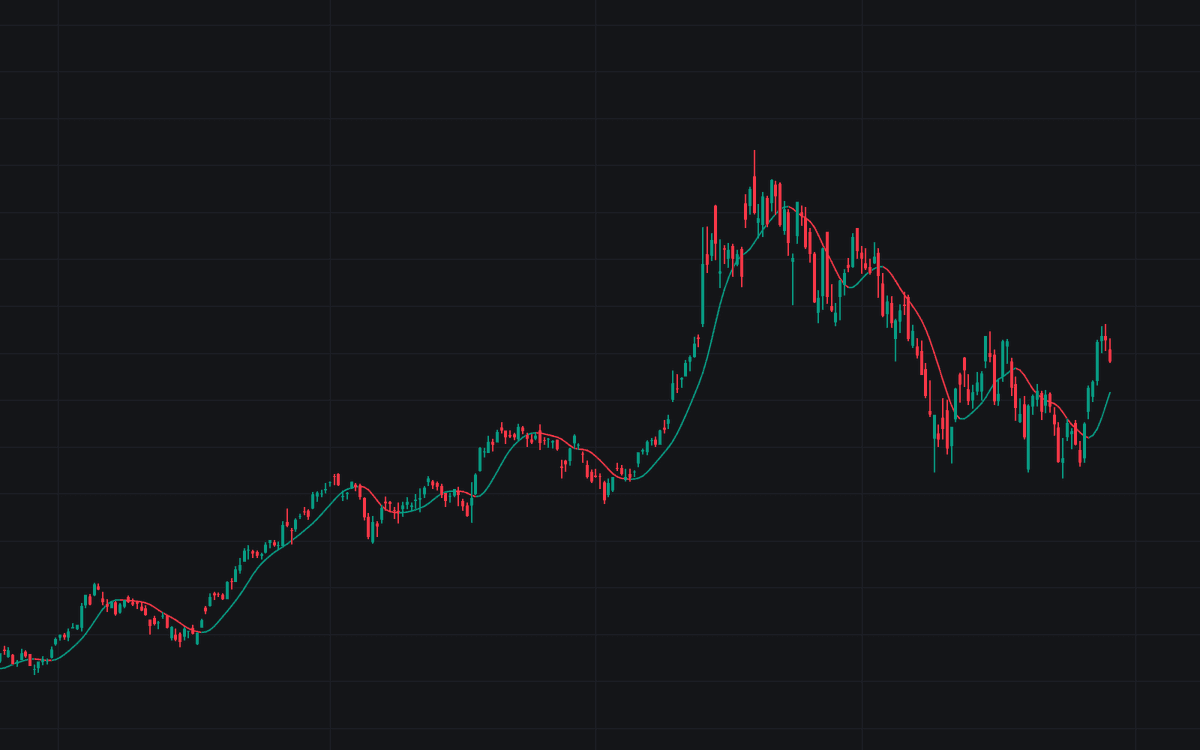

Butterworth Filter implements the Butterworth filter in its recursive trading form, the library's first dedicated build of the design. Coefficients derive from the cutoff period for both pole counts, an optional short FIR average (1-2-1 or 1-3-3-1 weights) feeds the recursion as published, and gain is normalized to unity at zero frequency. The payoff is a maximally flat passband: swings slower than the cutoff pass at close to true amplitude while faster fluctuations are strongly attenuated. The filter line colors by slope out of the box, and an ATR-scaled tolerance band can be drawn around it for touch-based rules.
How to Trade the Butterworth Filter?
- Slope color: rising reads bullish, falling bearish. Slope rules transfer directly from moving averages, with alerts on every turn.
- Price crossing the filter: crossover and crossunder alerts support entry and exit logic against the smoothed line.
- Tolerance band touches: the design's small step overshoot can carry the line a touch beyond the level price settles at after a shock bar, so exact-touch rules are better tested against the band.
Butterworth Filter Settings
- Source (default close): series fed to the filter.
- Cutoff Period (default 20): a cutoff, not a lookback: wavelengths shorter than roughly this many bars are strongly attenuated, and lag grows as it rises.
- Poles (default Two-pole): Three-pole rolls off harder for noisy intraday data but answers genuine turns more slowly.
- Input FIR Average (default enabled): pre-average the source before the recursion rather than feeding it raw.
- Show Tolerance Band (default disabled) with Band Width (ATR Multiple) (default 0.5) and ATR Length (default 14).
- Coloration (default Slope) and Line Width (default 2) control presentation.
Frequently Asked Questions

The Library is free. Quant makes it yours.
Pull any concept or indicator into Quant: rebuild it, retune it, or turn it into a backtested strategy of your own.