Concept
Butterworth Filter
Butterworth Filter is a Trend concept. The Library holds 1 implementation, a working definition you can pull into Quant.
Top Butterworth Filter indicator
The top custom implementation, built on the original standard Butterworth Filter formula.
1 total
From studying Butterworth Filter to trading it: take the implementation below into Quant and backtest it instantly.
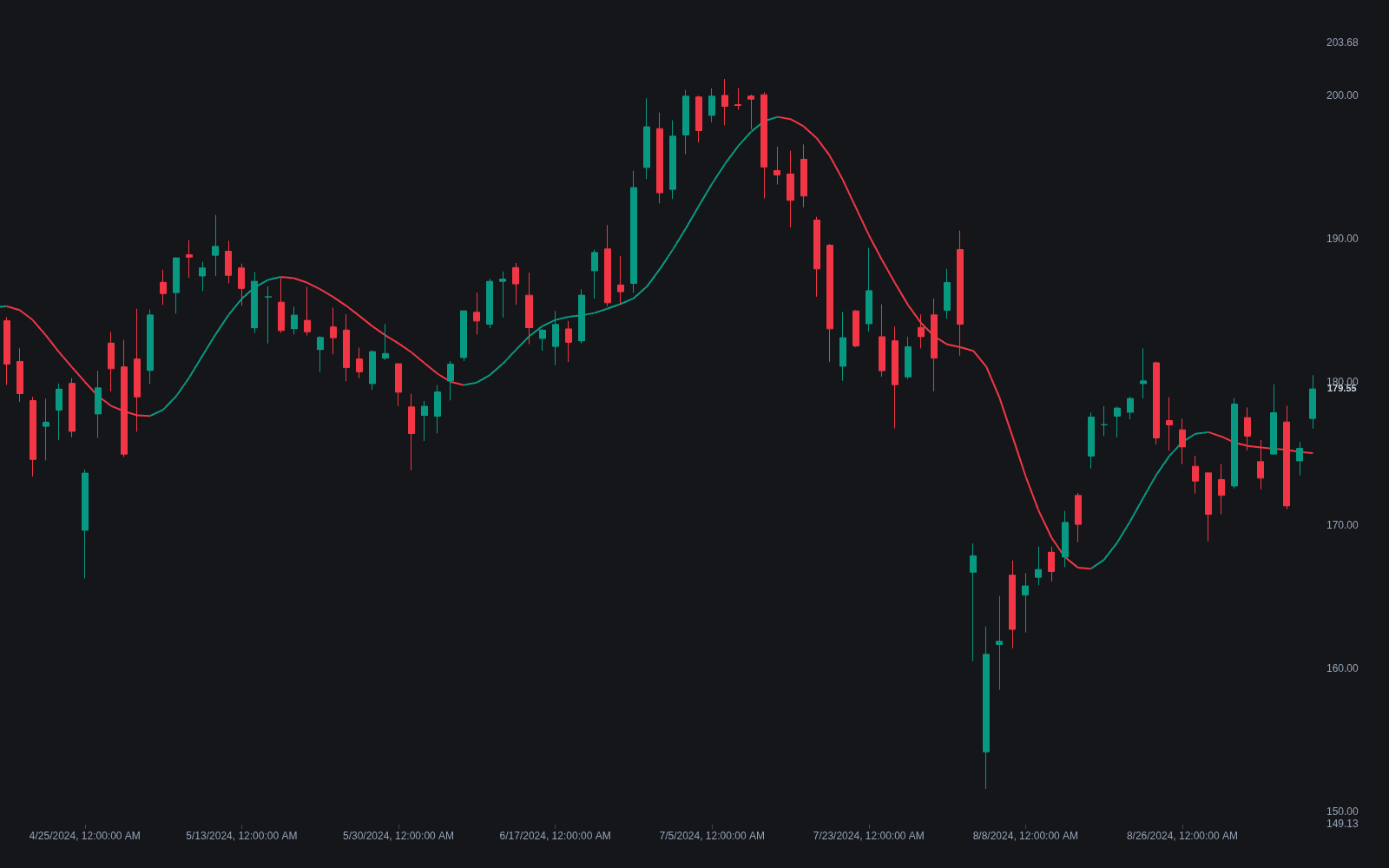
What is a Butterworth filter?
A Butterworth filter is a low-pass filter design whose magnitude response is maximally flat in the passband: the wavelengths it keeps are passed with as little amplitude distortion as mathematically possible for the chosen order, then attenuation rolls off monotonically beyond the cutoff. The design was introduced by the British engineer Stephen Butterworth in 1930 and became one of the standard prototypes of filter theory. In trading it entered mainstream use largely through John Ehlers, who published two-pole and three-pole recursive versions as price smoothers and built several of his later tools on them.
The appeal for chart work is the combination of a clean passband and a monotonic rolloff. Unlike ripple-based designs, a Butterworth smoother does not selectively boost or cut wavelengths inside the band it keeps, so the smoothed line represents the surviving swings at close to their true amplitude. Compared with a simple EMA, a two-pole Butterworth attenuates short wavelengths much harder for similar passband behavior, which is why it tends to produce a noticeably quieter line at comparable responsiveness.
The tradeoffs are the usual ones for recursive smoothers. It is causal, so it lags, and the lag grows with the cutoff period and the order. Its step response shows a small overshoot, so a violent move can push the smoothed line slightly past where price settles. And like every fixed-period filter, a Butterworth tuned for one regime passes too much noise or clips too much signal when volatility and dominant wavelength shift.
How it's calculated
The form traders usually implement is Ehlers' two-pole Butterworth smoother, a second-order recursion with a short input average:
This is the two-pole version as published in Ehlers' work; a three-pole variant with sharper rolloff and more lag also circulates.
The (x + 2x + x) input average adds a small FIR smoothing stage; some implementations feed the raw price instead.
Seed the recursion by setting the first outputs equal to price.
How traders use it
- As a drop-in replacement for an EMA when the goal is a quieter trend line at similar lag; slope and price-relative-to-line rules transfer directly.
- As the smoothing stage inside oscillators and bands, where its strong attenuation of two- to P-bar noise reduces false triggers without the heavy lag of a long SMA.
- In moving-average crossover systems, replacing one or both averages to cut whipsaw; the improvement is incremental, not transformative, and still fails in trendless tape.
- Its overshoot is worth respecting: after a shock bar the line can exceed the subsequent equilibrium slightly, so exact-touch rules against the filter line should carry tolerance.
Butterworth vs the other classical designs
Bessel filter: Bessel trades rolloff steepness for uniform delay and negligible overshoot; Butterworth trades a little waveform fidelity for stronger noise suppression at the same order. Butterworth is the more common default for price smoothing.
Chebyshev filters: Chebyshev designs roll off faster than Butterworth by accepting ripple, in the passband (Type I) or stopband (Type II). Butterworth is the ripple-free middle ground.
Ehlers SuperSmoother: The SuperSmoother is Ehlers' refinement of the two-pole Butterworth idea, tuned to null out the shortest wavelengths in sampled market data. In practice the two produce similar lines; the SuperSmoother is the one embedded in his later indicators such as the roofing filter.
Gaussian filter: The Gaussian smoother has no overshoot but a softer rolloff; Butterworth attenuates stopband noise harder but can slightly overshoot sharp moves.
Concept family
Trend
100 concepts mapped · 100 in the Library
Butterworth Filter FAQ
Turn Butterworth Filter into a trading strategy.
Take the implementation from this page into Quant, then build on it, backtest it on real data, and keep refining it in conversation.