Ehlers SuperSmoother
 By LuxAlgoMay 23, 2026
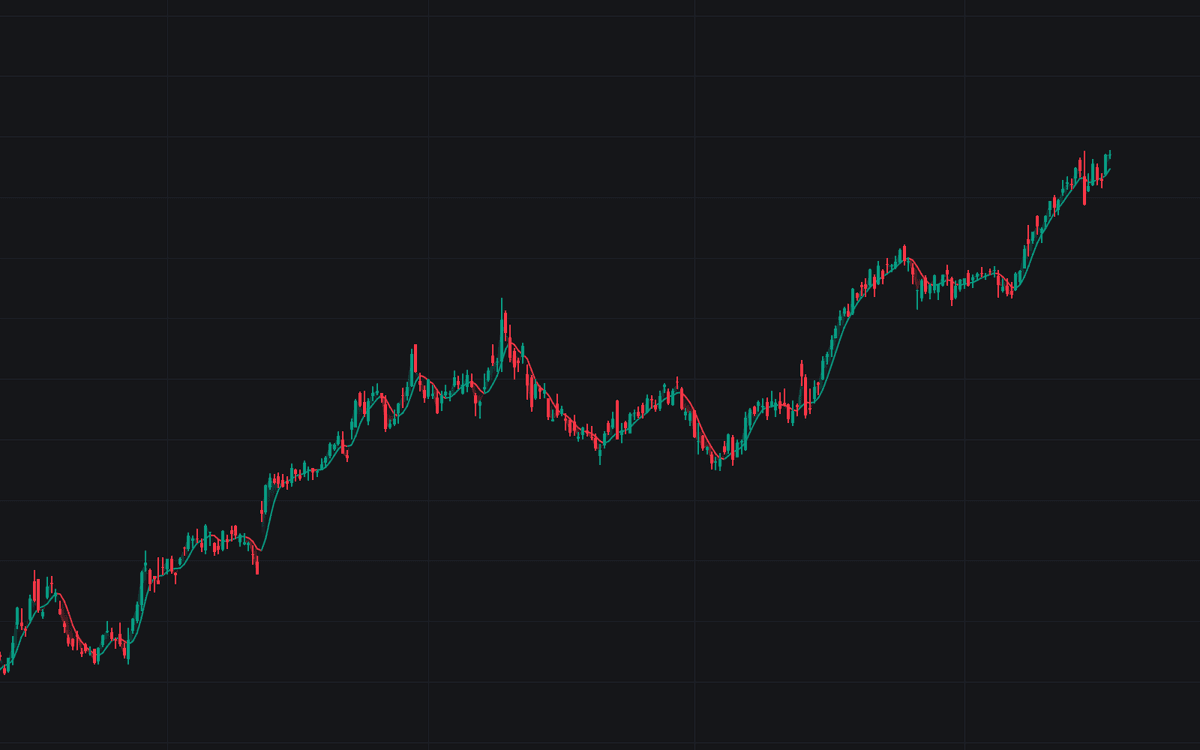

Ehlers SuperSmoother brings filter engineering to the price panel: a low-pass recursion John Ehlers derived from Butterworth design, specified by a cutoff wavelength instead of a lookback length. Swings slower than the 10-bar Cutoff Period keep their shape; faster fluctuations are sharply rejected rather than merely dampened. The case the SuperSmoother makes against a conventional average is more noise removed for the same delay. The line colors bullish while rising and bearish while falling, with a gradient fill showing which side of the filter price holds.
How to Trade the Ehlers SuperSmoother?
- Slope color: a rising filter is the trend-up read, a falling filter trend-down; slope reversals carry alerts.
- Price crossings: read them exactly as you would a moving-average cross (alertable, with optional triangle markers).
- Fill direction: the gradient runs bullish while price holds above the filter and bearish below, a one-glance bias check.
Like the other engineered smoothers in the library's trend family, it earns its place wherever stacking conventional averages would stack lag: one pass of this filter substitutes for several of the usual kind.
Ehlers SuperSmoother Settings
- Source (default close): the price series the filter smooths.
- Cutoff Period (default 10): the cutoff wavelength in bars, effectively the shortest swing you choose to keep; everything faster is declared noise.
- Poles (default 2): the filter order. Two poles give the best lag-to-smoothness balance; three reject noise more steeply for a little more lag.
- Style toggles: Slope Trend Coloring and Price / Filter Gradient Fill default on; Price Crossing Markers default off, with the crossing alerts active regardless.
Frequently Asked Questions

The Library is free. Quant makes it yours.
Pull any concept or indicator into Quant: rebuild it, retune it, or turn it into a backtested strategy of your own.